


RECENT POSTS





13.February.2026
Best Boots for Standing All Day: A Guide to Uncompromising Comfort & Support
0 Comments



31.January.2026
Why Off-the-Rack Heels Are Failing Women (and What Custom Fit Really Means)
0 Comments
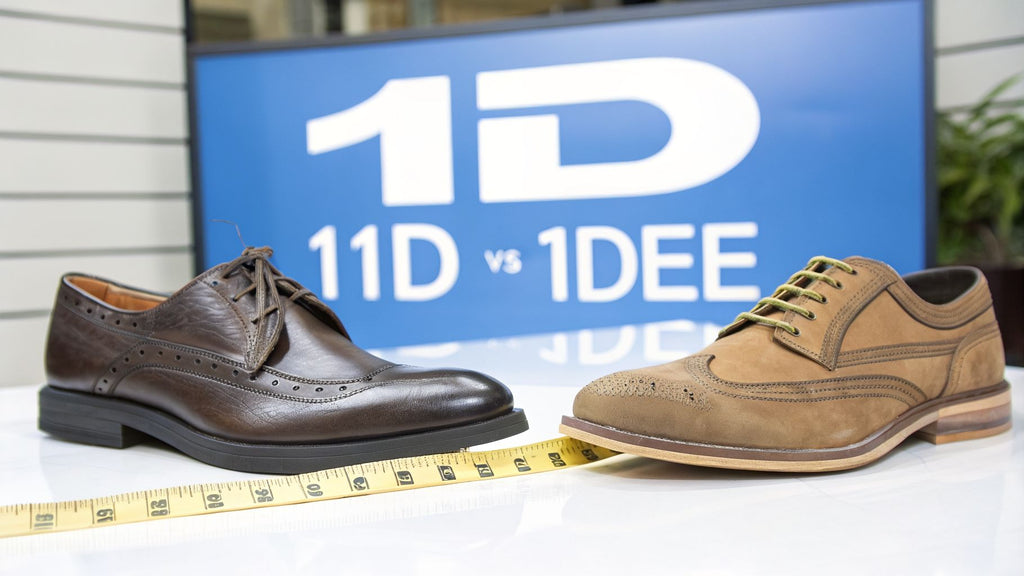
How Much Wider Are Wide Shoes? A Guide to Finding Your Perfect Fit
So, how much wider are wide shoes, really? The general rule is that for each step you go up in width—say, from a standard 'D' to a wide '2E'—you gain about 1/8 to 1/4 of an inch (or 3-6 mm) in girth. It may not sound like much, but that small adjustment can be the difference between all-day comfort and a day spent in pain.
Why A Little Extra Width Makes a Big Difference

If you've ever found a shoe that’s the right length but still squeezes the sides of your feet, you know that a good fit is about more than just your shoe size. Most mass-produced shoes are made for a so-called "average" foot, but the truth is, very few people actually have that shape.
This forces many of us into a frustrating cycle of buying and returning shoes, never finding that perfect fit. It points to a bigger problem in the footwear world: a one-size-fits-all approach just doesn't work. To get a better handle on this, you can learn more about what wide width shoes really mean and why they’re so important.
For a quick reference, here’s what you can expect with each increase in width.
Shoe Width Increase at a Glance
This table shows the typical incremental increase in width as you move up from one width size to the next, like from a 'D' to an 'E'.
| Width Increase | Typical Added Width (Imperial) | Typical Added Width (Metric) |
|---|---|---|
| 1 Width Step Up | 1/8" to 1/4" | 3 mm to 6 mm |
As you can see, even a single step up provides a noticeable increase in volume, which is often all that's needed to relieve pressure and improve comfort.
The Problem with a "Close Enough" Fit
When you force your feet into shoes that don't respect their natural width, you're setting yourself up for more than just a little discomfort. Over time, it can lead to real problems.
- Constant Pressure: That nagging feeling of your shoes pinching the sides of your feet all day long.
- Painful Blisters: Friction from a tight fit is the number one cause of blisters on the toes and the ball of the foot.
- Long-Term Damage: Continual pressure can contribute to conditions like bunions, hammertoes, and other foot deformities.
The search for comfortable footwear almost always comes down to getting the width right. Standard shoe molds simply can't account for the diversity of human feet, which is why it's so important to find solutions that honor your unique shape.
At Alexander Noel, we take a different path. We blend modern innovation with time-honored craftsmanship to create shoes that aren't a compromise. Our goal is to deliver a shoe that feels like a natural extension of your foot, not something you have to endure.
Decoding the Alphabet of Shoe Widths
Have you ever looked at the letters on a shoe box and felt like you were trying to crack a code? You’re not the only one. That alphabet soup of shoe widths—B, D, 2E, 4E—can be baffling.Think of these letters as different notches on a belt, but for the girth of your feet. This system, used mainly in the US and UK, is meant to standardize how much volume a shoe provides. The catch is that "standard" means something very different for men's and women's shoes.
Standard vs. Wide: A Quick Comparison
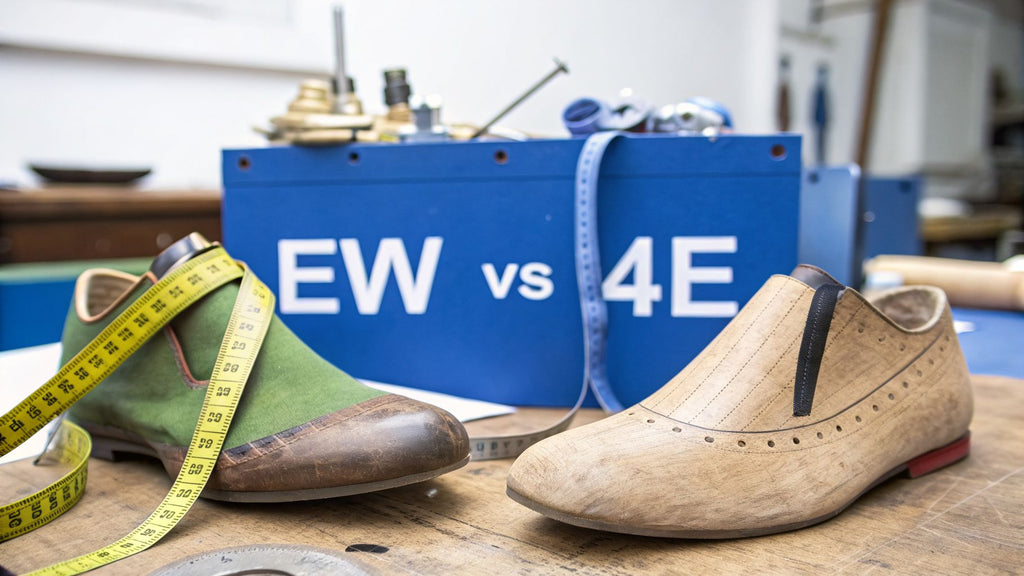
For men's dress shoes, a "D" width is the standard. If your foot needs more room across the bridge or instep, you move up to a "2E" (or EE), which is wide, and then to a "4E" (or EEEE) for an extra-wide fit. Each letter up provides that crucial extra space for a comfortable fit.
For women, the entire scale shifts. A "B" width is considered the standard. A "D" width—which is standard for men—is actually a wide for women. This is a critical distinction and a common source of sizing mistakes.
The most important takeaway is that shoe width isn't universal. A "wide" for women is a "standard" for men, highlighting why simply grabbing a box off the shelf is often a gamble.
To put this in perspective, these letters represent a significant, measurable difference. A women's size 10.5, for example, can range from 3¾ inches for a narrow fit to nearly 5⅞ inches for the widest options. That's a difference of over two inches, which has a massive impact on both comfort and long-term foot health.
The system gets even trickier with European sizing, which frequently leaves out width letters entirely and assumes one standard fit. This can be incredibly frustrating for anyone whose feet don't fit the "average" mold. For a deeper look into these wider designations, check out our ultimate guide on understanding EE, EEE, and EEEE sizing for maximum comfort.
Learning to read this alphabet empowers you to look at any shoe label and know exactly what it offers. It’s the first step toward finding a truly perfect fit.
Why Mass-Produced Shoes Often Fail Your Feet
The global footwear industry is a colossal machine, churning out an astonishing 24 billion pairs of shoes every single year. To hit numbers like that, big brands rely on standardized molds, called “lasts,” which are based on a theoretical “average” foot.
The problem? That average foot almost never exists in the real world. You can get a better sense of just how massive the footwear market is and why they rely on these methods.
This one-size-fits-all approach is exactly why so many of us struggle to find a truly comfortable pair of shoes. Your feet have their own unique width, arch, and volume. Mass production simply can’t cater to that kind of individuality, forcing millions of people into a frustrating cycle of buying and returning.
The Problem of the "Average" Foot
The entire system is built for efficiency, not for your individual fit. This creates a situation where shoes are made for an imaginary person in the middle, leaving anyone who falls outside that narrow standard to just "make do."
This compromise almost always leads to real-world problems:
- Daily Discomfort: That all-too-familiar pinching and cramping when a shoe is just a little too tight across the bridge.
- Painful Ailments: Constant, unnatural pressure is a direct contributor to issues like bunions, corns, and hammertoes over time.
- A Frustrating Search: You end up wasting time and money on shoes that promise comfort but just can't deliver.
Simply understanding why common shoe designs aren't working for you is the first step toward finding a solution. For those already dealing with the consequences, finding lasting pain relief for foot pain becomes a top priority.
When your footwear is built on a foundation of averages, it’s bound to fail the individual. The discomfort you feel isn't your fault; it's a flaw in a system that ignores the true shape of human feet.
At Alexander Noel, we reject this outdated model. We don't try to force your feet into a pre-made mold. Instead, we start with your unique measurements. Our direct-to-consumer model and partnerships with skilled global artisans allow us to craft shoes that truly honor your individual shape, delivering a personalized fit that mass production can never hope to match.
How To Measure Your Foot Width Accurately At Home
If you've ever suffered through a day in shoes that pinch, you know that guesswork isn't the answer. Taking charge of your own comfort starts with a simple, crucial step: measuring your own feet. With just a few household items, you can get the precise data needed to find a shoe that actually fits.
This straightforward process gives you the exact numbers you need to understand your unique foot shape. It's the first step in truly understanding how much wider are wide shoes and how that applies directly to you.
Your Simple Step-By-Step Guide
For the most accurate measurement, it’s best to measure your feet at the end of the day. They naturally swell over the course of the day and will be at their largest.
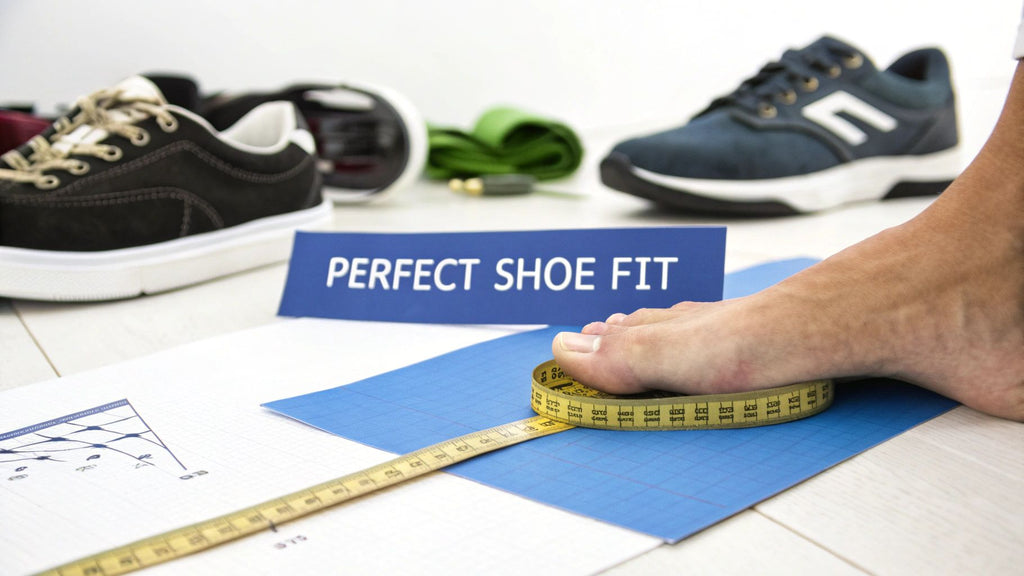
- Trace Your Foot: Get a piece of paper and place it on a hard, flat floor. Stand on it, keeping your weight balanced, and carefully trace the outline of your foot. Make sure to hold the pen or pencil straight up and down.
- Measure the Widest Point: Take a ruler or tape measure and find the distance between the two widest points on your tracing. This is usually right across the ball of your foot.
- Record Your Measurement: Note the width in both inches and millimeters. This makes it easier to compare your numbers against different brand charts.
Why is this simple measurement so important? The mass-production process relies on standardized lasts, which simply can't account for the vast diversity of human foot shapes.

The flowchart above clearly shows how this one-size-fits-all approach often results in a poor fit for so many of us.
Knowing your width measurement is like having the key to unlock true footwear comfort. It moves you from being a passive consumer to an informed buyer who demands a better fit.
Once you have this information, you're no longer stuck guessing with off-the-shelf options. For a complete walkthrough on finding your numbers, you can check out our detailed guide on how to measure shoe size at home. This data is the foundation of a perfectly fitting shoe—a principle at the very core of Alexander Noel's custom, made-to-order process.
Moving Beyond 'Wide' with a Custom-Fit Solution
So what happens when even an "EE" or "EEE" shoe doesn't feel right? For many of our customers, off-the-shelf options have always been a compromise, especially for those dealing with bunions, high insteps, or feet that just aren't the same size. This is where the standard width letters show their limits, and a truly custom-made shoe proves its worth.

Instead of forcing your unique feet into a pre-made mold, a bespoke process starts with you. At Alexander Noel, we move past the entire alphabet of widths by crafting footwear based on your exact measurements. We don’t try to find a shoe that fits you; instead, we build a shoe that is made for you.
The Alexander Noel Difference
Our method combines timeless craftsmanship with modern precision. We work with skilled artisans from around the world who use your individual foot data to create a shoe that becomes a true extension of your foot.
More and more people are seeing the value in this level of personalization. The global footwear market is projected to grow from USD 700.90 billion in 2024 to USD 1100.38 billion by 2032. As shoppers become more willing to invest in quality, the demand for personalized shoes that meet specific width needs is also growing. You can see more data on global footwear market growth at Data Bridge Market Research.
Your search for the perfect fit shouldn't end in compromise. True comfort begins when the shoe is built around your foot, not the other way around.
Our at-home fitting system and Design Lab put you in control of the creative process. You get to design every aesthetic detail while we handle the technical side, ensuring the shoe's last is perfectly matched to your dimensions. You can read more about how this transforms the experience in our guide to custom-made shoes for wide feet.
With our perfect fit guarantee, this is where your search for the right width ends. The experience of true comfort is just beginning.
Common Questions About Shoe Width and Custom Fitting
As you start the journey toward a truly perfect fit, a few questions always seem to pop up. Moving away from standard off-the-shelf sizing can feel like new territory, but the answers are usually quite straightforward. We've gathered the most common concerns we hear from customers and offer our expert guidance.
If a Shoe Feels Tight, Should I Just Buy a Half-Size Up?
This is a classic mistake many people make, and it almost never works. When a shoe feels tight across the ball of your foot, your instinct might be to go up a half-size, but this only adds length—not the width you actually need.
This quick fix often creates more problems. You’ll likely get heel slippage, and the shoe's built-in arch support will be in the wrong place, leading to poor alignment and discomfort. The proper solution is to find the correct width for your measured length, not to compromise on both.
Are 'Wide' Shoes the Same for Every Brand?
No, and this is where much of the frustration with shoe shopping comes from. There is no universal, legally-enforced standard for what "wide," "EE," or any other width designation means. A 2E from an American brand can feel completely different from one made in Europe.
This very inconsistency is why taking your own measurements is so powerful. A brand like Alexander Noel, which builds every shoe based on your specific foot data, can provide a perfect fit that mass-produced brands simply cannot guarantee.
By starting with your unique measurements, we remove all the guesswork. This ensures you get a reliable, consistent fit every single time, regardless of the style you choose.
What Should I Do If My Feet Are Different Sizes?
It is more common than not for a person to have one foot that is slightly longer or wider than the other. When you buy shoes off the rack, you are forced to fit the larger foot, which means the smaller foot is left to slide around, creating friction, blisters, and instability.
This is exactly where bespoke footwear shines. At Alexander Noel, we craft the left and right shoes as individual pieces. We use the unique measurements for each of your feet to ensure a perfect, symmetrical fit for both. It’s a level of detail that is fundamental to our made-to-order process.
Is a Custom Width Only for Dress Shoes?
Absolutely not. The need for a proper, supportive fit applies to every shoe you wear. Your comfort and foot health are just as important in a pair of casual boots or luxury sneakers as they are in a formal Oxford.
Whether you're creating elegant stilettos or relaxed sneakers in our Design Lab, we apply the same meticulous, made-to-measure principles. Your ideal width is essential for any style, and our process guarantees you get it across our entire collection of handcrafted footwear.
Your journey to exceptional comfort and personal style does not need to be a compromise. With Alexander Noel, you can step into a world where every shoe is built precisely for you. Explore our Design Lab and create your perfect pair today.
Related post
06
Apr
06
Apr
06
Apr
04
Apr
