

RECENT POSTS

29.August.2026
Custom Women's Boots for Fall: Choosing Between Two Black Chelsea Silhouettes
0 Comments




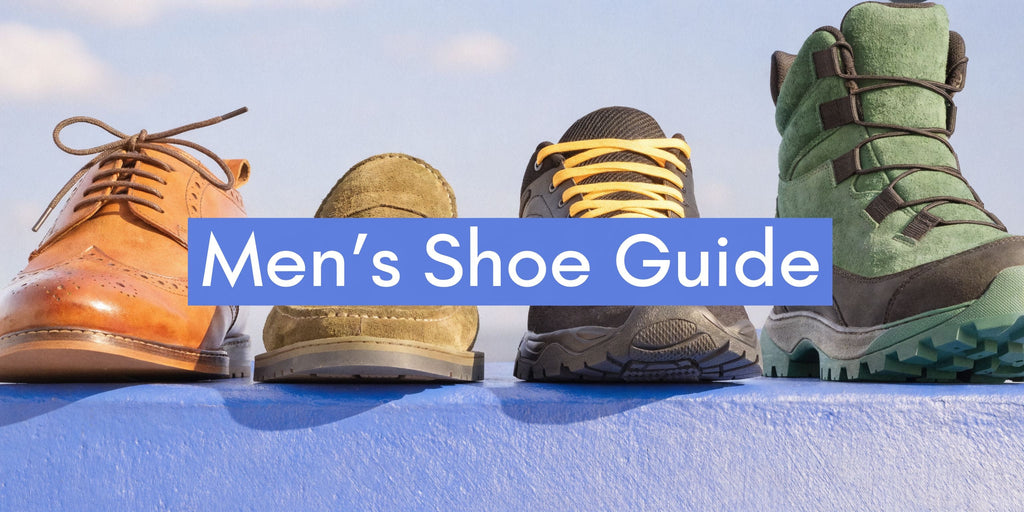
How to Choose the Right Shoe Size for a Perfect Fit Every Time
Trying to choose the right shoe size can feel like a frustrating guessing game. We've all been there. The real problem is rooted in a simple truth: mass-produced shoes are built for volume, not for the unique, individual shape of your foot. This system forces everyone into standardized charts that completely ignore how unique our feet are, and it's the single biggest reason for sizing madness.
Before you can find a perfect fit, you first have to understand why your size 9 in one brand feels like a 10 in another. This guide is designed to educate and empower you, blending traditional footwear wisdom with modern, innovative solutions.
Why Your Shoe Size Is Never Consistent
Ever buy the same size from two different brands, only to find one fits like a glove while the other is an instrument of torture? You’re not imagining it. That frustrating experience is a direct consequence of how the global footwear industry works. It’s all about mass manufacturing, a system that, by design, has to overlook the actual shape of your feet.
The entire system is built on averages. A shoe last—the 3D mold a shoe is built around—is created for a “standard” foot that doesn’t really exist for most people. It just can’t account for crucial details like your arch height, the volume of your instep, or the subtle (and sometimes not-so-subtle) differences between your left and right foot. This is why even within the same brand, a boot made on one last will feel totally different than a sneaker built on another.
The Problem with Mass Production
The scale of this issue is massive. In 2023 alone, global footwear production hit a staggering 22.4 billion pairs. Even with a slight drop from the year before, that number tells you everything you need to know: a "one-size-fits-most" approach is guaranteed to fail millions of people.
With Asia producing 87.1% of the world's shoes, these standardized charts just can't keep up with the diverse foot shapes of customers around the globe. This helps explain a wild statistic: up to 70% of people are walking around in the wrong size shoe. You can get a closer look at the global production landscape in this report from WorldFootwear.com.
The gap between how shoes are made and how feet are shaped is the root cause of discomfort, returns, and even long-term foot problems. The system forces your unique feet to conform to a generic mold.
Moving Beyond Generic Sizing
This inconsistency isn’t just an annoyance for you; it creates huge problems for businesses, too. Poor sizing is a primary driver of high return rates, creating logistical nightmares for retailers. For a deeper dive into the business side of things, you can explore these insights on understanding footwear fulfillment challenges.
The solution is to stop thinking in terms of generic sizes and start focusing on personal measurements.
Getting to know your exact foot length and, just as importantly, your width is the first real step toward finding comfort and confidence in your shoes. Our comprehensive shoe width sizing guide is a great place to start. When you move past the limitations of off-the-rack shoes, you can finally find a fit that feels like it was truly made for you.
How to Measure Your Feet Accurately at Home
A perfect fit doesn't start in a shoe store; it starts right in your own home. Before you can even think about sizes, you need hard data on your own two feet. Forget the guesswork. With just a few simple items you already have, you can get the precise measurements you need to shop with total confidence.
Here’s what you’ll need to get started:
- Two pieces of paper (make sure they’re bigger than your feet)
- A pen or a fine-tipped marker
- A ruler or measuring tape
- A wall or any flat, vertical surface
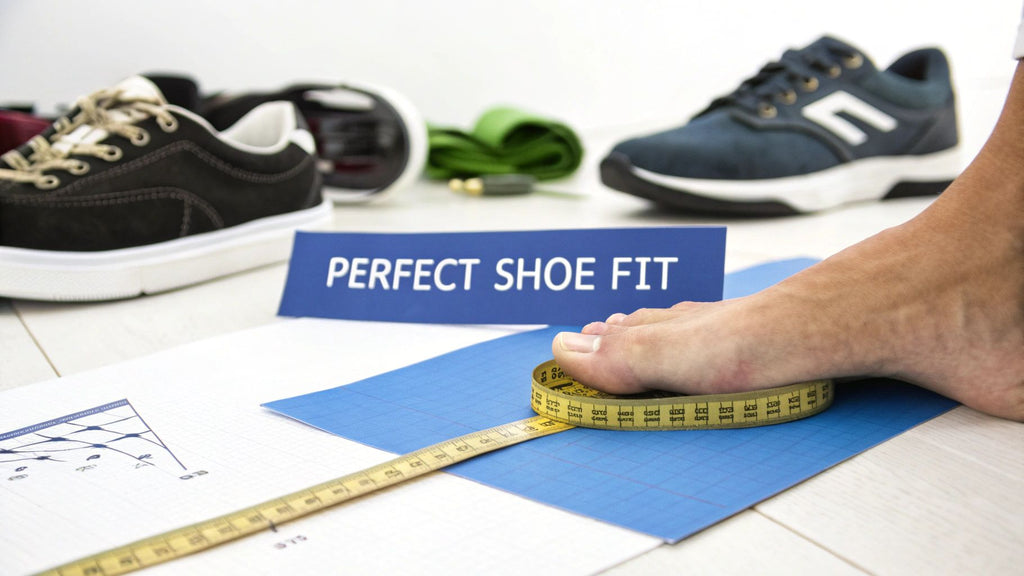
This step is more critical than most people realize. The entire shoe industry is built on mass production, which is the root cause of all those sizing inconsistencies and, ultimately, a poor fit.
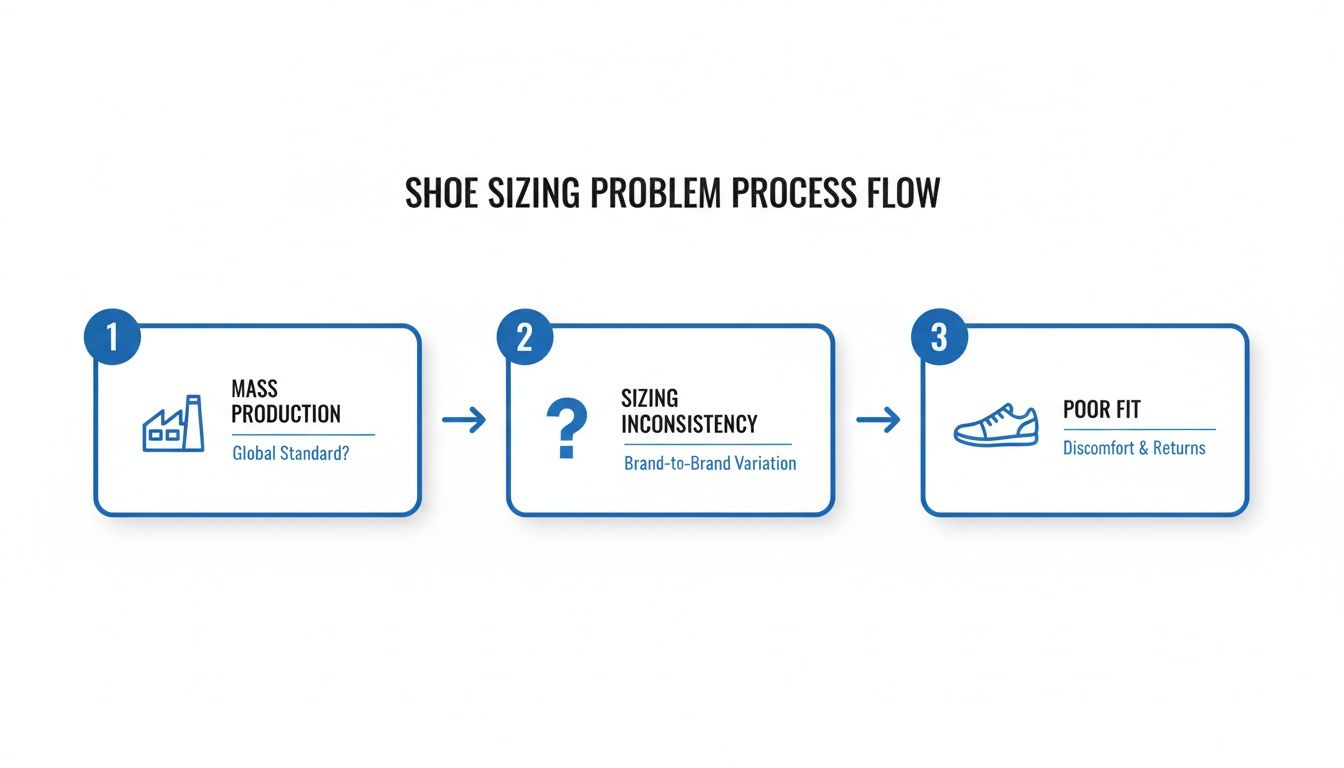
The image above really breaks down the problem. Standardized manufacturing simply can't account for the unique shape of your feet. That's why taking your own measurements is the only real solution.
Prepping for an Accurate Measurement
Believe it or not, when you measure is just as important as how. Your feet naturally swell and expand throughout the day from walking and being upright. For the most accurate reading, always measure them in the evening. If you measure first thing in the morning, you might end up with a pair of shoes that feel painfully tight by the end of the workday.
Also, think about the socks. The thickness of a cushioned athletic sock is worlds apart from a thin dress sock, and that difference can absolutely change the fit of a shoe. Make sure you’re wearing the type of socks you plan to pair with the shoes you're looking to buy.
Here’s the single most common mistake people make: they only measure one foot. It’s a well-known fact that most people have feet of slightly different sizes. Always, always measure both, and use the numbers from your larger foot to guide your purchase.
Capturing Your Foot's True Dimensions
Alright, let's get those numbers. Take a piece of paper and place it on a hard floor, making sure one edge is flush against a wall. Now, stand on the paper with your heel pressed firmly against that wall. This simple trick ensures you get a true length measurement without any wiggle room.
While standing, the best way to do this is to have someone else trace the outline of your foot. Make sure they keep the pen held perfectly upright, not at an angle. If you're on your own, just sit in a chair but keep your weight pressed down on that foot to get a realistic tracing.
Once you're done, grab the second piece of paper and do it all over again for your other foot.
Finding Your Length and Width
With your tracings ready, it's time to find your two most important data points.
- Measure the Length: Use your ruler to measure the distance from the very back of the heel to the tip of your longest toe on each tracing. Don't just assume it's your big toe—for a lot of people, the second toe is actually longer.
- Measure the Width: Look for the widest part of your forefoot on the tracing. This is usually the ball of your foot, right below your toes. Measure this distance straight across.
Jot down both the length and width for each foot. It's a good idea to record them in both inches and centimeters, since different brands use different sizing charts.
Having these two precise numbers is the secret to finally understanding how to measure shoe size at home and ending the sizing confusion for good. This data is your personal key to a world of footwear that truly fits, from off-the-shelf styles to a completely bespoke pair from our Design Lab.
Navigating International Shoe Size Charts
So, you have your exact foot measurements. Fantastic. Now you’re ready for the next step in finding that perfect fit: making sense of shoe size charts. This can feel like trying to read a foreign language, especially when you’re shopping from international brands where US, UK, and European sizing systems all come into play.
When you're exploring shoes from a global network of artisans, you're going to run into different sizing standards. It's a common point of confusion. A men's US 9 isn't a UK 9, and an EU 42 throws another wrench in the works. These aren't just random numbers; they come from different historical systems, like the UK's old barleycorn system versus the Paris point system used across Europe.
This is exactly why so many online shoe purchases end in a frustrating return. In fact, studies show that up to 72% of adults are walking around in shoes that don't fit right, often because they simply misread a size chart.
Cracking the Code of Conversion Charts
A good conversion chart is your best friend here. While you can find dozens online with a quick search, your first stop should always be the brand's own chart if they provide one. Still, having a general idea of how these sizes relate will give you a major confidence boost.
To give you a quick reference, here’s a simplified chart to get you started.
International Shoe Size Conversion Chart
This table offers a basic comparison between common sizing systems, but think of it as a starting point.
| US Men | US Women | UK | EU |
|---|---|---|---|
| 8 | 9.5 | 7.5 | 41 |
| 9 | 10.5 | 8.5 | 42 |
| 10 | 11.5 | 9.5 | 43 |
| 11 | 12.5 | 10.5 | 44 |
Remember, this is a guide, not a guarantee. Every brand has its own quirks. For a much more thorough look at the topic, our guide on international shoe size conversions goes into greater detail.
Why the Shoe Last Is the Real Secret
Here’s a bit of insider knowledge that explains why sizes can feel inconsistent even within the same brand. Every single shoe is constructed around a last—a three-dimensional mold that dictates the shoe's shape, volume, and overall fit. A sleek Italian loafer is built on a narrow, elegant last, while a tough work boot will use a much wider, roomier one.
This is the hidden variable that a simple size chart can never capture. You could have two size 10 shoes from the exact same company, but if they were made on different lasts, they will fit completely differently. This is where bespoke shoemaking truly makes a difference, as our artisans use your specific measurements to craft a shoe that isn’t based on a generic mold.
A shoe size chart gets you in the ballpark, but understanding the last and the shoe's intended shape is what gets you a home run. It’s the difference between a shoe that you can wear and a shoe that feels made for you.
Looking Beyond the Numbers
A size chart is more than just a list of length conversions. To really get it right, you have to look for the other details that most people skip over.
- Width Indicators: Keep an eye out for letters like B (narrow), D (standard), and 2E (wide). These are just as crucial as the length, especially if your own measurements showed your foot is on the narrower or wider side.
- Material Notes: Some brands will tell you how a material affects the fit. Premium leather, for example, will naturally stretch and mold to your foot over time, so a snug fit at the start is usually a good thing. On the other hand, synthetic materials have almost no give, so how they feel on day one is how they'll feel forever.
By combining your personal measurements with a smarter way of reading these charts, you're no longer just guessing. You have the skills to move beyond just picking a size and start choosing the right size for a genuinely perfect fit.
Finding the Right Fit for Different Shoe Types
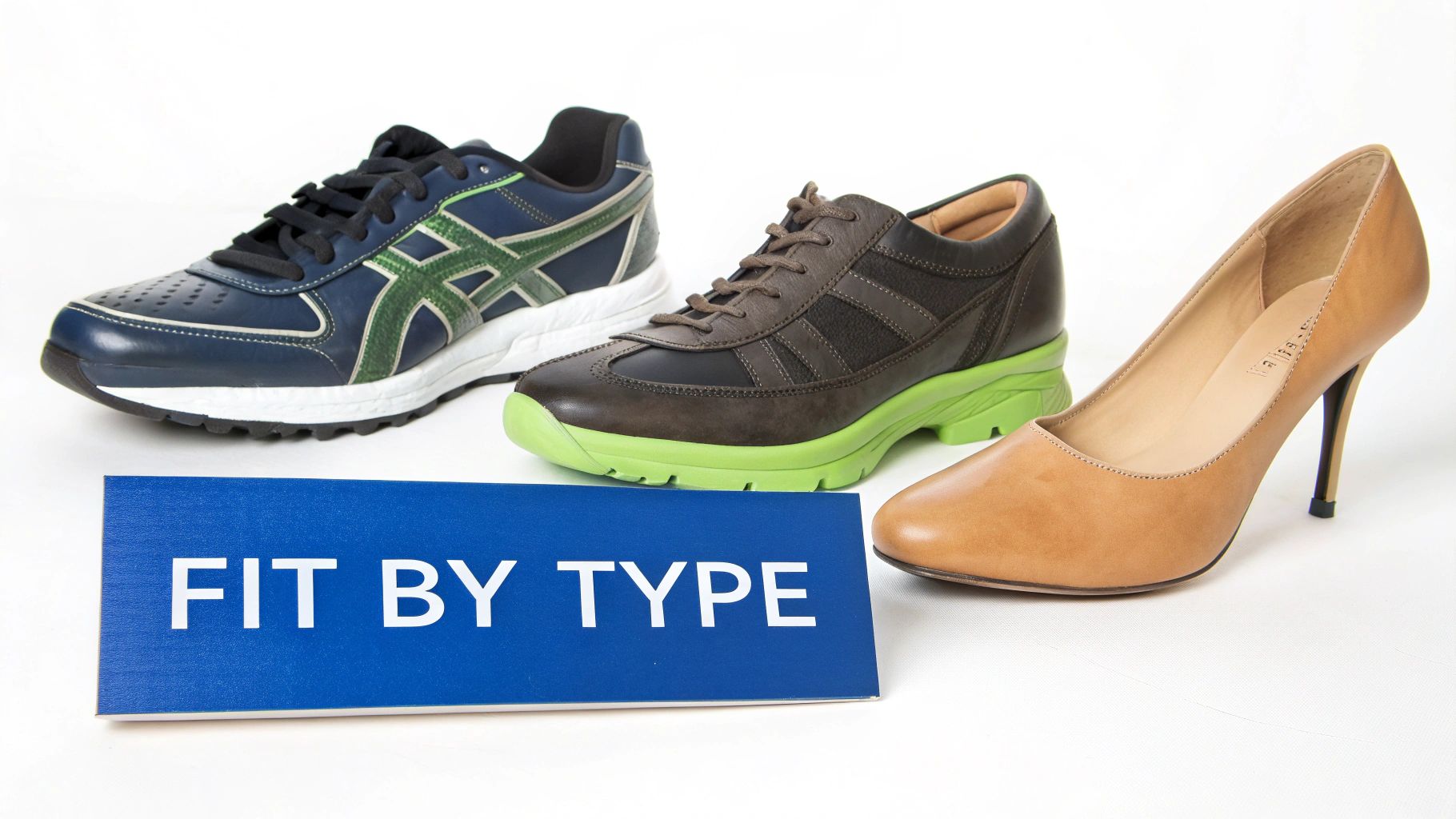
Knowing your measurements is a fantastic start, but it's really only half the battle. The truth is, not all shoes are created equal. A running sneaker is built for performance and movement, while a fine leather dress shoe is designed to mold to your foot over time. Understanding these crucial differences is the secret to building a wardrobe where every single pair feels like it was made just for you.
Each type of shoe has its own unwritten rules for what a "perfect fit" actually means. The amount of space you need in the toe box, how snug it feels around the instep, and the way it grips your heel all change depending on the shoe's purpose. Once you master these specific fit checks, you'll be able to assess any shoe like a pro, guaranteeing both style and total comfort.
Sneakers and Athletic Footwear
With sneakers, like those in our WIRA sneakers line, it's all about accommodating movement. When you walk, run, or train, your feet naturally swell and your toes spread out. Giving them enough room isn't just a comfort thing—it's essential for preventing blisters, bruised toenails, and other nagging injuries.
The golden rule here is the classic "rule of thumb." You should have about a half-inch of space, or roughly a thumb's width, between your longest toe and the very end of the shoe. This gives your foot the room it needs to flex and move naturally without bumping against the front.
At the same time, the middle of your foot should feel secure without being squeezed. You want a solid, locked-down feel that stops your foot from sliding around, which is a major cause of friction and instability. The heel should also be nicely cupped, with little to no slipping as you take a step.
Dress Shoes and Artisan Boots
When we talk about high-quality leather dress shoes and artisan boots, the fitting philosophy changes completely. Unlike the synthetic materials in most sneakers, premium leather has this incredible ability to stretch, soften, and mold to the exact shape of your foot. That means the way it feels out of the box should be very different.
A brand-new pair of leather dress shoes or boots should feel snug and firm. You want to feel your foot being held securely, especially across the instep and around the heel, but without any sharp pinching or pain. A bit of initial tightness is actually a good sign; it means the leather will relax and break in perfectly to create a truly custom fit.
If a leather shoe feels perfectly comfortable and a little roomy right away, it’s going to end up far too loose and sloppy after you've worn it a few times. The goal is a glove-like fit that adapts to you.
You still need enough room for your toes to lie flat, but you don't need that full thumb's width you'd look for in a sneaker. The focus here is on a supportive, structured fit that will only get better with age.
High Heels and Stilettos
For high heels, the fit is all about stability. A poorly fitting heel isn't just uncomfortable; it's a straight path to strained ankles and potential injury. The two most critical spots to check are the heel and the arch.
Your heel must sit locked into the back of the shoe with absolutely no slipping or gapping as you walk. If your heel is popping out with every step, the shoe is too big, and your toes will instinctively try to claw and grip to hold on. That's a primary source of foot pain and fatigue.
Proper arch support is just as important. The arch of the shoe should line up perfectly with your own arch, creating a supportive foundation. If there's a gap there, your entire body weight gets slammed onto the ball of your foot, causing intense pressure and discomfort. The fit of a custom shoe is engineered to distribute that pressure more evenly for a much more wearable experience.
Specific Fit Checks for Every Shoe
To make sure you know how to choose the right shoe size every time, run through this quick mental checklist:
- Toe Room: Can you wiggle your toes, and are they lying flat?
- Width: Does the widest part of your foot feel supported without bulging over the sides of the sole?
- Instep: Is the top of the shoe digging into your instep, or is there a big gap?
- Heel Grip: Is your heel held firmly in place, or does it lift out when you walk?
Understanding these distinctions is vital, especially when you consider the state of the modern shoe industry. While the worldwide footwear market hit an incredible $423.35 billion in 2024, sizing problems are more common than ever. Studies show that 60-80% of people deal with foot pain caused by shoes that just don't fit right. You can find more footwear market trends on straitsresearch.com.
This is a problem that our community knows all too well. For busy professionals, a bespoke fit isn't a luxury—it's a necessity for feeling comfortable and confident all day long. Our direct-to-consumer model allows us to bypass the pitfalls of mass production and connect you directly with global artisans who create shoes for your unique feet.
The Custom Solution for a Guaranteed Perfect Fit
Let's be honest. All the measuring guides and conversion charts in the world can only get you so close. They help you make a more educated guess, but they can't solve the core problem of mass-produced footwear: it simply wasn't made for you. This is where the old way of doing things hits a wall, and a modern, personalized approach finally puts your unique feet first.
Instead of trying to squeeze your foot into a generic mold, imagine a shoe built from the ground up using your precise measurements. That’s the entire principle behind the Alexander Noel bespoke experience. We’ve bridged the gap between traditional, handcrafted quality and the power of modern technology to create a process that ends sizing anxiety for good.
Beyond the Guesswork with Bespoke Craftsmanship
Our approach begins right where standard retail gives up. Using our at-home fitting system, you capture the exact data that mass manufacturing completely ignores. These aren't just numbers to plug into a chart; they are the specific blueprint for your feet, which we then send directly to our global network of master artisans.
Whether it's a team in Portugal known for their durable boots or craftsmen in Spain celebrated for their elegant dress shoes, your measurements guide their hands. This direct-to-consumer model connects you straight to the source, ensuring that every curve and contour of your foot is perfectly accounted for.
This process tackles one of the biggest frustrations in the entire footwear industry. Think about it: the US footwear market hit a staggering $88.5 billion in 2023, yet sizing issues are so common that up to 25% of all online shoe purchases are sent back due to poor fit. That's not just an inconvenience; it’s a massive source of waste and frustration. Our made-to-order system is designed to slash those return rates by getting it right the very first time.
Step into the Interactive Design Lab
Getting the fit right is paramount, but true satisfaction comes when that perfect fit meets your personal style. This is where our Interactive Shoe Designer transforms the experience from just buying a shoe to creating one. It's your personal digital workshop, and you're the creative director.
The process is straightforward but gives you an incredible level of control over every single element of your design.
- Choose Your Canvas: Start by selecting your preferred style, whether it’s our WIRA luxury sneakers, a classic artisan boot, or a sharp pair of stilettos.
- Select Your Materials: This is where you can truly make the shoe your own. You could opt for the cloud-like comfort of certified baby alpaca fiber, the timeless elegance of premium Italian leather, or the soft durability of a sheep leather lining.
- Define the Details: It's the smallest touches that make the biggest impact. Decide on the color of the stitching, the finish on the eyelets, or whether you want a subtle monogram. Add a touch of luxury with gold buckles on a pair of heels, or choose a rugged, durable sole for your new boots.
This isn't just customization; it's a real conversation between your vision and our artisans' skill. The result is a shoe that reflects not only your measurements but also your personality.
This kind of deep personalization is quickly becoming a key differentiator for successful brands. For others looking to offer truly custom solutions, checking out these top e-commerce personalization examples shows just how powerful this approach can be.
The Alexander Noel Guarantee
By combining an educational approach with advanced technology and old-world craftsmanship, we deliver more than just a shoe. We provide a guaranteed solution to a problem that plagues millions of consumers. It's a promise of uncompromising quality, a perfect fit, and a style that is uniquely, undeniably yours.
Our direct-to-consumer model also means we eliminate the unnecessary retail markups, making bespoke luxury much more accessible. From the moment you finalize your design to the day your handcrafted shoes arrive—often in just 48 hours to 10 days—the focus is entirely on creating the perfect pair for you. You can learn more about how we help you discover your perfect pair with Alexander Noel's bespoke shoes and finally end the search for the right fit.
Your Top Shoe Sizing Questions Answered
Even when you've done your homework, a few specific questions always seem to pop up on the quest for the perfect fit. Getting the nuances of shoe size right can feel complicated, but the answers are usually more straightforward than you’d think. Let's tackle some of the most common concerns we hear every day.
Think of this as your go-to guide for those last nagging questions that stand between you and a truly flawless pair of shoes.
What if My Feet Are Two Different Sizes?
This is, hands down, one of the most frequent questions we get. The answer is simple: it’s incredibly common. In fact, it's more unusual to have two feet that are exactly the same. Most of us have one foot that’s slightly larger than the other.
When you're buying shoes off the rack, the standard advice is to always fit your larger foot to avoid painful cramping and blisters. The obvious downside is that the shoe on your smaller foot often feels loose and doesn't give you the support you need.
This is precisely where bespoke footwear completely changes the game. With the Alexander Noel made-to-order process, we build your shoes to accommodate these natural differences. By taking measurements for both your left and right foot, our artisans craft a pair that fits each one perfectly, eliminating that frustrating compromise for good.
How Much Space Should I Leave at the End of My Shoes?
The right amount of room depends entirely on the type of shoe you're wearing, as each is designed for a completely different purpose.
- Athletic and Casual Sneakers: For shoes built for movement, a good rule of thumb is to have about a half-inch (roughly a thumb's width) of space between your longest toe and the end of the shoe. This gives your foot room to flex and naturally swell a bit during activity.
- Leather Dress Shoes or Boots: With more structured footwear, the fit should be snug but never painfully tight. Remember, premium leather is designed to stretch and mold to your foot over time, so a firm initial fit is actually a good sign that it will break in perfectly.
- Open-Toed Shoes or Heels: Here, the goal is security and alignment. Your heel should sit securely in the back without hanging over the edge, and your toes shouldn't spill over the front.
Does Shoe Material Affect the Size I Should Choose?
Absolutely. The material a shoe is made from plays a huge role in how it fits and feels over time—a critical factor many people overlook.
Natural materials, like the premium full-grain leather we use in our dress shoes, have a "break-in" period. They will gradually stretch and conform to the unique shape of your foot, creating a truly custom fit with each wear.
On the other hand, most synthetic materials have very little give, meaning the fit you feel on day one is pretty much the fit you'll have for the life of the shoe. Even specialized materials like the certified baby alpaca fiber in our WIRA sneakers offer a soft, flexible fit right from the start. When you use our Interactive Shoe Designer, our system automatically accounts for these material properties to ensure your final handcrafted pair fits perfectly right out of the box.
Ready to move beyond guesswork and experience a fit that's truly made for you? At Alexander Noel, we combine traditional craftsmanship with modern innovation to deliver a guaranteed perfect fit. Explore our Interactive Shoe Designer to create a pair of shoes that is uniquely yours, from the precise measurements to the last stylish detail.
Related post
26
Sep
26
Sep
26
Sep
26
Sep
26
Sep
