

RECENT POSTS

29.August.2026
Custom Women's Boots for Fall: Choosing Between Two Black Chelsea Silhouettes
0 Comments









Shoe Size Conversion International: Your Guide to a Perfect Fit
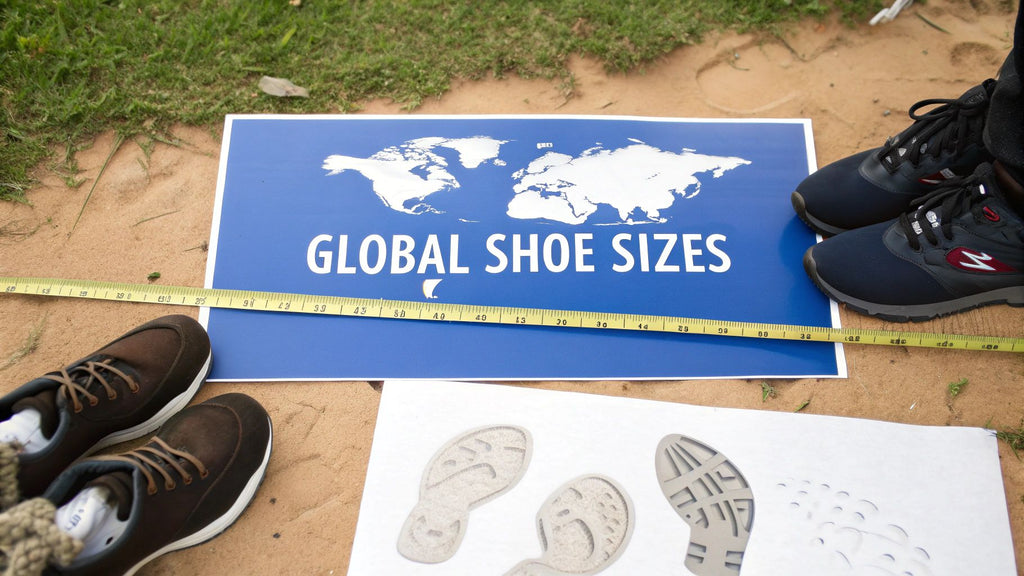
Navigating the world of international shoe sizes can feel like learning a new language. A US size 10 is not a UK 10, and neither is an EU 10, creating a common headache for discerning shoppers across the globe. Think of this guide as your personal translator, an educational resource designed to clear up the confusion and connect you with that elusive perfect fit.
Why International Shoe Sizes Are So Confusing
Have you ever ordered your go-to size from a brand overseas, only to find the shoes are painfully tight or comically large? It’s not a random fluke; this sizing discrepancy is deeply rooted in history. Different regions of the world developed their own measurement systems long before global e-commerce connected us all.
It helps to think of it like currency conversion—every system has its own unique value and origin story. The US and UK, for example, built their sizing on the barleycorn, an old English unit of measurement equal to 1/3 of an inch. Meanwhile, the European Union uses the Paris Point, which is 2/3 of a centimeter. With such different foundations, it’s clear how things were bound to get complicated.
The Real-World Impact of Mismatched Systems
This lack of a universal standard does more than just cause a bit of confusion. It leads to very real problems, especially for those investing in high-quality, handcrafted footwear.
- Costly Returns: Shipping a pair of shoes back and forth across oceans is not only expensive but also a significant waste of time.
- Foot Discomfort: Squeezing your feet into the wrong size can cause blisters, pressure points, and even lead to long-term foot health issues.
- Compromised Quality: An improper fit doesn't just hurt your feet; it can permanently damage the shoe’s structure and stretch out premium, artisan-selected materials.
At Alexander Noel, we merge timeless artisan craftsmanship with modern innovation to solve this exact problem. Our educational approach aims to eliminate the guesswork, ensuring the shoes you design in our Lab are crafted for your feet, not just a number on a chart.
Globally, the average adult shoe size tends to be between a US 9-12 for men and a US 7-9 for women. While there are broad similarities, the regional numbering systems create the challenge. In the United States, a major market, men's averages are around a US 10-11, with women averaging a US 9—these numbers highlight just how critical a precise conversion is for anyone sourcing luxury footwear from abroad. You can explore more of these global footwear trends over at World Population Review.
Understanding these fundamental differences is the first step toward finding a truly perfect fit. It empowers you to look past generic charts and see the value in a more personalized approach—a non-negotiable when commissioning a custom pair of shoes from artisans around the world.
How to Measure Your Feet Accurately at Home
Before you even glance at a shoe size conversion international chart, you need the single most important number: your own measurement. Relying on the size of your last pair of shoes is like using an old map—it might get you to the right neighborhood, but it won't lead you to the perfect destination. A truly great fit starts with an accurate measurement you can easily do yourself.
The best part? You don't need any fancy equipment. A few simple items from around the house are all it takes to get the exact length and width of your feet, providing the foundation for true customization.
Your Step-by-Step Measurement Guide
First, grab a piece of paper that’s larger than your foot, a pen, a ruler or measuring tape, and find a wall. It’s a simple toolkit for a surprisingly precise result.
- Set Up Your Space: Lay the paper flat on a hard floor, ensuring one of the shorter edges is pushed flush against the wall. This creates a solid, square starting point.
- Trace Your Foot: Step onto the paper with your heel fitting snugly against the wall. Put your full weight on that foot and carefully trace the entire outline. Keep the pen perpendicular to the paper, not at an angle.
- Measure the Length: Step off the paper. Now, use your ruler to measure the distance from the very back of the heel on your tracing to the tip of your longest toe. This is your foot length.
- Measure the Width: Look at your tracing and find the widest part of your foot, which is typically across the ball. Measure that distance to get your foot width.
Here's a tip straight from our artisans: always measure your feet in the late afternoon or evening. Feet tend to swell slightly as the day goes on, so measuring them at their largest ensures your shoes will be comfortable from morning to night.
Pro-Tips for a Flawless Fit
Knowing how to do this yourself is empowering, especially when considering custom footwear. For an even more in-depth look, check out our guide on how to measure your shoe size at home, which has more visuals to walk you through the process.
Finally, make sure you repeat the whole process for both feet. It might sound strange, but for up to 60% of people, one foot is slightly larger than the other. Always, always use the measurements from your larger foot when choosing a size. It’s a simple step that prevents the frustrating feeling of one shoe fitting perfectly while the other is just a bit too tight.
With these exact numbers in hand, you’re ready to use tools like the Alexander Noel Design Lab with total confidence, knowing those custom WIRA Luxury Sneakers or designer boots will be made just for you.
The Ultimate International Shoe Size Conversion Charts
Alright, you've measured your feet and have your precise numbers. Now, let's turn that data into the perfect fit, no matter where in the world your dream shoes are coming from. Think of this next step—navigating an international shoe size conversion chart—as the bridge connecting your unique measurements to the master artisans crafting your shoes in Italy, Spain, or Portugal.
These charts are essentially a Rosetta Stone for footwear. They let you decode the different sizing languages used across the globe with confidence. Just find your size in a system you already know (like US sizes or your centimeter measurement), look across that row, and you'll see its exact equivalent in the UK, EU, or JP systems. It takes all the guesswork out of the equation.
To get started, you need that core measurement. The diagram below breaks down the simple, three-step method for getting it right every time.

By tracing your foot, measuring its length, and then its width, you’ll have the precise data you need to use these conversion charts like a pro.
Men's International Shoe Size Conversion Chart
When it comes to men's sizes, there’s a handy rule of thumb: UK sizes are almost always one full size smaller than US sizes. So, if you're a US size 10, you can bet you’re a UK size 9.
Still, it's always best to check a detailed chart to be certain, especially when you're dealing with European sizing, which follows its own distinct system. Here’s a quick-reference chart to help you out.
| US | UK | EU | Japan (cm) |
|---|---|---|---|
| 7 | 6 | 40 | 25 |
| 8 | 7 | 41 | 26 |
| 9 | 8 | 42 | 27 |
| 10 | 9 | 43 | 28 |
| 11 | 10 | 44 | 29 |
| 12 | 11 | 45 | 30 |
| 13 | 12 | 46 | 31 |
This table covers the most common sizes to make converting simple and fast.
Remember, these charts represent the industry standard. At Alexander Noel, this is just the starting point. We use your converted size as a baseline before our artisans begin the bespoke process, ensuring the final product is a testament to true personalization.
Women's International Shoe Size Conversion Chart
For women, the difference between US and UK sizing is a little more pronounced. Typically, a woman's UK size is two sizes smaller than her US size. A US 8, for example, becomes a UK 6. This is a critical detail to keep in mind when you're looking at shoes from UK-based or European designers.
While our chart below covers the basics, you can get an even deeper look in our article on US shoe size conversion specifics.
| US | UK | EU | Japan (cm) |
|---|---|---|---|
| 6 | 4 | 37 | 23 |
| 7 | 5 | 38 | 24 |
| 8 | 6 | 39 | 25 |
| 9 | 7 | 40 | 26 |
| 10 | 8 | 41 | 27 |
| 11 | 9 | 42 | 28 |
Of course, different regions sometimes have their own unique systems. For anyone trying to convert between Korean and US shoe sizes, The Ultimate Korean Shoes Size to US Conversion Guide is an excellent resource full of charts and brand-specific tips. Using tools like these empowers you to order with confidence, knowing you’re one step closer to that perfect fit.
Beyond the Charts: How Shoe Style and Material Impact Fit
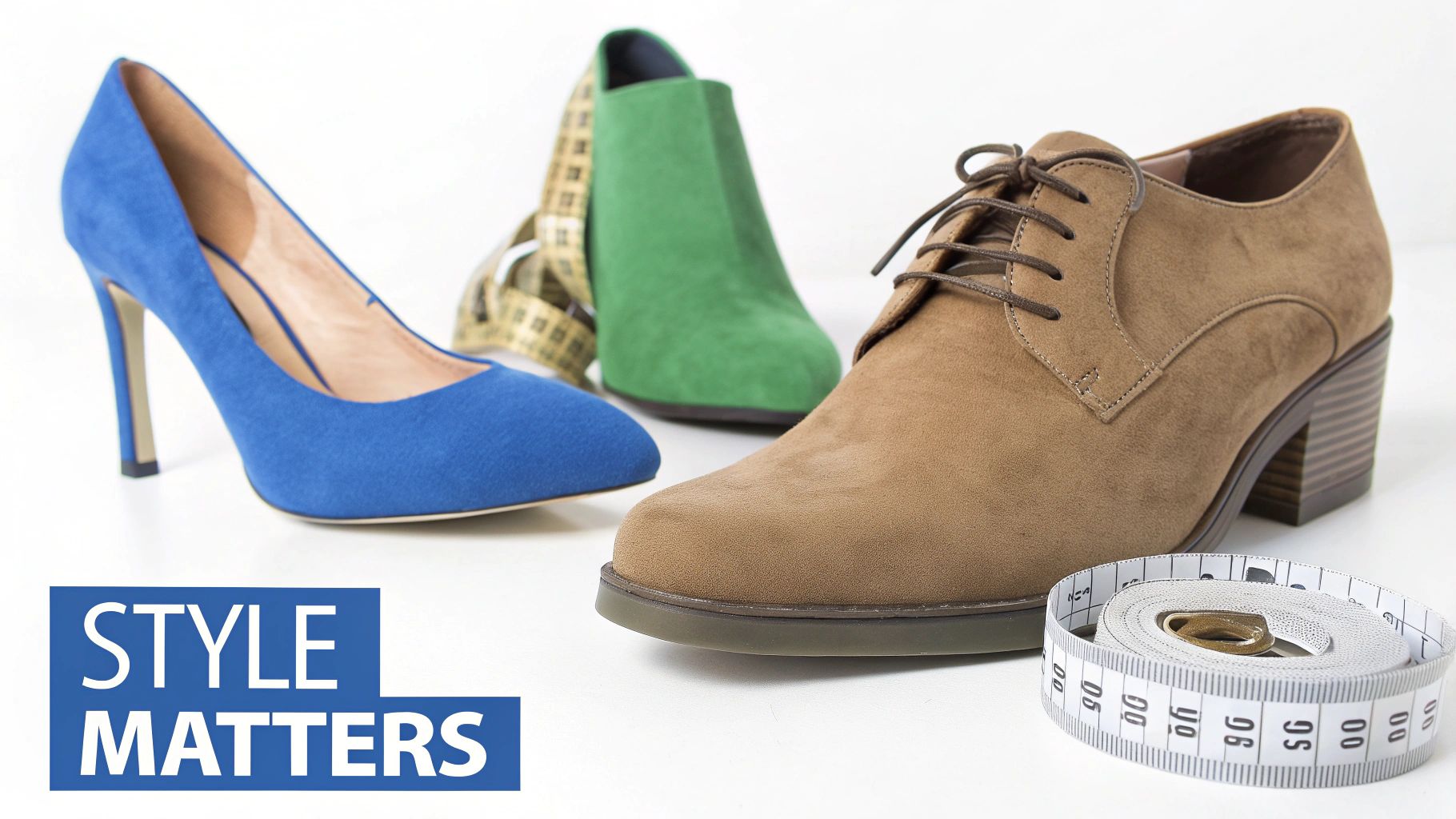
While a good shoe size conversion international chart is a fantastic place to start, it really only tells you half the story. Those numbers on the chart correspond to the length of a shoe last—the physical mold a shoe is built around. But they don't capture the critical details of a shoe’s unique design or the materials used to make it.
Think about it: a size 9 means something completely different for a sleek, pointed-toe stiletto than it does for a roomy, rounded-toe boot. The style itself drastically changes the internal volume and the actual shape where your foot has to live.
How Design Shapes Your Fit
The basic geometry of a shoe is everything when it comes to comfort. A narrow, tapered toe box is naturally going to feel tighter than a broad, square one, even if both shoes are technically the same size on paper. This is precisely why knowing your own foot’s shape, especially its width, is so important.
- Pointed-Toe Shoes: You’ll often need to size up for these, particularly if you have wider feet. That taper needs to go somewhere, and you need space for your toes.
- Rounded or Square-Toe Shoes: These are much more forgiving. They generally offer more interior room and are far more likely to fit true-to-size according to the chart.
A shoe’s fit is a three-dimensional puzzle of length, width, and volume. Standard sizing only solves for length, which is why a personalized, direct-to-consumer approach is the only way to guarantee a truly perfect fit.
The Role of High-Quality Materials
Beyond the shoe’s physical shape, the material it’s made from plays a massive role in how it feels and breaks in. Different materials have their own personalities; some conform to your foot over time, while others hold their rigid structure.
For example, a structured premium leather offers incredible durability, but it won’t have much initial give. In contrast, softer, more supple materials like suede or our signature baby alpaca fiber are far more forgiving and will mold to your foot’s unique contours almost immediately.
This is at the very heart of the Alexander Noel experience. Our made-to-order model means you can account for these subtleties right from the start, ensuring a personalized fit that you simply can't get from an off-the-shelf brand. If you have specific width needs, our guide on shoe widths explained provides even more detail.
Forget the Guesswork—Here's Your Perfect Fit Solution
Trying to decipher international shoe size conversion charts and figure out how different materials will affect the fit can be a real headache. It’s a flaw in the traditional retail model—one that costs you time, money, and comfort. This is especially frustrating for busy professionals and anyone with a keen sense of style who demands quality without the hassle.
That’s exactly why we developed a system to sidestep all that confusion. We combine our interactive Design Lab, a precise at-home fitting system, and a direct line to our world-class artisans. It’s a blend of modern tech and old-world craftsmanship that takes all the guesswork out of the equation, guaranteeing a perfect result every single time.
A Personalized Path to Your Perfect Pair
Instead of crossing your fingers and hoping a standard size works, our process puts you in complete control. You get to design your dream shoes from anywhere in the world, knowing they’ll be handcrafted to your exact specifications by global artisans.
Our system is built on a simple promise: to deliver a flawless, personalized fit by translating your unique measurements into a masterpiece of bespoke footwear, handcrafted just for you.
E-commerce data shows that by 2025, a shocking 35% of returns in US-EU-Asia trade will be due to sizing confusion—a massive issue that often hits traveling executives the hardest. Our precision sizing, complete with interactive visualization and at-home kits, solves this by converting any measurements into flawless bespoke flats or luxury heels. Each pair is then carefully inspected by our Portuguese artisans before its 10-day global delivery. You can see more on these global sizing trends on World Population Review.
This direct-to-consumer approach isn't just about making bespoke shoes more accessible; it's about delivering certainty. By connecting you directly with our craftspeople, we create a seamless journey from your initial design to the moment you unbox your shoes. Learn more about how you can discover your perfect pair with Alexander Noel's bespoke shoes in our detailed guide.
Still Have Questions About Shoe Sizing?
Even with the best charts in hand, it’s normal to have a few questions. International shoe sizing can feel like a maze, but getting the right answers is the final step to finding that perfect, handcrafted fit.
Let's tackle some of the most common questions we hear from customers navigating the world of bespoke footwear.
Are EU and US Shoe Sizes The Same Thing?
Not exactly. While conversion charts are a great starting point, the two systems are built on completely different foundations. The US system is based on the barleycorn (an old English unit measuring 1/3 of an inch), while the EU system uses the Paris Point (which is 2/3 of a centimeter).
Because of this fundamental difference, there's no perfect one-to-one conversion. It's why you might find yourself stuck between two EU sizes when converting from your US size. This is where a made-to-order process really shines, as it accounts for those subtle differences an off-the-shelf shoe simply can't.
What Should I Do If I'm a Half Size?
Half sizes are common in the US and UK, but not all systems recognize them. The European system, for example, only uses full sizes. If your foot measurement lands you squarely between two numbers, it’s a good sign that a standard-sized shoe might not be your best match.
If you find yourself in this situation, here are a couple of things to think about:
- The Style of the Shoe: If you're looking at a shoe with a pointed toe, it's almost always better to size up to the next full size. Your toes will thank you for the extra room.
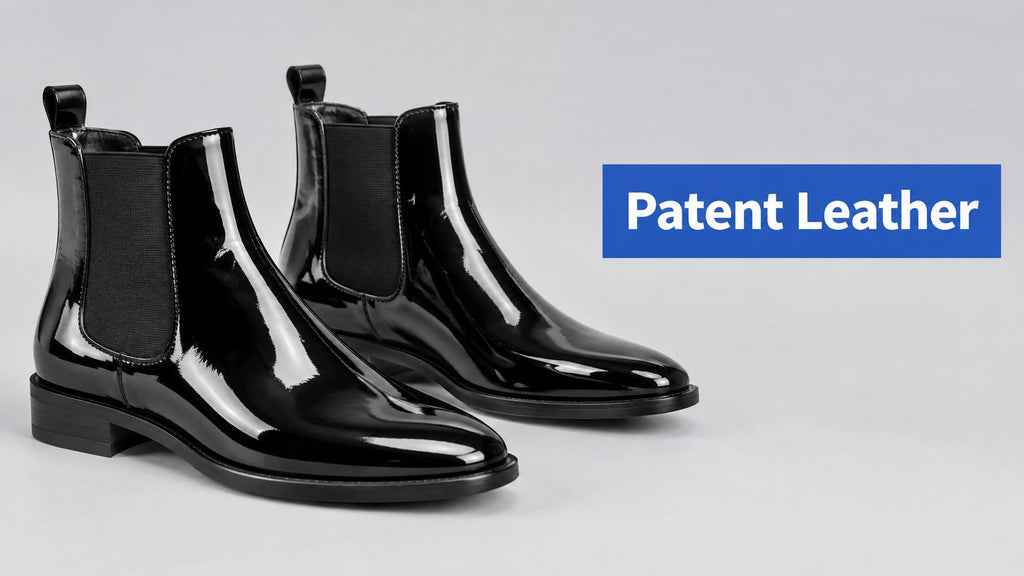
- The Material: Soft, supple materials like suede will have a bit more give and stretch over time, whereas a structured patent leather won't.
The best solution for a half-size foot? A custom-made shoe, hands down. At Alexander Noel, our artisans use your exact measurements to build a shoe that accommodates the unique length and width of your feet, completely eliminating the need to compromise.
Do All Shoe Brands Use the Same Size Chart?
Unfortunately, no. This is one of the biggest sources of confusion. While conversion charts give you a solid baseline, every brand uses its own lasts—the forms a shoe is shaped around. This means a size 42 from one Italian maker might fit a little differently than a 42 from another.
That’s why we take a more holistic approach to fit. We start with your measurements and the standard conversions, but our direct partnership with our artisans ensures the final shoe is true to our high standards and, more importantly, true to you. Our direct-to-consumer model allows us to maintain exceptional quality and consistency across our entire collection, from the moment you start creating in our Design Lab to the final stitch on your handcrafted shoe.
Ready to leave the confusion of generic size charts behind and experience what a truly perfect fit feels like? At Alexander Noel, we bring together modern design tools and timeless craftsmanship to create bespoke shoes made just for you.
Step into our Design Lab and start creating your own pair of custom, handcrafted shoes today.
Related post
12
Sep
12
Sep
12
Sep
29
Aug
