

RECENT POSTS

29.August.2026
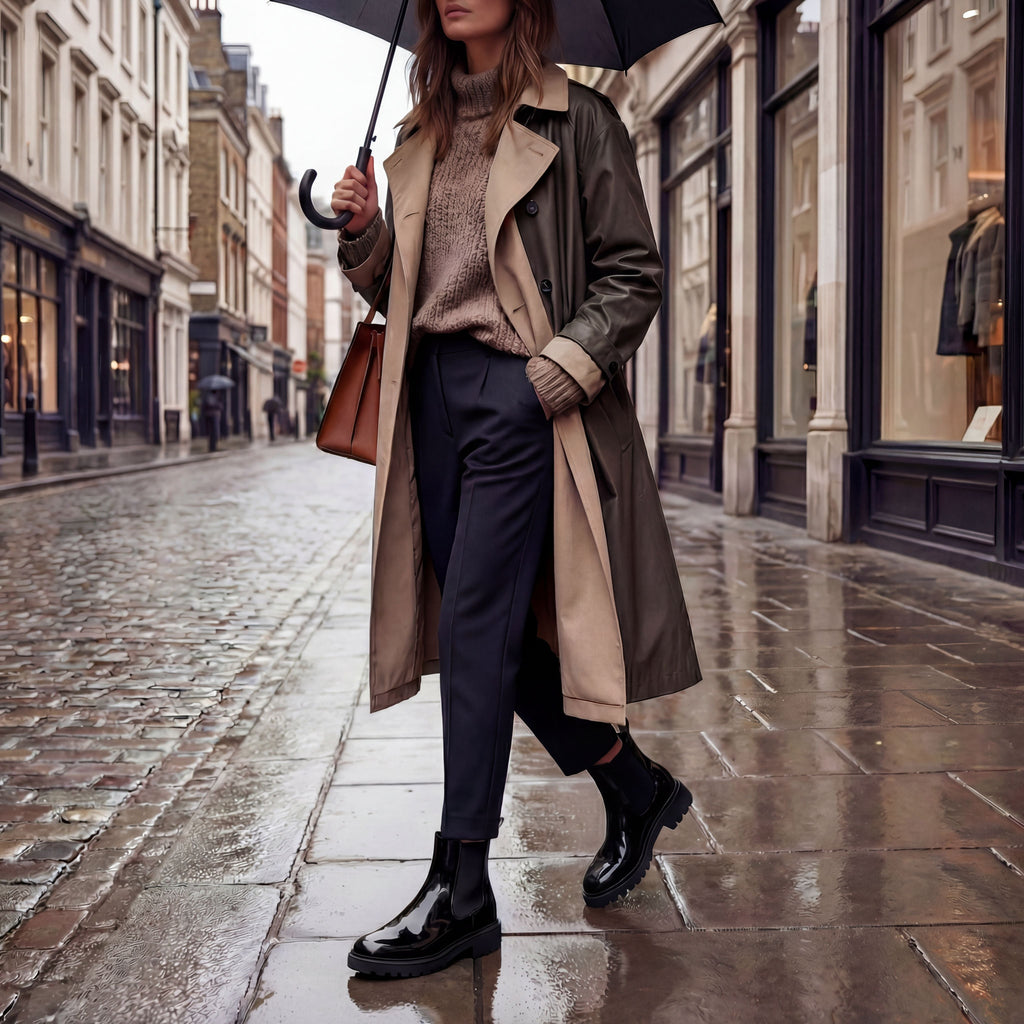
Custom Women's Boots for Fall: Choosing Between Two Black Chelsea Silhouettes
0 Comments













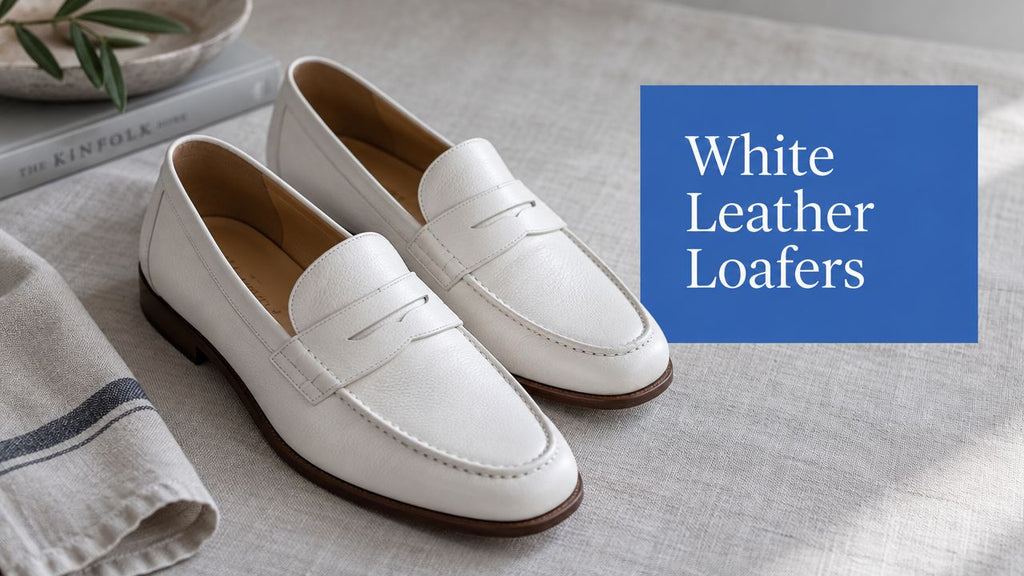
Mens White Leather Loafers: A Buyer's Guide to Fit and Care
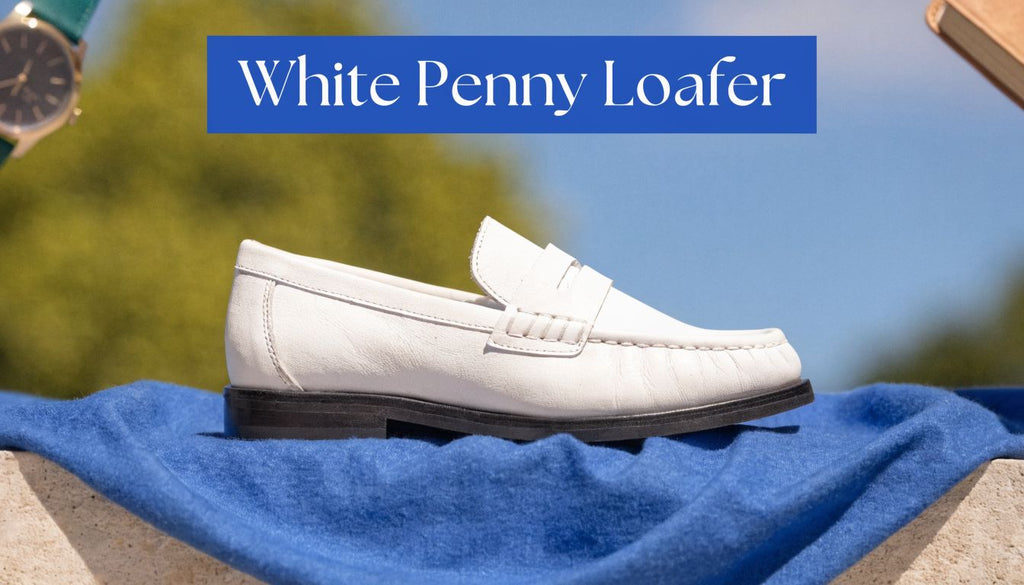
You're standing in a fitting room with one foot in a pair of white leather loafers and the other still in your old shoes. The pale leather catches the overhead light, the vamp feels slightly stiff across the instep, and the mirror shows an immediate contrast against your darker trousers. They look sharp. Then comes the practical question: will the elegance justify the work required to keep them clean?
That question matters more with white leather than with brown calf or black leather. Scuffs appear sooner, poor fit creates more visible creasing, and neglect turns a refined slip-on into a tired-looking novelty. Yet a well-chosen pair can move from relaxed tailoring to semi-formal dressing and stay useful beyond warm-weather outfits.
This guide treats mens white leather loafers as a serious wardrobe purchase. The focus is the same one I use at the fitting stool: leather quality, construction, heel security, instep volume, seasonal styling, and the care routine that determines whether the shoes earn their shelf space.
The First Time You Try On White Leather Loafers
Start with the fitting-room sensation, because it reveals more than a product photograph ever will. The leather should feel cool and faintly resistant as you slide your foot in. A new loafer often gives a slight squeeze across the vamp before break-in, but that pressure must feel even rather than concentrated over one bone or joint.
Stand still, then walk. The polished surface will expose every small movement, while the heel counter should hold your rearfoot without forcing you to grip with your toes. If your heel lifts dramatically, don't solve the problem by sizing up or stuffing the toe. A longer shoe creates more forward slide and eventually produces deeper, more obvious creases across the white upper.
Fitting-stool rule: A loafer should feel secure before the leather softens. Break-in can improve comfort, but it can't repair the wrong shape.
The visual appeal is immediate. White leather against charcoal, navy, or dark brown tailoring looks clean because the shoe becomes a deliberate light point rather than a background detail. With relaxed clothing, the same pair can look modern and easy, provided the last, stitching, and hardware keep the shoe from drifting into costume territory.
The responsibility is just as immediate. Pale leather shows dust, denim transfer, salt, and careless toe contact faster than darker finishes. That doesn't make white loafers impractical. It means the owner has to accept a small ritual after wear and choose a finish that can be maintained without looking artificial.
The rest of the decision comes down to less glamorous details: how the upper is cut, how the sole is attached, whether the heel and instep suit your foot, and whether you'll clean the shoes before marks become permanent. White loafers reward commitment, but they punish neglect.
Where Mens White Leather Loafers Sit in the Market
White loafers sit inside a substantial footwear category, not outside it as a social-media experiment. The global loafers market was estimated at USD 35.82 billion in 2025 and is projected to reach USD 49.11 billion by 2033, with a 4.1% CAGR from 2026 to 2033, according to Grand View Research's loafers market analysis. Leather loafers held the largest product share at 47.18% in 2025, while the men's segment led with 51.49% of revenue in the same source.
Those figures don't prove that white is taking over. They prove something more useful: men's loafers have enough breadth and demand to support careful buying decisions across construction, material, and use. White remains a narrower color choice, and current trend coverage puts more emphasis on textured materials, raffia and woven details, sleek shapes, and colors such as tan, grey, cognac, and navy than on white specifically, as reflected in spring 2026 loafer trend coverage.
The market still leaves buyers with a practical gap. Generic loafer guides discuss penny, tassel, and horsebit styles, but they rarely address the maintenance burden of a pale upper or explain when a white pair is a wardrobe staple rather than a high-maintenance impulse.
| Price Tier | Typical Price (USD) | Construction | Best For |
|---|---|---|---|
| Mid-market | Around $150 to $300 | Usually cemented, with varying leather quality | Occasional wear and style testing |
| Premium | Around $400 to $900 | Blake stitch, welted, or carefully finished constructions | Frequent rotation and long-term wardrobe use |
| Bespoke | Beyond $1,000 | Custom last and hand-finished or artisan construction | Difficult fits and full personalization |
The price bands above are useful positioning categories, not guarantees of quality. A high price doesn't excuse a poor last, and a lower price can still work if the buyer understands the limits of cemented construction and accepts a shorter repair path.
For a broader view of how a direct-to-consumer footwear business can present product education and customer journeys, the True Linkswear case study offers helpful context. The relevant lesson is not to copy another brand's product. It's to expect clear information about materials, fit, and use before committing to a distinctive shoe.
Choosing Leather and Construction That Lasts
White loafers need an upper with enough substance to hold its line. I recommend specifying full-grain or top-grain bovine or calf leather in the 1.4 to 1.6 mm range for a structured slip-on. That thickness supports the vamp and toe while retaining enough flexibility for walking, and it aligns with the sourcing guidance for men's white leather loafers in this category.
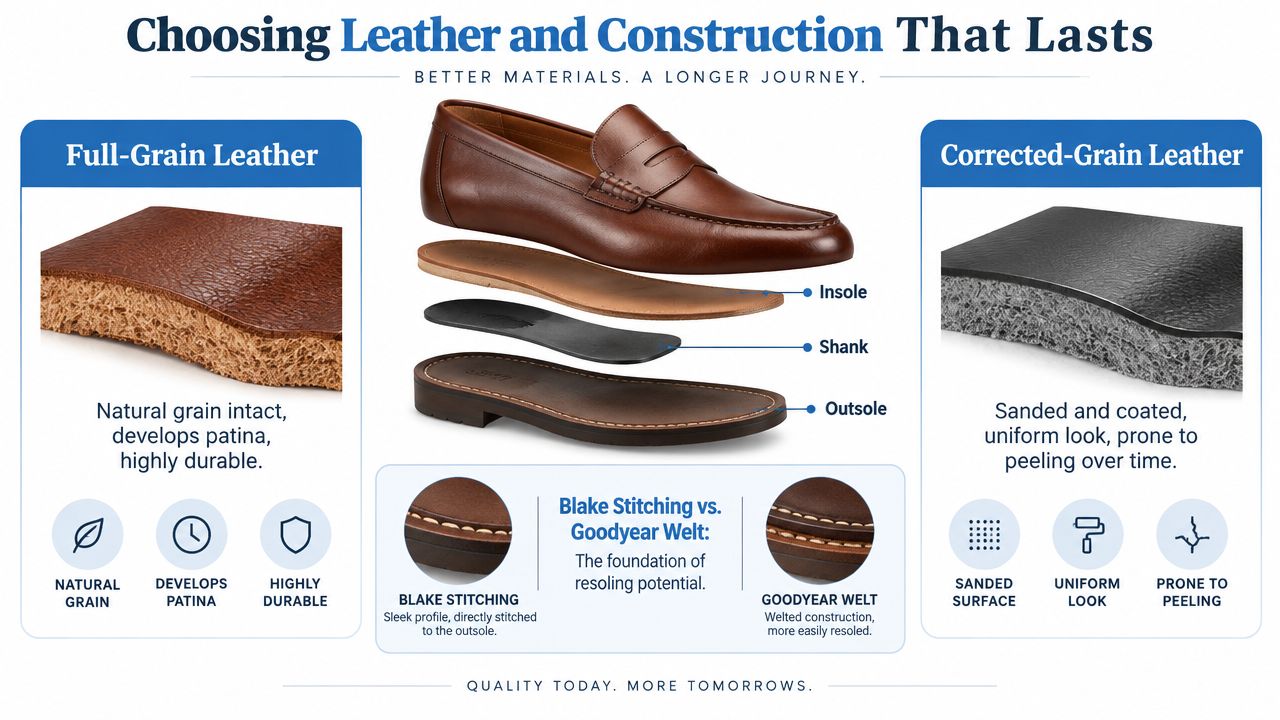
Full-grain leather keeps the natural grain intact. It tends to crease with more character and can develop a softer patina rather than immediately revealing a plastic-looking coating when marked. Corrected-grain leather has a more uniform surface because the hide is sanded and coated, but once that coating breaks, repairs can look conspicuous and peeling becomes a concern. For a detailed discussion of leather grading and production considerations, see this leather grades and sourcing review.
Match the build to the silhouette
Blake stitching is usually the sensible choice for a refined loafer. It keeps the sole edge relatively sleek and supports resoling when the rest of the shoe remains sound. Goodyear welt construction also supports resoling and can extend service life by up to about three re-solings when the upper remains intact, according to the classic leather loafer sourcing guide.
That doesn't mean Goodyear welting is automatically superior here. On a slim white loafer, a heavy welt can make the shoe look too substantial, especially with sharp trousers. I'd choose it for a sturdy, country-influenced model, not as a reflexive premium upgrade.
Cemented construction feels light and can produce a clean profile, but it generally offers a weaker repair path. Look for a leather lining rather than a flimsy synthetic interior, a structured toe box, a firm heel counter, and neatly painted edges. White leather magnifies sloppy finishing, so rough edge paint and uneven stitching will stay visible.
Getting the Fit Right From Heel to Toe
Fit is where most slip-on purchases fail. Laces can disguise volume problems by pulling the upper over the foot. Loafers have no such adjustment, so the heel, instep, and toe shape must work together from the first try-on.
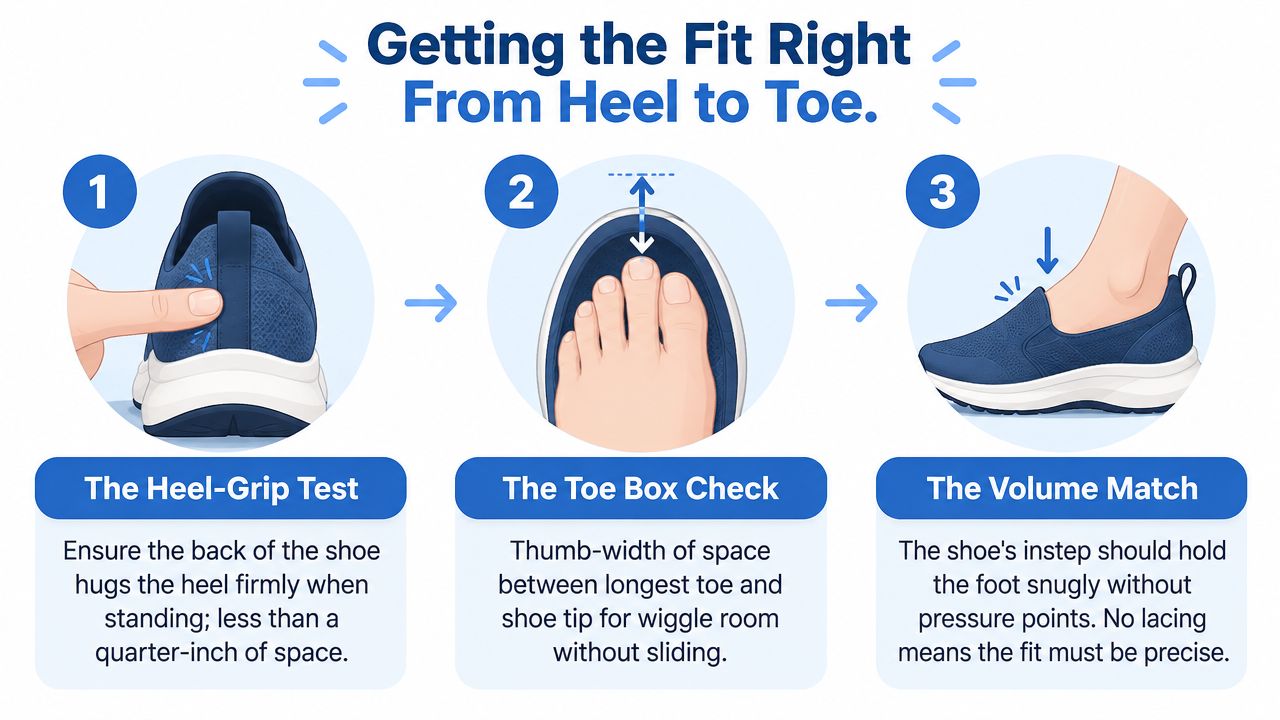
Begin with the heel. The counter should cup the back of your foot without digging into the Achilles area. Walk at a normal pace, including a turn, and watch whether the shoe stays attached as your foot leaves the ground. A small amount of initial movement can settle as the upper conforms, but persistent slipping usually means the last is wrong, not that you need a larger size.
Check volume before length
The instep is the critical area. Too shallow, and the vamp presses across the metatarsal. Too deep, and your foot slides forward, forcing the toes against the front and creating premature creasing. Don't accept sharp pressure just because the shoes look excellent from above.
Toe shape matters just as much. An almond last suits a medium, tapered foot and gives a dressier impression. A round last offers more forgiving forefoot volume. A chisel last creates a sharper visual line, but it can punish a broad foot if the underlying dimensions aren't generous enough.
A common mistake is sizing up to stop heel slip. That creates excess length, more forward movement, and a larger flex point across the white leather. Try a different last or width before changing length.
Practical fit test: Your foot should feel held across the instep, with room for the toes to move without sliding toward the toe box.
Off-the-rack sizing works when your heel, instep, and forefoot correspond closely to the manufacturer's last. European half-sizes can solve modest length or volume differences. Made-to-order becomes more sensible when one foot differs noticeably from the other, the heel is narrow, the forefoot is broad, or standard loafers repeatedly slip despite correct length.
Bespoke shoemaking uses measurements to create a custom last or wooden form, followed by a fitting pair that lets the client test proportions before final production. That process directly reduces sizing risk, as explained by Francis Waplinger's bespoke shoemaking practice. For hard-to-fit feet, customization isn't indulgence. It's often the cleanest way to make a laced-free shoe stay in place.
Styling White Loafers From Casual to Semi-Formal
White loafers work best when the clothing acknowledges their visual brightness. Pairing them with equally stark, formal pieces can make the outfit look staged. Pairing them with relaxed fabrics gives the shoes room to feel intentional rather than precious.
For casual wear, start with lightly washed or cropped denim, stone chinos, an untucked linen shirt, or an unstructured cotton blazer. The contrast between pale leather and softened fabric is the point. A penny loafer usually sits at the casual end because its apron and strap read familiar and understated. A horsebit model carries more visual weight, while dense apron stitching can push the shoe toward a richer, more dressed expression.
Semi-formal styling needs restraint. White loafers can replace brown calf with a navy or light-grey linen suit, a soft-collar shirt, and no tie. A knit tie can work when the loafer has enough structure and the suit isn't aggressively formal. Black formal trousers, heavy tweed, and socks that interrupt the clean line usually ask the shoe to do work it can't comfortably do.
| Outfit | Loafer Type | Formality Level |
|---|---|---|
| Cropped denim and linen shirt | White penny loafer | Relaxed |
| Stone chinos and cotton blazer | Apron-stitch loafer | Smart casual |
| Navy linen suit and soft-collar shirt | Sleek penny or horsebit loafer | Semi-formal |
| Light-grey tailoring and knit tie | Structured horsebit loafer | Upper semi-formal |
The rule I use is simple: match formality through hardware and stitching density before matching it through the outfit. Minimal hardware and a clean penny strap keep the shoe versatile. Metal hardware, sharper toe shaping, and a more substantial sole make the pair read later into the evening.
For more combinations built around the category, this guide to stylish men's loafers is a useful reference. The white version still needs editing. Don't copy every loafer outfit just because the color is available.
Why White Loafers Are Not Just a Summer Shoe
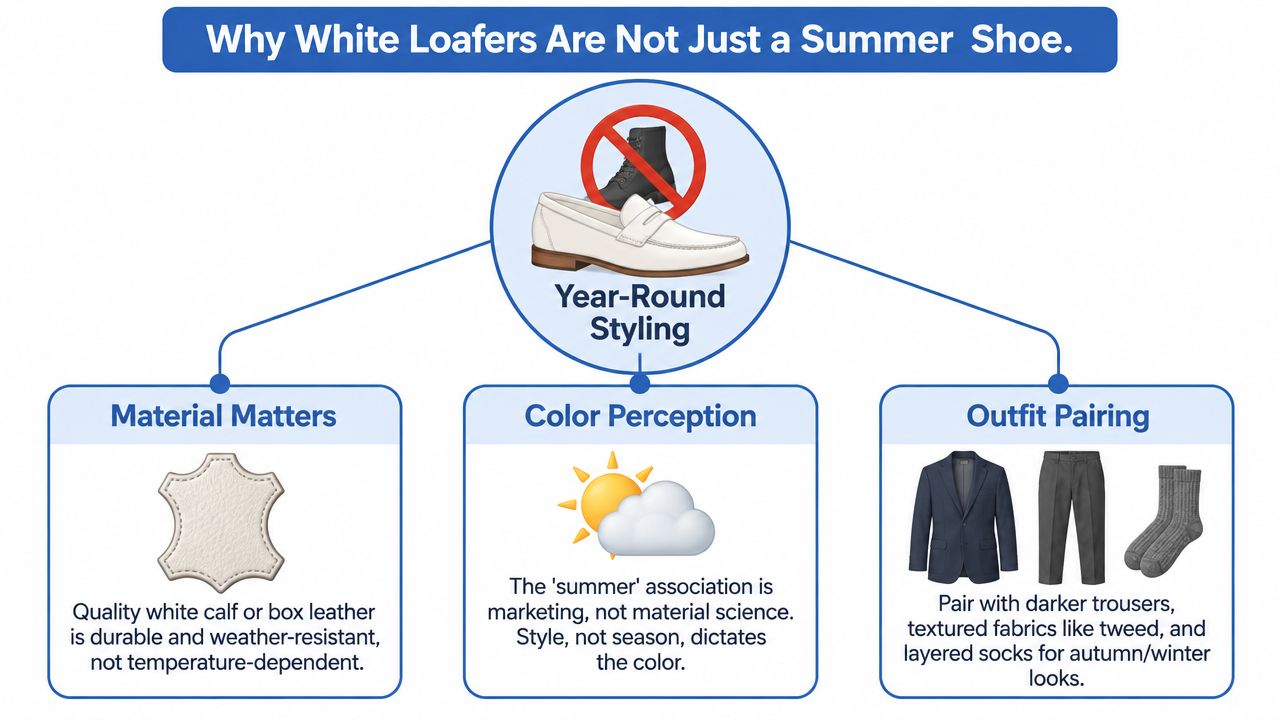
White leather is associated with summer because retailers and stylists present it that way. The leather itself doesn't know the season. A well-finished calf or box leather upper can work in autumn, mild winter, and spring if the surrounding fabrics and colors provide enough weight.
Try raw indigo denim with an oatmeal roll-neck and camel topcoat in autumn. The dark denim grounds the shoe, while the warm neutrals prevent the contrast from looking clinical. For winter, flannel trousers, a charcoal knit, and a dark overcoat let the white loafer become the light point in an otherwise muted palette.
Let fabric carry the season
An indoor spring outfit can use wool-silk blend trousers with a lightweight knit or soft jacket. The shoe remains bright, but the outfit no longer depends on linen or bare ankles to signal warm weather. That is the more mature approach. Seasonal dressing comes from texture, layering, and color depth, not from automatically shelving a white shoe after summer.
The maintenance argument is real. Salt and slush show quickly, and wet streets can stain pale leather if you ignore them. A wipe routine and a pale-leather protector reduce exposure, but they don't make white loafers weatherproof. If your daily commute involves heavy precipitation, keep a darker pair available for punishing days.
“Summer shoe” is often a styling shortcut, not a construction fact.
The strongest year-round combinations use one of three controls: darker trousers, textured fabrics, or layered outerwear. White loafers with raw denim and a topcoat look deliberate. White loafers with lightweight shorts and a formal shirt look seasonal. Both choices may be valid, but they communicate different levels of effort.
Don't force the shoe into every winter outfit. Heavy workwear, rugged outdoor clothing, and muddy conditions remain poor partners. The point is not to wear white constantly. It's to stop treating the color as disposable once the calendar changes.
Caring for White Leather So It Stays Crisp
White loafers rarely fail because white leather is weak. They fail because owners wait until grime has embedded itself, then attack the finish with an aggressive household product. Use a light routine consistently instead.
Build the routine around prevention
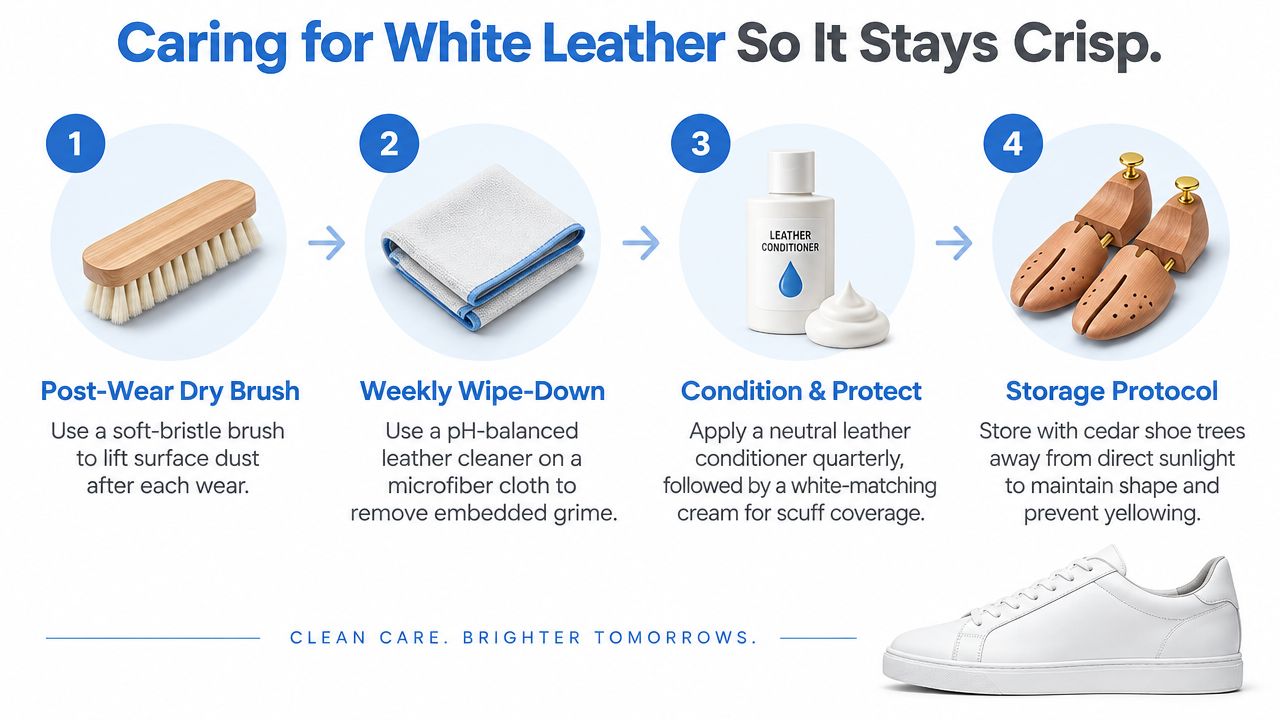
- Brush after wear. Use a soft-bristle brush to lift dust from the vamp, welt, and seam channels before it gets worked into the surface.
- Wipe gently. Use a microfiber cloth with a pH-balanced leather cleaner for embedded grime. Baby wipes, kitchen sprays, and general-purpose cleaners can strip or disturb the finish.
- Condition sparingly. Apply a thin layer of colorless or white-specific balm when the leather begins to feel dry, then buff it clean. Too much product can darken the surface or leave a greasy film that attracts dirt.
- Treat scuffs early. Use a matching cream or leather recoloring balm, but test it on the inner tongue first. White products vary in undertone, and a mismatched repair can be more visible than the original mark.
- Protect the upper. A hydrophobic spray rated for pale leather adds a barrier against routine moisture. Apply it according to the product instructions and renew the protection when it stops beading.
- Store correctly. Cedar shoe trees absorb moisture and support the vamp while the leather rests. Keep the loafers away from direct sunlight, and rotate pairs so each shoe has time to dry between wears.
For broader product-information and merchandising context, a fashion line sheet guide can help explain how footwear details are organized for buyers and teams. For the actual owner, the essential discipline is simpler: brush, wipe, condition, protect, and store.
A detailed shoe care guide from Alexander Noel can serve as a useful reference for maintaining leather footwear. The most important habit is immediate attention. A small mark handled early is a maintenance task. The same mark after repeated wear can become a restoration problem.
Making the Buying Decision With Confidence
Buy the lifestyle first, then the loafer. Ask how often you wear slip-ons, whether your wardrobe is structured or relaxed, and what your actual climate demands. A white pair for occasional dinners has a different job from a daily office loafer, and neither should be judged by the same standard.
The market context supports buying leather when you want longevity, but material alone won't save a bad fit. Use the heel, instep, and toe checks from earlier, then examine the construction. If the shoe almost works but needs constant heel gripping, it's not a bargain. It's an expensive object you'll avoid wearing.
Use this purchase checklist
- Leather grade: Look for full-grain or top-grain bovine or calf leather, with enough substance to hold the upper's shape.
- Construction method: Prefer Blake stitch or another repairable build when long-term use matters. Treat cemented construction as a deliberate trade-off, not a hidden advantage.
- Last shape: Match almond, round, or chisel shaping to your actual forefoot, not to a photograph.
- Hardware and stitching: Choose details that match the occasions you plan to dress for. More hardware generally pushes the shoe toward evening and statement dressing.
- Care compatibility: Confirm that the finish can accept a pale-leather cleaner, conditioner, cream, and protector without changing its surface character.
- Returns and recrafting: Check the return policy before wearing the shoes outside, and ask whether the maker supports resoling or recrafting.
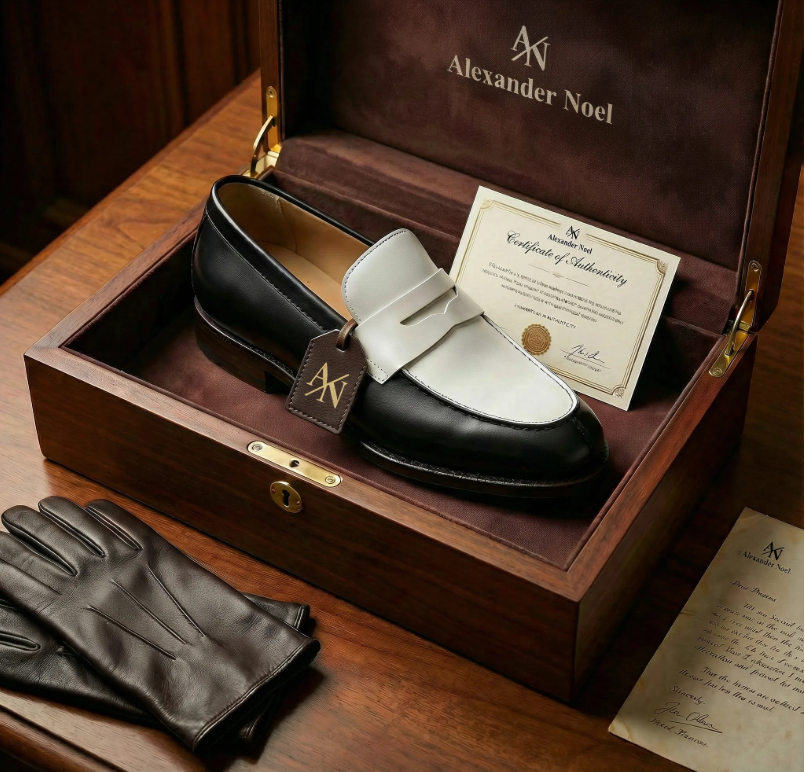
Alexander Noel's direct-to-consumer model combines a Design Lab, made-to-order customization, and partnerships with artisans in Italy, Portugal, Spain, and India. That approach is relevant when standard sizing or off-the-rack styling leaves too much compromise, especially for a white loafer that has nowhere to hide fit errors.
The right pair earns its shelf space across seasons, not weeks. If you'll maintain it, wear it with enough of your wardrobe, and choose a last that holds your foot without tricks, white leather loafers can become a disciplined investment. If you want zero maintenance, buy darker leather instead.
If you want a white loafer built around your measurements, materials, and preferred styling details, visit Alexander Noel and explore the Design Lab. Use the customization process to resolve the fit issues that standard slip-ons often leave behind, then choose a construction and finish you'll realistically care for.
Related post
19
Sep
19
Sep
19
Sep
19
Sep
19
Sep
