

RECENT POSTS

29.August.2026
Custom Women's Boots for Fall: Choosing Between Two Black Chelsea Silhouettes
0 Comments







Shoe Widths Explained (EEE and Beyond): Your Guide to a Perfect Fit
You know the feeling. You find a pair of shoes in the perfect length, but they crush the sides of your feet. It’s a frustration every person with wide feet knows well. This is what happens when we focus only on the number—the length—and completely ignore the letters that define a shoe's width.
This one simple mistake is the root of so many foot problems, from nagging blisters to bunions and chronic pain. Shoe width isn’t a minor detail; it's the critical, and often overlooked, dimension that decides whether a shoe actually fits.
Why Your Shoe Width Is the Key to All-Day Comfort
Think of buying a shoe like commissioning a bespoke suit. You wouldn't just look at the length of the jacket sleeves. You’d ensure it fits perfectly across your shoulders and chest, right? Your feet are no different. They have three dimensions, and forcing them into a shoe that only gets the length right is a recipe for disaster.
Understanding labels like EEE and beyond is what transforms shoe shopping from a painful guessing game into a precise, empowering process. It's the first step toward appreciating footwear not just as an accessory, but as an investment in your well-being.
The Problem with Standard Sizing
Here’s a hard truth: the footwear industry's "standard" width—usually a 'D' for men and a 'B' for women—is built for an "average" foot shape that a huge number of us just don't have. It’s a one-size-fits-most approach that leaves too many people struggling.
This causes some real problems:
- It creates serious pain. Squeezing a wide foot into a standard-width shoe creates constant pressure points, leading to discomfort and even long-term issues like hammertoes.
- It throws off your stability. When the sides of your foot spill over the sole, you lose the support you need, which can mess with your balance and the way you walk.
- It leads to bad compromises. Many people just go up a size in length to get more width. But that’s a bad trade-off, causing problems like heel slippage and throwing your arch support completely out of whack.
Finding the right width isn't a luxury—it's a requirement for foot health and lasting comfort. A proper fit allows your toes to splay naturally and supports your foot's unique structure from morning to night.
Once you know how to measure your feet and what designations like EE and EEE actually mean, you can finally break free from the limits of off-the-rack shoes. This guide will give you the know-how to find footwear that feels like it was made just for you.
Decoding the Letters on Your Shoe Box
That alphabet soup on the side of a shoe box—B, D, EE, EEE—can feel like a secret code. But once you crack it, it's as simple as reading a shirt size. Think of it this way: just as a shirt comes in S, M, or L, shoes have a scale for width. Those letters are your map to a perfect fit.
For most US brands, the system is progressive and easy to follow. It kicks off with narrower widths like A or B and moves up to the industry standard, which is a D width for men and a B for women. Anything beyond that is where you get into the world of wide and extra-wide fits.
The Progressive Scale of Width
Each step up the letter scale means a real, tangible increase in space across the ball of your foot—its widest point. This isn't just a random label; it's a specific measurement that makes a world of difference in how a shoe feels.
As a general rule, each successive letter in the width scale adds about a quarter-inch of extra room. That small increment can be the deciding factor between a day of pinching and one of pure comfort.
This structured progression is what makes the system work so well once you know how to read it. It gives you a clear path from a standard fit to one that truly accommodates your foot's unique shape.
This diagram breaks down how a truly comfortable shoe fit is built on getting both the length and the width just right.
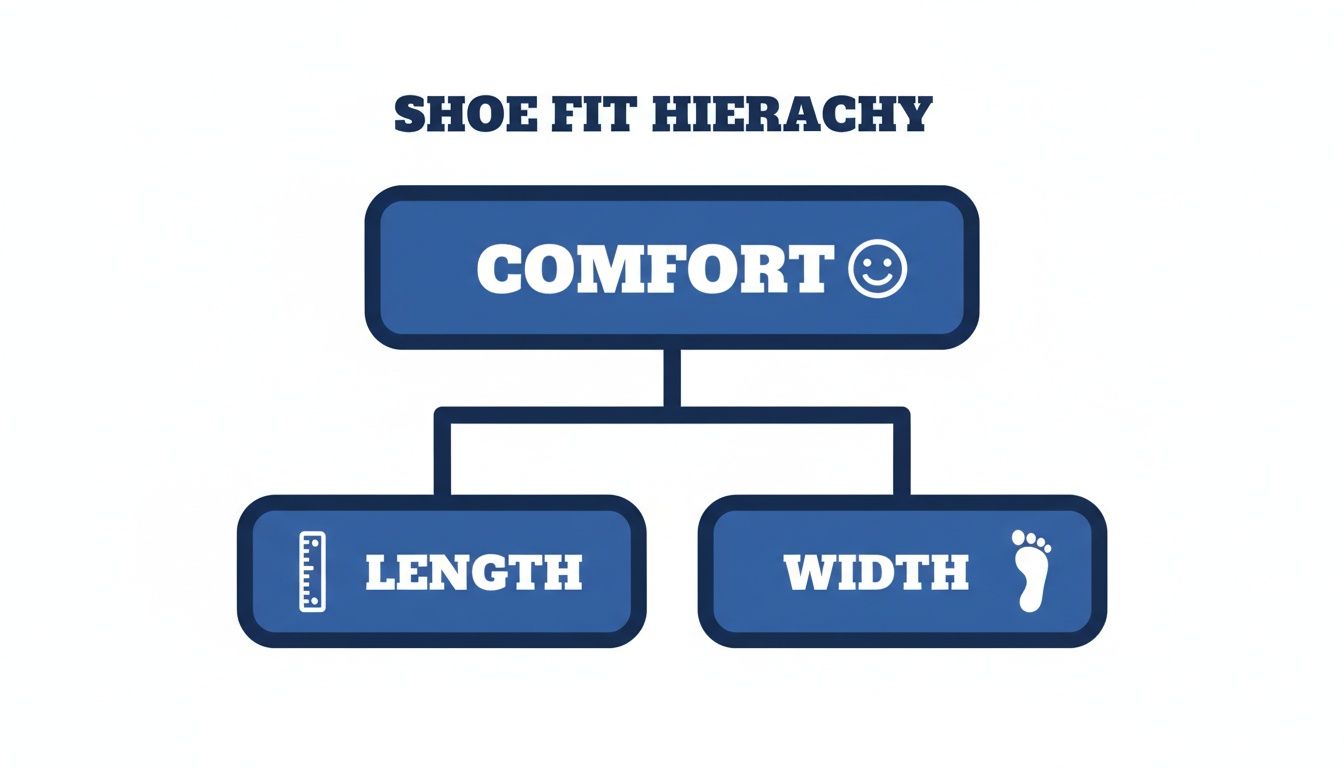
As you can see, comfort is the ultimate prize, and it's supported by two equal pillars: getting the length right, and just as critically, nailing the proper width.
Men's vs. Women's US Shoe Width Designations
One of the trickiest parts of navigating shoe widths is that the letters can mean different things for men's and women's sizing. A B width, for instance, is considered "Medium" or "Standard" for women but "Narrow" for men.
This chart clears up the confusion, showing the common letter designations side-by-side.
| Width Letter | Men's Width Name | Women's Width Name |
|---|---|---|
| AA | Narrow | Super Slim (SS) or Extra Narrow (XN) |
| A | Narrow | Slim (S) or Narrow (N) |
| B | Narrow | Medium (M) or Standard |
| C | Narrow | Wide (W) |
| D | Medium (M) or Standard | Wide (W) |
| E | Wide (W) | Extra Wide (XW) |
| EE | Wide (W) or Extra Wide (XW) | Extra Wide (XW) |
| EEE | Extra Wide (XW) | Extra Wide (XW) |
Understanding this distinction is key, especially when shopping across different departments or for unisex styles. Always be sure you're looking at the chart for the correct gender.
Moving into Extra-Wide Territory with EEE and Beyond
When you start seeing multiple letters stacked together, like EE or EEE, you've entered extra-wide territory. These are shoes engineered for feet that need a lot more room than a standard D width can provide. For many people, finding these sizes is a game-changer.
- E Width: This is your first step into the "wide" category for men's shoes.
- EE Width: Often called "double E," this offers another significant jump in roominess.
- EEE Width: Known as "triple E," this size provides substantial volume for even the widest feet.
For anyone who has spent years cramming their feet into standard-sized shoes, discovering a triple-wide EEE option can feel like a revelation. At Alexander Noel, we've blended modern innovation with traditional craftsmanship to make these essential sizes a core part of our Design Lab. We believe exceptional fit and timeless style should be accessible to everyone, no matter their width.
Your Footprint in a Global Context
Have you ever found the perfect shoe online, only to have it arrive and feel completely wrong, despite being your usual size? The culprit often isn't just the brand, but the simple fact that a "standard" fit is anything but standard across the world. The truth is, foot anatomy isn't universal—it varies dramatically from one region to another.
This means a shoe designed around a typical European foot might feel far too narrow for someone in Asia, or vice versa. The one-size-fits-all model of mass production has long ignored this fundamental diversity, leading to endless frustration for countless customers. It's a key reason why the demand for wider fits like EEE and beyond is growing so rapidly.
Why Geography Matters for Your Feet
The idea of regional foot differences isn't just a feeling; it's backed by extensive data. For instance, a landmark study analyzed a staggering 1.2 million foot scans from North America, Europe, and Asia, and the results were eye-opening.
The research found that, on average, the feet of female customers in Asia were considerably wider than those in North America and Europe. This data explains perfectly why a standard "B" width might be comfortable for one person but painfully restrictive for another. You can explore the full findings of this insightful research on foot shape diversity.
This global variation highlights a major flaw in traditional sizing. In the US system, each width letter adds about 4.76 mm of space. Yet, the same study showed that for some populations, a single "standard" width designation only fits about 40% of people correctly.
To properly fit 90% of customers in these groups, a brand would need to offer at least three different width options. This is precisely why a simple "standard" width fails so many people.
A Modern Approach to a Global Problem
Understanding these global nuances is what drives modern, direct-to-consumer brands like Alexander Noel. Instead of relying on a single regional prototype, we lean on our global artisan partnerships to cater to a worldwide audience. This approach allows us to gather diverse fit feedback and create footwear that acknowledges anatomical reality.
Our model is built on personalization, moving beyond the limitations of off-the-rack sizing. By connecting you directly with our skilled craftspeople in Italy, Spain, and beyond, we can address the need for a truly personal fit. This global perspective is also crucial for navigating the subtle differences between sizing systems—a topic you can dive deeper into with our helpful US shoe size conversion guide.
This commitment ensures that no matter where you are in the world, you can design a shoe that feels like it was made just for your footprint.
How to Measure Your Foot Width at Home
Forget the guesswork. Taking charge of your shoe shopping experience starts with one simple, crucial step: measuring your own feet. Guessing is what leads to painful break-in periods and frustrating returns, but a quick measurement is all you need to start buying with real confidence.
The best part? You don’t need any specialized tools. Just a few things you already have lying around the house are enough to get the data you need for that perfect, comfortable fit. Whether you're buying off the rack or designing your own pair, this is where it all begins.
Your Step-by-Step Measurement Guide
Ready to find your true width? This whole process only takes a few minutes. For the most accurate results, try to do this later in the day, since feet naturally swell a bit as the day goes on.
- Get Set Up: Find a hard, flat floor and lay down a piece of paper. You'll also need a pencil or pen and a ruler or tape measure.
- Trace Your Foot: Put on a pair of socks you'd typically wear with your shoes, and plant one foot firmly on the paper. Lean your weight forward slightly and carefully trace the entire outline of your foot. It's really important to keep the pencil perfectly vertical—not angled in or out—to get an accurate trace.
- Find the Widest Points: Take a look at the drawing. You'll see the widest part of your foot is usually the ball, right behind your toes. Use your ruler to draw a straight line connecting these two points.
- Measure the Width: Now, just measure the length of that line. You can use inches or millimeters, whichever you prefer. That number is your foot width.
- Do It Again: Almost everyone has one foot that's slightly wider than the other. Make sure you repeat the whole process for your other foot and use the larger of the two measurements.
This simple outline gives you a crystal-clear picture of your foot's widest point.
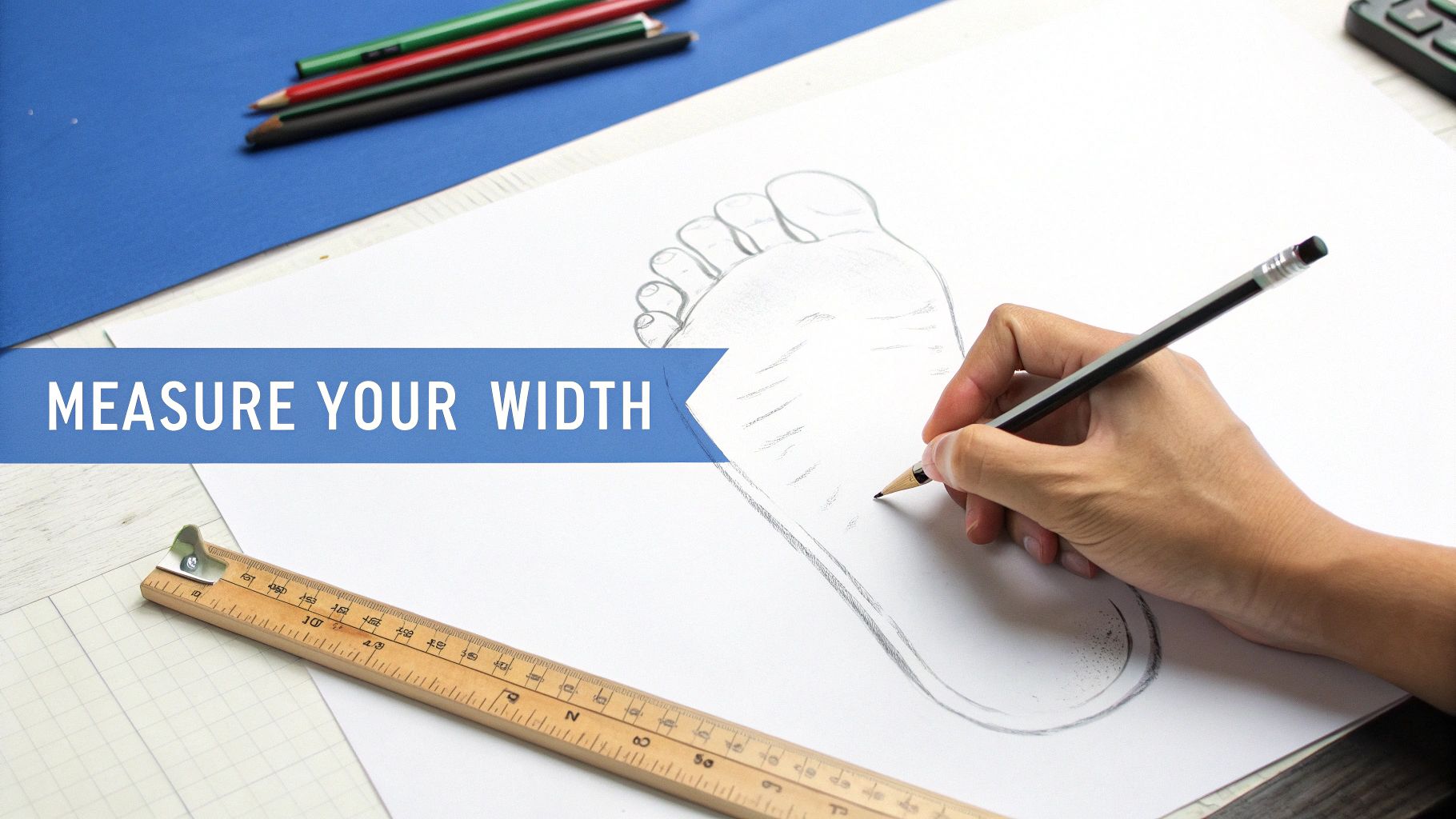
The key is to measure that straight line across the broadest part of the outline you just drew.
Putting Your Numbers to Use
Once you have your width in hand, you'll compare it against your shoe length to find your proper width letter, whether that's a D, EE, or EEE. While you’re at it, you can get the full picture by learning how to measure shoe size at home, too.
Pro Tip: Jot down your length and width measurements in the notes app on your phone. Having that info ready to go makes online shopping a breeze and takes all the doubt out of trying a new brand.
Remember, sizing isn't always identical from one brand to the next. It’s always a good idea to check your numbers against a specific manufacturer's chart. For instance, looking at a resource like Pediped's sizing guide shows you just how differently brands can interpret these measurements. That little bit of extra diligence is what ensures you make the best possible choice for your feet.
Common Signs You Need a Wider Shoe
Your feet are constantly sending you signals about the shoes you wear—it’s time to learn how to read them. So many of us put up with discomfort, writing it off as the normal pain of "breaking in" a new pair. But here's the truth: persistent pain and certain visual cues are clear signs your shoes are just too narrow.
Ignoring these warnings isn't just about dealing with temporary aches; it can spiral into long-term foot health problems. Spotting the symptoms early is your first step toward finding the genuine, lasting comfort that only a perfect fit can provide.
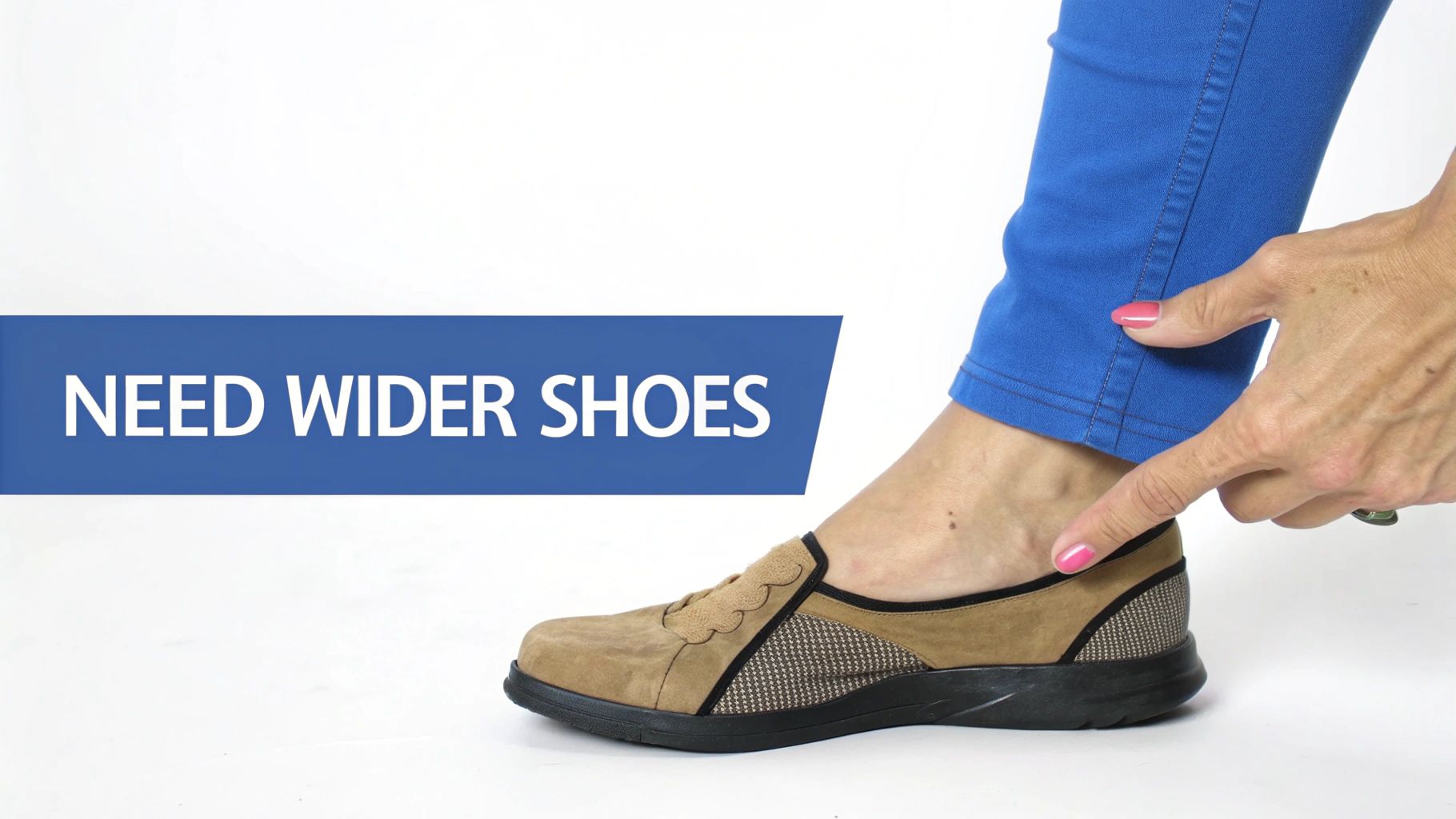
Reading the Telltale Physical Signs
The most obvious clues come from how your shoes actually look and feel when they're on your feet. If any of these sound familiar, it’s a huge red flag that you need to explore wider options, like shoes in EEE and beyond.
- Sides Are Bulging: Does your foot look like it’s spilling over the edges of the insole? This "foot muffin top" is a classic giveaway that the shoe's base is too narrow to properly support your foot's natural shape.
- Cramped or Overlapping Toes: Your toes should have enough room to lie flat and spread out naturally. If they’re getting squeezed together or even starting to overlap, the toe box is far too restrictive.
- Pressure, Numbness, or Blisters: Constant pressure on the sides of your feet—especially around the little toe or the ball of your foot—can cause pain, numbness, and those dreaded recurring blisters. This is your foot screaming for more space.
Your shoes should conform to the shape of your feet, not the other way around. Persistent discomfort is never a sign of a good fit—it's a warning that something is wrong.
The Myth of Sizing Up for Width
A common but deeply flawed strategy for dealing with a narrow fit is to just buy a longer shoe. While this might give you a tiny bit of extra width, it creates a whole new set of problems. It all comes down to this: shoe length and width are engineered to work together, and messing with one throws off the entire architecture of the shoe.
Going up a size creates a mismatch where the shoe's key support features no longer align with your foot's anatomy. This leads to issues like:
- Heel Slippage: Too much length means your heel won't be locked in place, causing friction, instability, and blisters with every step.
- Poor Arch Alignment: The built-in arch support will be in the wrong spot, failing to do its job and potentially causing painful strain.
- Tripping Hazards: That extra, empty space at the toe just increases your risk of catching your shoe and taking a tumble.
The real solution isn't to go longer, but to go wider. Choosing the right width designation ensures the entire shoe is scaled correctly for a perfect fit from heel to toe.
The Modern Solution for a Truly Personal Fit
Recognizing the signs of a poor fit is one thing, but what do you do about it? For too long, the choice was a frustrating one: either settle for a mass-produced shoe that almost fits, or dive into the expensive, time-consuming world of traditional bespoke shoemaking.
Today, there’s a better way—an approach that marries timeless craftsmanship with modern, accessible technology.
This is exactly the philosophy that drives us at Alexander Noel. Our direct-to-consumer model cuts out the middleman, connecting you straight to skilled artisans from around the world. We see it as more than just selling shoes; it's an educational journey where we empower you to solve your own fit problems, especially if you're dealing with widths like EEE and beyond.
The Power of the Design Lab
Imagine being the architect of your own shoes—crafting a pair built not for some generic "average" foot, but specifically and exclusively for yours. That’s the experience our Design Lab was created to deliver. It hands the reins over to you, letting you dictate not just the style and materials, but the precise width you need for true, all-day comfort.
This is the ultimate answer to the universal problem of finding a shoe that actually fits. Instead of an endless hunt for the right box, you get to build the shoe from the ground up.
- Beyond Standard Sizing: Forget the limits of D, EE, or even EEE. We empower you to create footwear tailored to your foot's unique measurements.
- Artisan Quality: Every pair is meticulously handcrafted by master shoemakers, blending old-world techniques with an eye for modern precision.
- Direct Connection: Our model ensures you get a premium, made-to-order product without the layers of retail markup.
When you combine your personal measurements with our expert craftsmanship, the result is a shoe that feels like a natural extension of your foot. It’s a level of comfort that mass-produced footwear simply cannot replicate.
Thankfully, the wider market is starting to catch on, with more specialized options becoming available, like the best CrossFit and cross-training shoes for wide feet, proving that a perfect fit is crucial everywhere, from the boardroom to the gym.
Our mission is to make this personalized fit an accessible reality for everyone. To see how our process can finally solve your fit issues, take a look at our guide on creating custom-made shoes for wide feet. It’s where your personal style meets perfect, individualized comfort.
Common Questions About Shoe Width
Diving into the world of shoe widths can bring up a lot of questions. But getting the right answers is the last step before you can shop with total confidence. Let’s tackle some of the most common things people ask when trying to find that perfect fit.
Once you have this knowledge, you can finally move beyond the limitations of "standard" sizes and find real, lasting comfort. A shoe that fits properly is the foundation of a great day, and understanding widths like EEE is how you build it.
Is a EEE Width the Same for Every Brand?
Unfortunately, it’s not. A lot like clothing sizes, shoe width can definitely vary from one maker to the next. The reason is that every brand uses its own "last"—the foot-shaped mold a shoe is built around—which can create small but noticeable differences in the final fit.
This is exactly why taking your own measurements is so important. And for a truly guaranteed fit that takes all the guesswork out of the equation, a personalization service like our Design Lab is created to solve this exact problem by building the shoe to your unique dimensions.
Can My Foot Width Change Over Time?
Absolutely. It’s actually very common for feet to get wider as we age. Over time, our tendons and ligaments naturally lose some elasticity, which can cause the arch to flatten a bit and the foot to spread out. Big life events like pregnancy or significant changes in weight can also alter your foot size and width.
It’s a great idea to re-measure your feet every few years. This makes sure you're always wearing the most supportive and comfortable size for your body's natural changes.
This isn't just about personal comfort; it's a huge market trend. The demand for wide-fit footwear, including EEE and beyond, is booming. It's a $6.8 billion niche in 2024 that’s expected to nearly double by 2033. This growth is a clear sign that personalized fit matters more than ever in the massive global footwear market. You can read more about these footwear market trends if you're interested.
Should I Just Buy a Longer Shoe to Get More Width?
This is probably one of the most common mistakes people make, but it’s a strategy that just doesn't work. When you size up in length just to get more room on the sides, you throw off the entire architecture of the shoe. This almost always leads to problems like:
- Heel slippage, which causes painful friction and blisters.
- Improper arch support because the arch of the shoe is no longer aligned with the arch of your foot.
- Tripping hazards thanks to that extra, empty space at the toe.
The right move is always to stick with your correct length and find a shoe specifically made in a wider size, like EE or EEE. This ensures the entire shoe is scaled properly for your foot, giving you the support and fit you actually need.
At Alexander Noel, we don't think you should ever have to choose between a great fit and great style. Our Design Lab gives you the power to create handcrafted, bespoke shoes made to your exact measurements, delivering a perfect fit and incredible comfort every single time.
Related post
19
Sep
19
Sep
19
Sep
19
Sep
19
Sep
