


RECENT POSTS

29.August.2026
Custom Women's Boots for Fall: Choosing Between Two Black Chelsea Silhouettes
0 Comments












Shoe Size In Inches A Guide to Finding Your Perfect Fit
Knowing your shoe size in inches is the single most effective way to guarantee a perfect fit. Why? Because a standard size 9 can vary dramatically between brands. This precise measurement becomes your personal, universal standard, cutting through the confusing world of international sizing charts and connecting you to a level of comfort only possible with a truly personalized fit.
Why Your Shoe Size In Inches Is The Key To Comfort
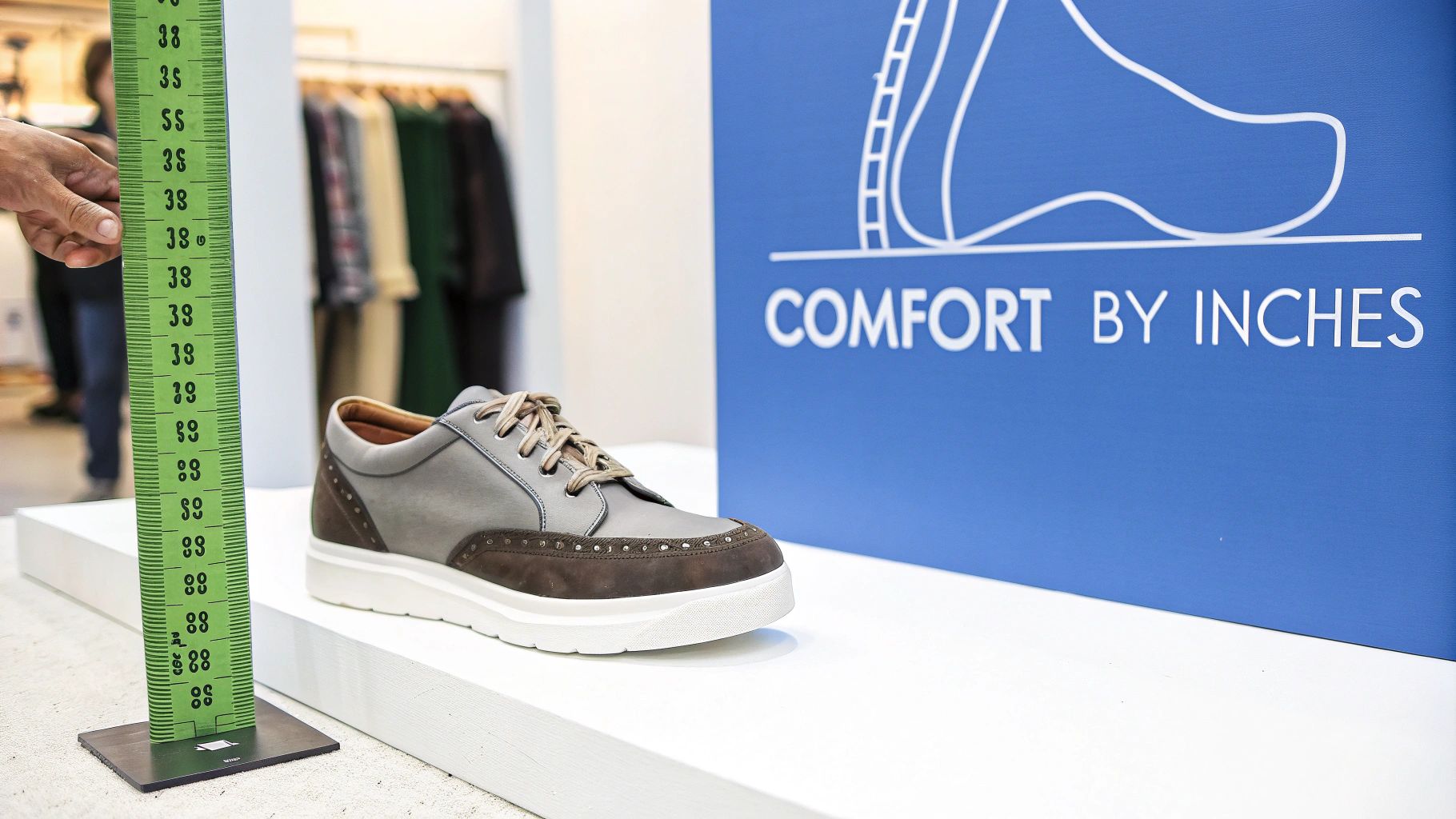
Let's be honest—choosing a shoe size often feels like a shot in the dark. You might be a size 10 in your favorite sneakers but find you need a 9.5 in a pair of dress shoes from another brand.
This inconsistency is a direct result of mass-produced footwear. Shoes are built for an imaginary "average" foot that doesn't truly exist. This one-size-fits-all mentality ignores the unique contours of your feet—your arch height, width, and even the subtle differences between your left and right foot. The result is almost always a compromise on comfort, from pinched toes to slipping heels.
The Problem With Standard Sizing
The footwear industry's reliance on standardized sizing is a holdover from the early days of mass manufacturing. While efficient for production lines, it consistently fails the individual. Think about it: would you buy a suit from a tailor who only offered three generic sizes? Of course not. Yet, this is what we accept with our shoes—the very foundation of our daily comfort and mobility.
This is where knowing your shoe size in inches becomes a game-changer. An inch is an inch, no matter where you are in the world. It’s a precise, objective measurement that doesn't shift from one brand's interpretation to the next.
A shoe that is just 1/8 of an inch too small can cause significant discomfort and even lead to foot problems over time. Precision isn't just a detail; it's the very core of a proper fit.
Embracing a Philosophy of Precision
At Alexander Noel, we believe a perfect fit isn't a luxury—it's the standard. Our entire process is built around this core principle, from our partnerships with global artisans to our innovative direct-to-consumer model. We move beyond generic numbers to focus on the real-world dimensions that define your foot.
This precision-first mindset is what connects you to a pair of shoes that feel as if they were molded just for you. It ensures the final product, whether it’s a custom stiletto from our Design Lab or a pair of handcrafted boots, truly honors the unique shape of your feet by blending traditional craftsmanship with modern innovation.
Here’s why this educational approach to footwear truly matters:
- It Eliminates Guesswork. Your measurement in inches acts as a true north for sizing, giving you a reliable baseline for any shoe, anywhere.
- It Accounts for Uniqueness. This is the critical first step in creating footwear that respects your foot's specific length, width, and volume.
- It Unlocks True Comfort. A shoe built to your exact dimensions supports your foot's natural mechanics, preventing the pain and fatigue that come from a poor fit.
By shifting your focus from an arbitrary size number to a concrete measurement, you take back control of your comfort. This is the foundation of the Alexander Noel experience—where your measurements guide our artisans' hands to create a masterpiece just for you.
How To Measure Your Foot Length In Inches At Home
Getting a truly accurate measurement of your feet in inches is much easier than you might think. All you need are a few common household items and a few minutes to get the exact dimensions needed for a perfect fit. This educational step takes you from guessing your size to knowing it with confidence.
The best part? No special equipment is needed. This straightforward process is your starting point for building a custom pair in the Alexander Noel Design Lab, where every detail revolves around your unique measurements and personal style.
Gathering Your Tools And Setting The Stage
Before you start, let's get your supplies in order. Having everything on hand makes the whole process smoother and, more importantly, far more accurate.
- A blank piece of paper that’s bigger than your foot.
- A pen or pencil. You'll need to hold it as vertically as possible.
- A ruler or measuring tape with clear inch markings.
- A solid, flat surface—a hardwood or tile floor is perfect.
- The type of socks you plan on wearing with your new shoes.
Now, a quick word on timing. Your feet naturally swell as the day goes on, thanks to gravity and activity. If you measure first thing in the morning, you might get a number that’s a bit smaller than your foot's true size later in the day.
Pro Tip: For the most reliable measurement, measure your feet in the late afternoon or evening. This ensures you're measuring your foot at its largest point, which is absolutely critical for all-day comfort.
The Measurement Process Step By Step
Once you're all set, find a spot with a hard floor next to a wall. Avoid measuring on carpet or rugs, as the soft surface can throw off your tracing and give you an inaccurate result.
- Set Up the Paper: Lay the sheet of paper flat on the floor. Make sure one of the shorter edges is sitting flush against the wall.
- Position Your Foot: Step onto the paper wearing the socks you chose. Your heel should be pressed firmly but naturally against the wall. It’s important to stand normally and keep your weight evenly distributed—leaning too far forward or back can change your foot’s length.
- Trace Your Foot: Standing up straight, have a friend help you trace the outline of your foot. Make sure they keep the pen held perfectly perpendicular to the paper to get a clean, accurate line around your longest toe and your heel.
- Measure Both Feet: Don't forget to repeat the whole process for your other foot on a fresh sheet of paper. Most people have one foot that is slightly larger than the other, sometimes by as much as a half-size.
This quick tracing gives you a permanent, visual record of your foot’s unique shape. For a deeper dive, learning how to properly measure shoe size at home can offer even more detailed tips.
Finding Your True Measurement
Okay, you've got your tracings. Now it's time to turn those outlines into a precise number. Grab your ruler or measuring tape.
On each tracing, draw a straight line that touches the very back of the heel and another line that touches the very tip of your longest toe. The distance between these two parallel lines is your foot length in inches. Be sure to measure straight down the middle of the tracing, not at an angle.
Once you have an accurate measurement, you can even cross-reference it with a detailed insole size guide to ensure a perfect fit if you plan on using additional support.
Always, always use the measurement from your larger foot as your official size. This is a non-negotiable rule in the world of shoe fitting. Ordering based on your smaller foot is a recipe for uncomfortable shoes. With this precise number in hand, you’re officially ready to find footwear that’s designed to fit you, not the other way around.
Navigating Global Shoe Size Conversion Charts
Once you have your exact foot measurement in inches, you hold the key to finding a great fit anywhere in the world. But this is where confusion often begins. How can a men's US size 10 be completely different from a UK size 10 or an EU size 43?
The truth is, there’s no single, universal standard for shoe sizing. Each system evolved independently, leading to the messy and often contradictory charts we struggle with today. That’s precisely why knowing your measurement in inches is so crucial—it's the one true constant you can rely on.
Why Sizing Systems Are So Different
A little history makes the chaos a bit clearer. Different regions developed their own units of measurement and starting points for their scales, creating systems that don't line up neatly.
-
United States (US): The US system is based on an old English unit called a barleycorn, which is roughly 1/3 of an inch. The scale starts at a set point, and each full size goes up by one barleycorn.
-
United Kingdom (UK): While the UK also uses the barleycorn, its sizing scale starts from a different zero point. This is why UK sizes are typically smaller numbers than their US equivalents.
-
Europe (EU): The European system uses a completely different unit called the Paris Point, which equals 2/3 of a centimeter. This unique unit is why EU sizes jump up so quickly and don't convert cleanly to US or UK sizes.
This infographic breaks down the essentials for getting an accurate measurement, which is your first step before tackling any conversion chart.
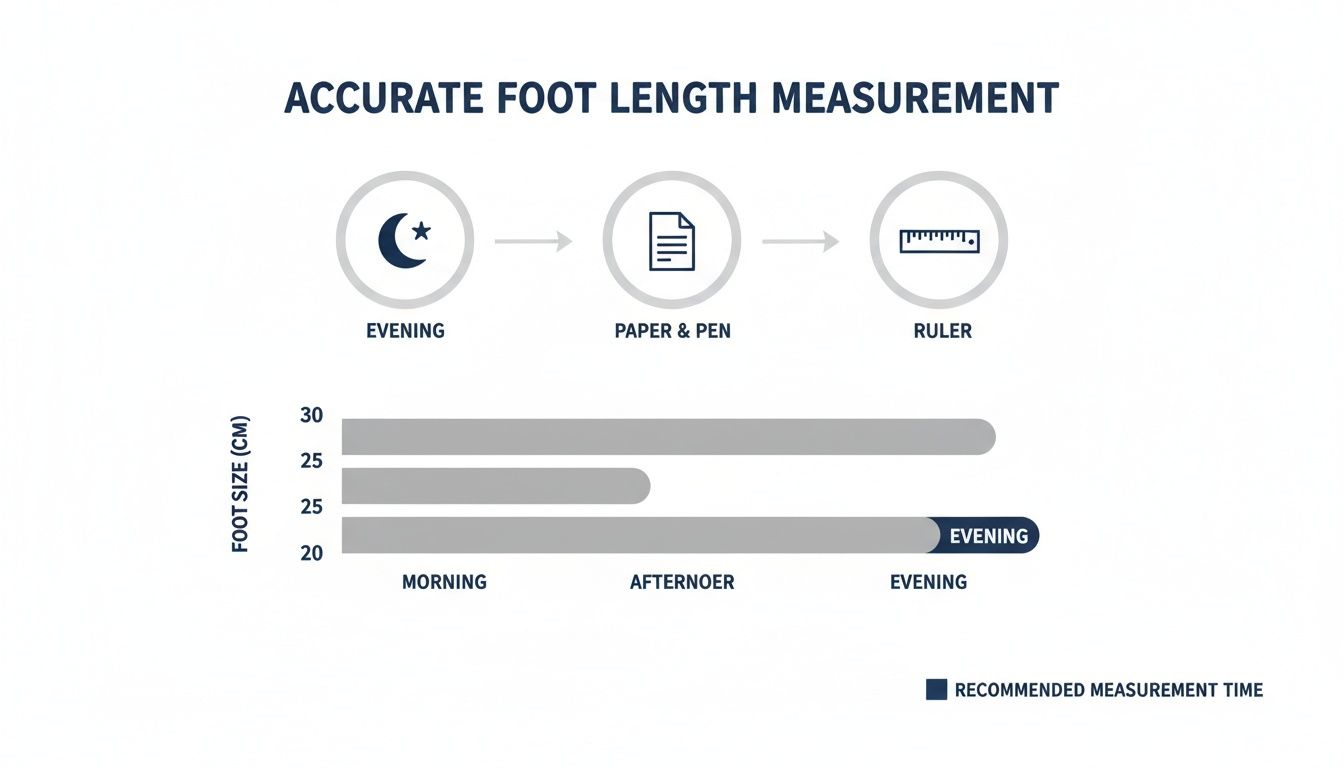
As you can see, consistency is everything. Measuring at the right time with the right technique gives you a number you can trust. Without that solid inch measurement, converting between these global systems is nothing more than a guess.
From Inches to International Sizes
So, how does your foot length in inches translate to all these different systems? It's a bit of a puzzle. A men's size 10 US shoe, for instance, fits a foot around 10.6 inches long. That same foot would need roughly a UK 9.5 or an EU 43.
For a deeper dive into how these systems compare side-by-side, our detailed international shoe size conversion guide is an excellent resource.
The table below gives you a solid starting point for converting your inch measurement into the most common sizing systems.
Men's & Women's Inches to Shoe Size Conversion Chart (US, UK, EU)
| Inches | Centimeters | US Women | US Men | UK Size | EU Size |
|---|---|---|---|---|---|
| 8.1875" | 20.8 | 4 | - | 2 | 35 |
| 8.5" | 21.6 | 5 | - | 3 | 35.5 |
| 8.75" | 22.2 | 6 | - | 4 | 36.5 |
| 9.0625" | 23 | 7 | - | 5 | 37.5 |
| 9.25" | 23.5 | 7.5 | - | 5.5 | 38 |
| 9.5" | 24.1 | 8.5 | 6.5 | 6 | 39 |
| 9.6875" | 24.6 | 9 | 7 | 6.5 | 40 |
| 9.875" | 25.1 | 9.5 | 7.5 | 7 | 40.5 |
| 10" | 25.4 | 10 | 8 | 7.5 | 41 |
| 10.1875" | 25.9 | 10.5 | 8.5 | 8 | 42 |
| 10.3125" | 26.2 | 11 | 9 | 8.5 | 42.5 |
| 10.5" | 26.7 | 11.5 | 9.5 | 9 | 43 |
| 10.6875" | 27.1 | 12 | 10 | 9.5 | 44 |
| 10.875" | 27.6 | 12.5 | 10.5 | 10 | 44.5 |
| 11.0625" | 28.1 | 13.5 | 11 | 10.5 | 45 |
| 11.25" | 28.6 | 14 | 12 | 11.5 | 46.5 |
| 11.5625" | 29.4 | 15 | 13 | 12.5 | 47.5 |
Remember, this chart is a guide. Every brand has its own nuances, which is where the real frustration comes from with off-the-shelf shoes.
The Alexander Noel Solution: The Power of Personalization
This is where a direct-to-consumer, artisan-led approach truly shines. When you buy mass-produced shoes, you’re stuck with their interpretation of these flawed sizing charts. You have to guess which generic size will fit your unique feet.
When you provide your measurements to Alexander Noel, you're not just giving us a number. You are handing our artisans in Italy and Spain the exact blueprint needed to craft a shoe that is uniquely yours—bypassing the confusing conversions entirely.
Our process is fundamentally different. We don't try to squeeze your foot into a generic size. We use your precise measurements in inches as the foundation for a custom last—the three-dimensional mold your shoe is built around.
This is the beauty of blending old-world craftsmanship with a modern, personal experience. Our artisans aren’t just grabbing a "size 10" off the shelf. They are meticulously shaping beautiful, premium leather around a form built specifically to your foot's length, width, and volume.
It’s a process that makes global conversion charts obsolete. It ensures the final product isn't just a shoe, but a perfect extension of you. In this world, your shoe size in inches is the only number that truly matters.
Looking Beyond Length To Foot Width And Volume
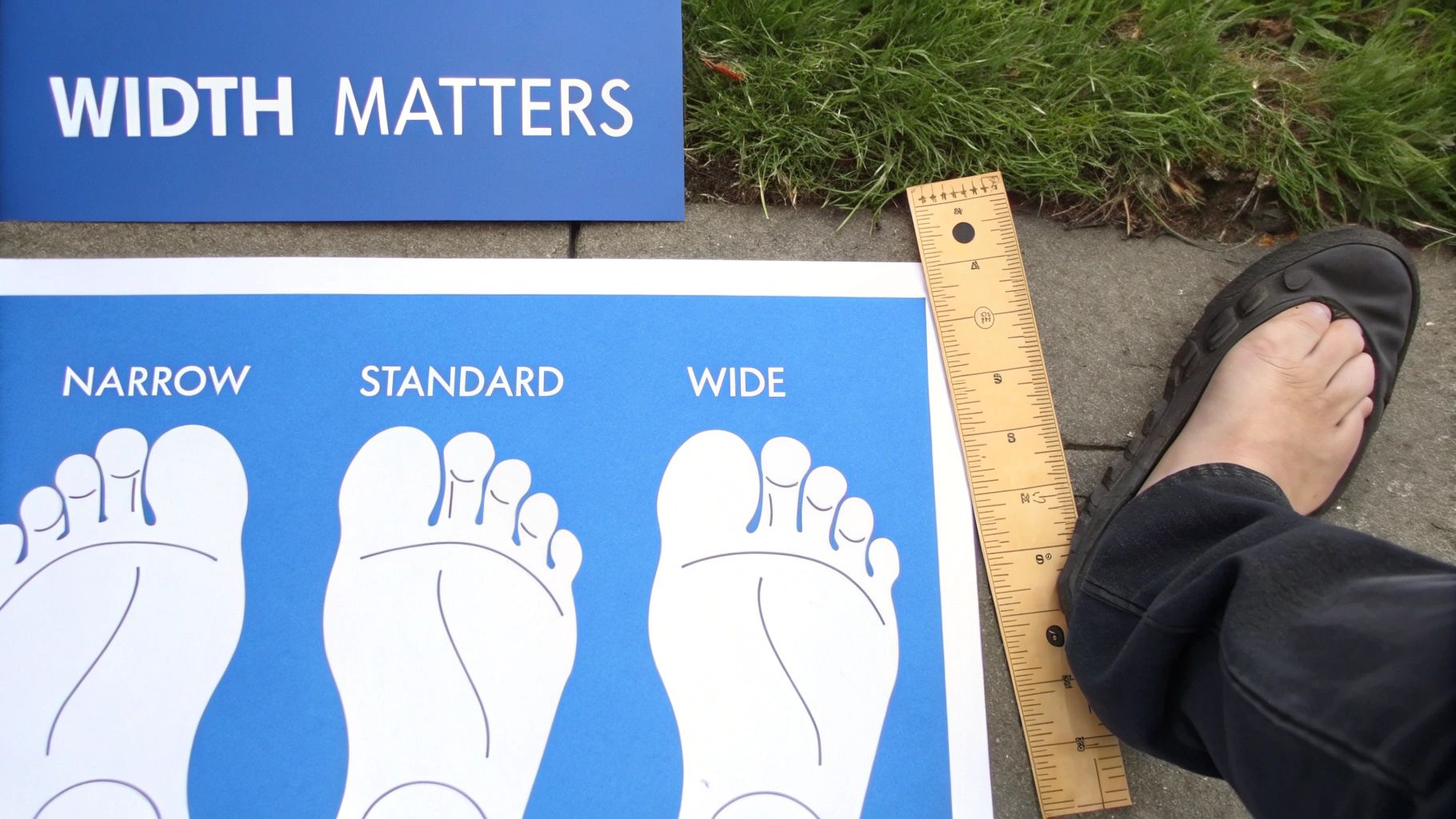
While your shoe size in inches gets you in the ballpark, it only tells part of the story. A truly comfortable fit is a three-dimensional equation, and two of the most critical—and often ignored—factors are foot width and volume. These variables explain why two people with the exact same foot length can feel completely different in the same pair of shoes.
Ever find a shoe that’s the perfect length, but it squeezes the sides of your feet? Or perhaps you've had the opposite problem: a shoe that fits from heel to toe but leaves your heel slipping or creates a frustrating gap along the sides. These are classic signs of a mismatch between the shoe's internal shape and your foot's specific width and volume.
Understanding Your Foot's True Shape
Most mass-produced shoes are built on standardized lasts—the molds that give footwear its shape. These are typically designed for a "standard" D width for men and a B width for women. If your foot falls outside this narrow average, finding off-the-shelf comfort can feel like a losing battle.
Recognizing your foot's unique dimensions is the key to that perfect fit. Here’s what to look out for:
- Wide Feet: If shoes constantly feel tight across the ball of your foot, or if you feel your foot spilling over the edges of the insole, you likely have wide feet.
- Narrow Feet: Do you always have to crank your laces down to feel secure? If you still experience internal foot movement, you probably have narrow feet.
- High Volume (High Instep): A tell-tale sign is a feeling of intense pressure across the top of your foot, even when the length and width seem okay.
- Low Volume (Low Instep): You find yourself pulling the laces so tight that the eyelets are practically touching, yet the shoe still feels loose.
A shoe's internal space, or volume, is just as important as its length. A low-volume shoe on a high-instep foot will create painful pressure points, while a high-volume shoe on a low-instep foot will never feel secure.
This is where the Alexander Noel promise of quality and fit truly shines. Our global artisans don't just look at your foot's length. They are trained to interpret its entire three-dimensional shape, ensuring the final handcrafted shoe cradles your foot perfectly from every angle. It’s a holistic approach that’s essential for genuine, all-day comfort.
The Problem With One-Dimensional Fitting
Trying to fit a wide or high-volume foot into a standard-fit shoe is like forcing a square peg into a round hole. The length might be right on paper, but the overall shape is completely wrong.
This is why so many people just "size up" to get more width—but that creates a whole new set of problems. A shoe that's too long lets your foot slide forward, leading to blisters, bruised toenails, and an unnatural gait. It’s a poor trade-off, swapping one kind of discomfort for another. A true fit isn't about finding a shoe that's "close enough"; it's about finding one that mirrors your foot.
If you want to dive deeper into the technical side, our guide on understanding shoe widths like EEE and beyond is a great resource.
The custom process sidesteps this entire issue. By providing precise measurements that account for width and instep height, you give our artisans the information they need to select or create a last that matches your foot's unique contours. The result is footwear that feels supportive from the moment you put it on, eliminating that painful "break-in" period. Your measurement in inches is the start, but understanding your foot's full dimension is the key to unlocking true personalized comfort.
How Alexander Noel Turns Your Measurements Into A Masterpiece
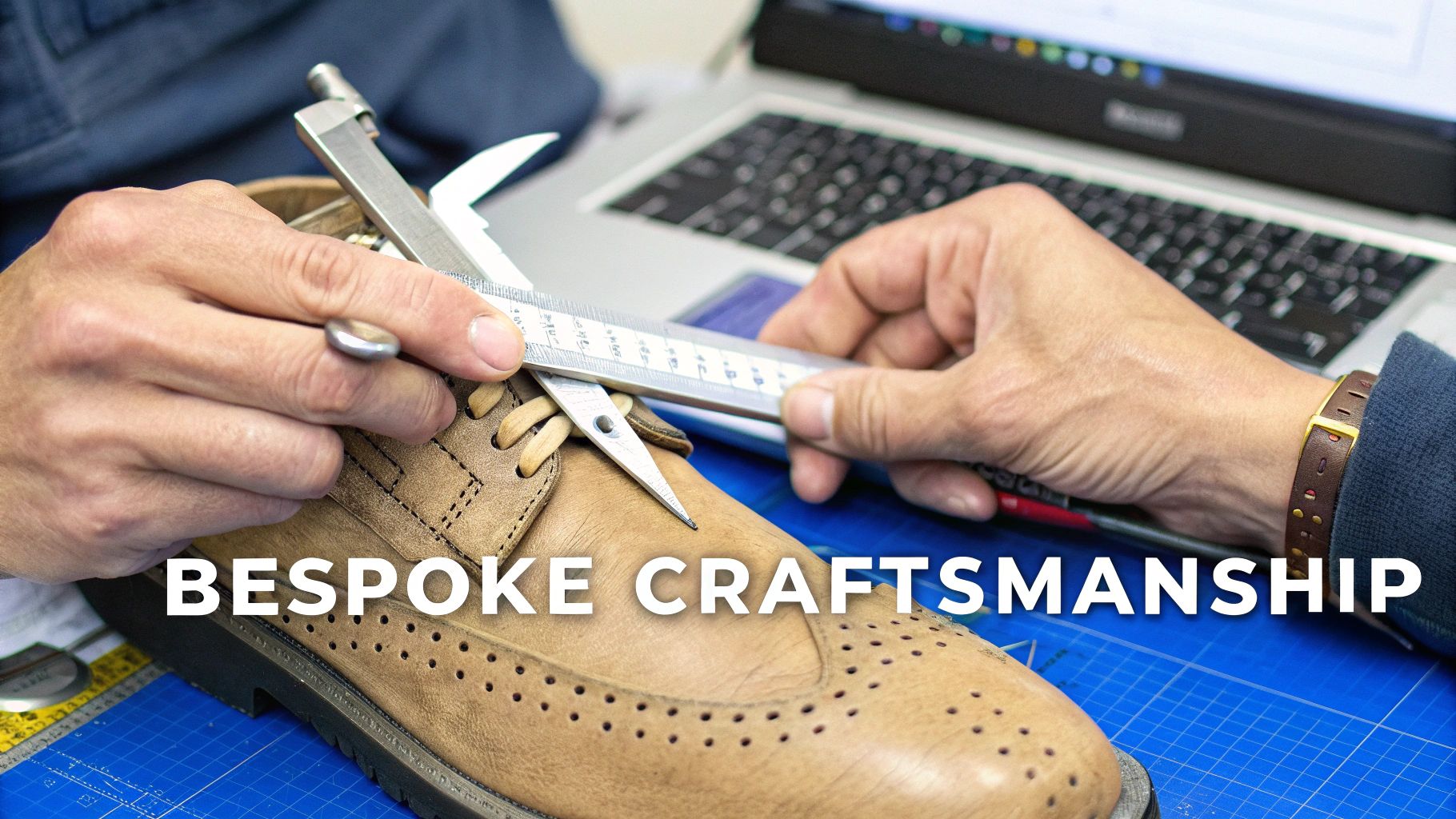
This is where the magic begins. Once you’ve taken down your precise shoe size in inches, you've handed our artisans the essential blueprint for their craft. It’s a process that connects your unique anatomy with centuries of shoemaking tradition.
To us, your dimensions aren't just numbers—they're the foundation of the custom experience. They travel from your home directly to the hands of our master shoemakers, setting the stage for a final product that is a true reflection of you.
The Interactive Design Lab Journey
Your first stop in this creative partnership is our interactive Design Lab. This is where you bring your vision for the perfect shoe to life. While you’re personalizing the aesthetics—picking premium leathers, selecting vibrant colors, and perfecting every detail—your inch-based measurements are already at work behind the scenes.
As you design, your dimensions are informing the very structure of the shoe. This is how we ensure that stunning pair of custom stilettos or rugged set of artisan boots doesn't just look incredible but feels like it was made just for you.
From Digital Design To Artisan Hands
After you’ve finalized your creation, we send your exact specifications to our network of world-class artisans. This is the moment modern innovation gracefully gives way to timeless craftsmanship. Our shoemakers don't pull a generic size off the shelf; they create a unique "last"—the physical mold your shoe is built around—shaped entirely by your measurements.
This is what separates true custom footwear from anything mass-produced. An artisan considers the complete three-dimensional profile of your foot, addressing not just length but also width and volume to sculpt a perfectly balanced shoe. It's a hands-on, intimate approach that guarantees a superior fit and quality.
At Alexander Noel, we merge the convenience of a direct-to-consumer model with the soul of traditional craftsmanship. This blend eliminates the retail markup, making true custom luxury accessible without compromising on quality or a perfect fit.
The importance of this personalized approach can't be overstated. A detailed analysis of 1.2 million foot scans confirmed that foot shapes vary significantly across different regions. What fits an "average" foot in one part of the world won't necessarily fit one elsewhere, which proves why a one-size-fits-all model just doesn't work.
The Final Product: A Testament To Precision
This careful, meticulous process ensures that every single pair of shoes, from our WIRA Luxury Sneakers to custom dress shoes, honors your unique anatomy. The result is footwear that offers incredible comfort and support, right out of the box.
- No More Guesswork: Your precise measurements take all the ambiguity out of sizing.
- A Truly Personal Fit: The shoe is built around a last that mirrors your foot's specific contours.
- Unmatched Comfort: By respecting your foot's natural shape, we eliminate common pain points like pinching, slipping, and blisters.
Ultimately, the journey from measurement to masterpiece is a collaborative one. Our technology empowers you to design, while your measurements guide our artisans' skilled hands. You can discover your perfect pair with Alexander Noel's bespoke shoes and experience this unique process for yourself. And while we honor tradition, we're always looking ahead; advanced tools like AI virtual try-on show exciting potential for making the custom experience even more immersive.
Your Top Shoe Sizing Questions, Answered
Even when you feel you've mastered the measuring tape, a few questions always seem to pop up. Think of this as your quick-hit guide to handling those final little uncertainties. We've compiled these answers from an educational standpoint so you can feel completely confident in your fit.
We've pulled together the most common questions we hear and given them straight, practical answers.
Does My Shoe Size In Inches Change During The Day?
Yes, it absolutely does. Your feet naturally swell throughout the day from walking, standing, and gravity. It's a subtle change, but one that makes a world of difference in how a shoe fits.
This is exactly why we always recommend people measure their feet in the late afternoon or evening. If you measure first thing in the morning, you could end up with a shoe that feels painfully tight by the end of the workday. By measuring your foot at its largest, you guarantee a comfortable fit from sunup to sundown—a small detail that's critical for custom footwear.
What Should I Do If My Feet Are Two Different Sizes?
First off, don't worry—this is far more common than you'd think. In fact, it's rare to find someone with two perfectly identical feet. When you're buying shoes off the rack, the standard advice is to always fit your larger foot to avoid cramming your toes.
But this is a classic problem that mass-produced shoes can't solve well. For a custom service like Alexander Noel, however, this is where we shine. We can accommodate these small differences with total precision. When placing a custom order, always give us the measurements for both feet so our artisans can craft the perfect fit for each one.
How Does Sock Thickness Affect My Shoe Measurement?
This is a huge one, and it's so often overlooked. The type of sock you wear can easily be the difference between a shoe that feels perfect and one that feels tight and restrictive.
It's simple: when you measure your feet, wear the exact type of sock you plan to wear with the shoes you're designing.
- Designing a pair of artisan boots? Grab a thicker wool or cotton sock before you measure.
- Crafting some custom dress shoes? A thin dress sock is what you'll need.
This ensures the final handcrafted shoe has just the right amount of space built in. It’s another layer of precision that leads to true, lasting comfort.
Why Can’t I Just Use The Size From My Favorite Shoes?
Using the size from your go-to pair is a decent starting point, but you should never treat it as your absolute truth. Sizing varies wildly between brands, styles, and even the country where the shoe was made. A size 9 athletic sneaker will feel completely different from a size 9 leather loafer from another brand.
Your personal measurement in inches is the only universal standard. It cuts through all the brand-specific noise and gives you an objective number you can trust.
This is what empowers you to order confidently, especially from a custom maker like Alexander Noel where every millimeter matters. Think about it: the global average shoe size for women is between a US 7 and 8, but that average jumps to a US 8.5 to 9 in the United States alone. You can dig into more global footwear statistics to see just how much variation there is. With that much inconsistency, your own inch measurement becomes the only number that really counts.
Ready to put that perfect measurement to good use? At Alexander Noel, we take your precise dimensions and turn them into a handcrafted masterpiece. Jump into our Design Lab and create a pair of shoes that is uniquely, unequivocally yours—built for you, not for the masses. Start designing your custom-fit shoes today.
Related post
29
Aug
29
Aug
22
Aug
