

RECENT POSTS

29.August.2026
Custom Women's Boots for Fall: Choosing Between Two Black Chelsea Silhouettes
0 Comments







Is an 11D the Same as 10 EEE? A Guide to Finding Your Perfect Fit
Let's get straight to it: no, an 11D is not the same as a 10EEE. It's a common point of confusion, and while the two sizes might feel vaguely similar in overall volume if you're just slipping your foot in, they are engineered for fundamentally different foot shapes.
An 11D is built for a longer, medium-width foot. A 10EEE, on the other hand, is for a shorter, much wider foot. Understanding this distinction is the first step toward achieving a truly exceptional fit.
Understanding The Core Sizing Difference
The "is an 11D the same as a 10EEE?" question gets to the heart of a frustration many of us face: trying to fit our unique feet into standardized shoes. People often compromise, grabbing a longer shoe to get the width they need, or vice-versa. But that's a recipe for discomfort. A true, proper fit comes from respecting both your length and width measurements—a core principle of bespoke shoemaking.
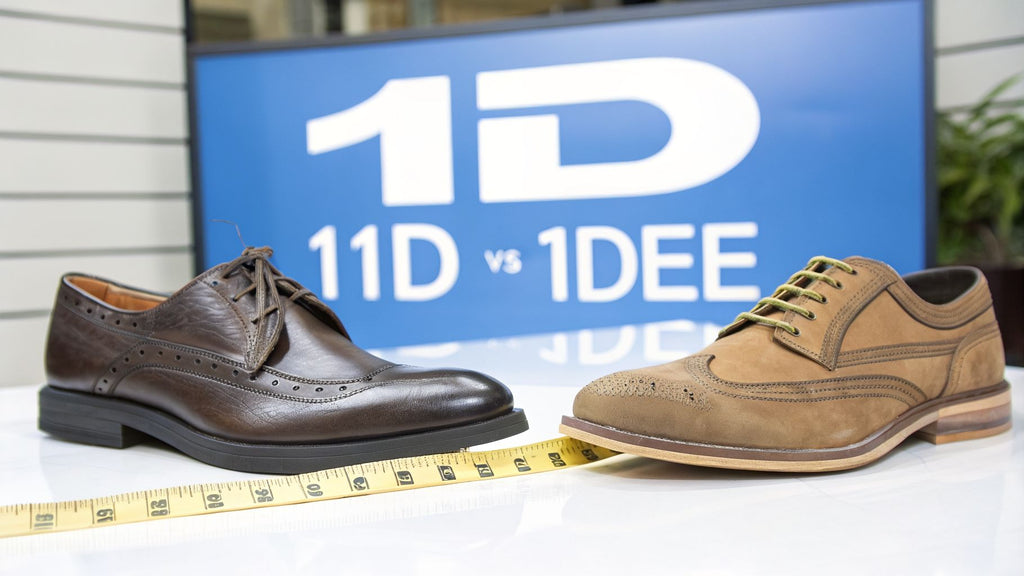
This image breaks down the distinct profiles of an 11D versus a 10EEE shoe.

As you can see, one size is all about length, while the other is constructed entirely around accommodating extra width from the get-go.
Key Fit Characteristics
Historically, shoe widths have followed standardized systems. For men, a D is considered a medium or standard width. The "E" designations indicate wider fits, with EEE being extra-wide. Each "E" you add typically provides an extra 3/16 of an inch in width. In the world of premium, handcrafted footwear, understanding these fine details is absolutely critical for achieving that perfect, glove-like fit.
The biggest mistake we see shoppers make is choosing a longer shoe just to gain more width. This completely throws off the shoe's architecture. The arch support will be in the wrong place, the flex point won't align with your foot's natural bend, and it leads to a sloppy fit and premature wear.
If you're trying to figure out how different brands handle their sizing, checking a definitive sizing guide for shoe brands can offer some valuable insights.
To put it simply, here’s a direct comparison of what each size is designed to do.
Core Differences Between an 11D and 10EEE
| Fit Characteristic | Size 11D (Medium Width) | Size 10EEE (Extra-Wide) |
|---|---|---|
| Primary Focus | Designed for foot length. | Designed for foot width. |
| Intended Foot Shape | Longer, average-width feet. | Shorter, very wide feet. |
| Common Fit Issue | Can feel too narrow for wide feet. | Can feel too short for long feet. |
Ultimately, these two sizes are intended for completely different customers. Trying to substitute one for the other is a compromise that will almost certainly lead to a poor fit.
Understanding How Shoe Length and Width Work Together
So, why isn't an 11D the same thing as a 10EEE? To get to the bottom of it, we need to break down what those numbers and letters on the shoe box actually mean. Think of them as two distinct coordinates for your feet. The number—like 10 or 11—is all about the length of the shoe, measured from your heel to your toe.
Every time you go up a full size, you're adding about 1/3 of an inch in length. This measurement is more than just about toe room; it's critical for making sure the shoe’s arch support lines up with your own and that the shoe bends exactly where your foot naturally flexes.

The letters, on the other hand, tell a different story. They define the shoe's width across the ball of your foot, which is its widest point. This is where the difference between a D and an EEE becomes so important.
The Role of Width in Shoe Architecture
A 'D' width is what the industry considers a standard or medium fit for men's shoes. An 'EEE' (which you'll sometimes see written as 3E) is an extra-wide fit, designed from the ground up to give your foot significantly more room from side to side. These two measurements—length and width—are independent. They work together, but you can't swap one for the other. For a deep dive on how different footwear is built for specific needs, even guides on performance footwear like skate shoes highlight how critical a proper fit is.
A shoe is constructed around a "last," which is essentially a three-dimensional model of a foot. This last dictates the shoe's exact length-to-width ratio. When you simply go up a size just to get more width, you're completely disrupting that carefully designed structure, leading to a fundamentally flawed fit.
Trying to squeeze a wide foot into a shoe that’s too long creates a cascade of problems. The arch support ends up in the wrong spot, you get way too much dead space in the toe box, and your heel will probably slip with every step. It’s a recipe for discomfort, blisters, and shoes that wear out long before they should. You can learn more about how it all works in our guide to shoe widths explained, from EEE and beyond.
Why Length and Width Are Not a Tradeoff
Think about building a house for a moment. The blueprint has separate measurements for the foundation's length and width. You wouldn't just make the foundation longer to get a wider living room—you’d change the width specification.
The very same logic applies to your shoes.
- Length (the number): This aligns the shoe's internal structure—like the arch and flex point—with your foot.
- Width (the letter): This gives your foot the space it needs across its widest point, preventing pinching without feeling loose.
Trying to trade length for width is one of the most common fitting mistakes people make. A truly great fit demands getting both measurements right. This is precisely why a custom, made-to-order approach is often the ultimate solution. It honors the unique length and width of each individual foot, resulting in a shoe that feels like it was built for you and you alone.
Real-World Consequences of a Mismatched Size
So, what really happens when you try to fit a size 10 extra-wide foot into an 11D shoe? We see this all the time—people trading correct length for a little more width. But it's a mistake that creates a cascade of problems, going way beyond simple discomfort. It fundamentally disrupts how the shoe is designed to work.
Let’s get practical. Imagine someone whose foot is a true 10EEE. When they slip on an 11D, the most glaring problem is the excess length. Their foot is about a third of an inch shorter than the shoe's last. This leaves a noticeable gap at the back, causing their heel to slip with every single step.

But the issues don't end there. Because the shoe is too long, the arch support built into the shoe is now in the wrong place, offering zero benefit. The shoe's flex point—the spot where it's meant to bend as you walk—is also completely misaligned. This leads to awkward, unnatural creasing in the leather and forces you into a clumsy gait.
The Problem in Reverse
Now, let's flip the script. What if a person with a standard 11D foot tries to cram their foot into a 10EEE? The width is more than generous, but the shoe is just too short. The result is painfully cramped toes, which can lead to some nasty foot conditions over time.
The pressure points are immense. The sides of the foot might feel fine, but the toes are getting jammed right up against the front of the shoe, creating constant friction and discomfort. A recent study found that nearly a third of professionals wear ill-fitting shoes, often making this exact compromise.
Using extra length to gain more width is a common sizing mistake that compromises both comfort and shoe longevity.
Lasting Damage to Your Shoes and Feet
Beyond the immediate feel, wearing the wrong size causes serious long-term damage to both your feet and your investment pieces.
- Heel Slippage: It's not just annoying. Constant slipping causes blisters and eventually breaks down the shoe's heel counter, ruining its structure. Our guide on how to prevent shoe blisters has some solid tips for dealing with friction from a poor fit.
- Improper Wear Patterns: A bad fit changes the way you walk. This forces the sole to wear down unevenly, shortening the life of your shoes dramatically.
- Structural Strain: When you force a wide foot into a medium shoe, you're putting incredible strain on the stitching and upper materials. Sooner or later, something's going to tear.
These are the real-world consequences, and they make it crystal clear why the answer to "is an 11D the same as a 10EEE?" has to be a firm "no." The sizes just aren't interchangeable. This is exactly where a bespoke approach shines, as it honors the unique length and width of each foot, eliminating the need for these damaging trade-offs.
Finding Your True Fit With Precise Measurements
After untangling the mess of mismatched sizes, the path to real comfort is clear: it all starts with accurate measurements. Guesswork won't do. The great news is you don’t need any fancy gear to get the numbers you need for a perfect fit—you can do it right at home with a few simple items.
This process takes you beyond the vague “is an 11D the same as a 10EEE?” debate and into the world of your own personal data. When you understand your foot's unique length and width, you can finally find a shoe that's genuinely built for you, not for a generic size on a chart.

Getting these measurements right is the first step toward commissioning a shoe that feels less like something you bought and more like an extension of your body.
A Step-by-Step Guide To Measuring Your Feet
For the most reliable results, measure your feet in the afternoon or evening. Our feet naturally swell a bit throughout the day, so measuring later ensures you capture them at their largest.
-
Get Set Up: Find a hard, flat surface and tape a piece of paper to the floor. You'll also need a pen or pencil and a good ruler or measuring tape.
-
Trace Your Foot: Put on socks of a similar thickness to what you'd typically wear with dress shoes. Place one foot firmly on the paper. Keeping the pen straight up and down (perpendicular to the paper!), carefully trace the entire outline of your foot.
-
Measure the Length: Using your ruler, measure the tracing from the very back of the heel to the tip of your longest toe. This number is your key to finding your numerical size.
-
Measure the Width: Now, find the widest part of your foot on the tracing. This is usually the ball of your foot, right behind your toes. Measure that distance straight across to get your width.
-
Do Both Feet: It’s incredibly common for one foot to be slightly larger than the other. Always repeat the process for your other foot and use the measurements from the larger foot. For a more detailed walkthrough, check out our guide on how to measure your shoe size at home.
From At-Home Data to Artisan Craftsmanship
Once you have these critical measurements, you're holding the exact data our artisans need. This is where the Alexander Noel experience shines, turning your personal dimensions into a tangible, perfectly crafted shoe. We bridge the gap between your unique foot shape and the time-honored art of shoemaking.
Your at-home measurements aren't just numbers; they are the blueprint for your comfort. This data directly informs how our global artisans will build your shoe from the ground up.
Our precision at-home fitting system and advanced Design Lab tools take your unique length and width and translate them into a specific shoe last. This ensures the final product isn't just a standard size pulled off a shelf—it's a piece of handcrafted footwear engineered to your exact specifications. It's this fusion of modern innovation and traditional craftsmanship that guarantees a fit mass-produced options simply can't match.
The Bespoke Solution to Sizing Challenges
The constant back-and-forth between sizes like 11D and 10EEE highlights a fundamental problem in the shoe industry: it’s built for the "average" foot, not your foot. This is where we at Alexander Noel introduce a different approach. Our direct-to-consumer model connects you with master artisans in legendary shoemaking hubs like Italy and Spain, making true bespoke footwear an accessible reality.
By cutting out retail markups, we deliver personalized, handcrafted quality without the traditional luxury price tag. This philosophy is central to everything we do. It’s about ensuring a perfect fit is always within reach and finally moving beyond the "close enough" mentality of off-the-shelf shoes.
Your Journey to a Perfect Fit
Creating your ideal shoe with us isn't just a transaction; it's a creative, personal journey. It all starts with your vision and your measurements, not a box on a shelf.
The first step is our Design Lab, a digital workshop where you're the one in charge. You get to select every detail, from the exact shade of premium leather to the style of the sole and even the color of the stitching. This isn’t about just picking a shoe; it’s about co-creating a piece that truly reflects your personal style.
If you have specific needs, our guide on custom-made shoes for wide feet offers more detailed insight into how we accommodate every unique foot shape.
Once you’ve finalized your design, your precise measurements are sent directly to our master shoemakers. They then craft a pair of shoes built exclusively for your feet, honoring their unique length, width, and volume.
This bespoke process ensures that the arch support is perfectly placed, the flex point aligns with your natural step, and the overall volume cradles your foot without pressure points. It's craftsmanship tailored to the individual.
Quality and Craftsmanship Above All
This commitment to personalization tackles a problem that has plagued footwear for decades. Historically, shoe sizing was standardized after WWII using Brannock devices that measured length and width as separate entities. This is why an 11D (medium) has a similar volume to a 10.5EE, but not a 10EEE—that extra width in the 10EEE actually shortens the effective toe room by 8-10mm.
In a luxury market projected to hit USD 32.89 billion in 2025 and grow at a 7.3% CAGR to USD 54.78 billion by 2034, personalization is the key. This is especially true for the 41% of luxury consumers in EMEA who prioritize a bespoke fit above all else. You can explore more market insights from this luxury footwear market report.
Our entire model is built on three core pillars:
- Quality: We source only the finest materials from around the globe.
- Personalization: Your measurements and design choices guide every single step.
- Craftsmanship: Our global artisans use time-honored techniques to create footwear that is both beautiful and built to last.
The result is a shoe that not only looks exceptional but feels like it was made for you and you alone—because it was. The whole debate over whether an 11D is the same as a 10EEE becomes completely irrelevant when your shoes are crafted to your exact specifications.
Common Questions About Finding the Right Shoe Size
We’ve dug into the details of comparing shoe sizes, but a few questions always seem to pop up. Here are some quick answers to the most common queries we hear, all of which point back to the need for a truly personal fit.
Should I Just Go Up a Half Size for More Width?
This is a common "fix," but we'd advise against it. Picking a longer shoe just to get a bit more room across the foot is a classic recipe for a poor fit. It almost guarantees you'll get that annoying heel slippage, and it throws the shoe's built-in arch support and natural flex point completely out of alignment with your foot.
The right way to solve the problem is to find a shoe made in the correct width—like an EE or EEE—that matches your actual foot length. If that’s proving to be a challenge with off-the-rack shoes, a custom-made pair is the best way to get both the length and width spot on.
Are Shoe Widths the Same for Every Brand?
Unfortunately, no. While the letter system (D, EE, EEE) gives you a starting point, the actual measurements can be surprisingly different from one brand to another. You can even find slight variations between different styles from the very same company.
This is a huge source of frustration for anyone trying to buy shoes, especially online. It’s also exactly why taking the time to measure your own feet is so important.
Bespoke services completely sidestep this problem. Instead of guessing which brand's "size 10" fits you, we build the shoe directly to your unique measurements, eliminating all the guesswork.
Can I Get Different Sizes for My Left and Right Foot?
Absolutely. In fact, it’s far more common than you’d think for people to have feet that aren't the exact same size or width. This is one of the biggest drawbacks of mass-produced shoes; they force you to buy a single pair in one size, which means one of your feet is always compromising.
Our made-to-order process is designed to fix this. We can craft each shoe—the left and the right—to the specific size and width of your individual foot. This delivers a level of personalized comfort you simply can't find on a retail shelf, ensuring both of your feet get the perfect fit they deserve.
Ready to stop compromising and experience footwear built exclusively for your feet? The Alexander Noel Design Lab empowers you to create the perfect pair, handcrafted by global artisans to your exact measurements. Design your custom shoes today.
Related post
12
Sep
12
Sep
12
Sep
29
Aug
