

RECENT POSTS


29.August.2026
Custom Women's Boots for Fall: Choosing Between Two Black Chelsea Silhouettes
0 Comments













The Ultimate Boot Sizing Chart for Men
Finding the perfect boot size can feel like guesswork, but it’s an art you can master. A truly exceptional fit goes beyond your usual shoe number—it’s a precise blend of length, width, and volume. For instance, while a US 10 often translates to a UK 9.5 or an EU 43, the real secret to all-day comfort lies in the unique measurements of your own foot.
Why Your Boot Size Is More Than Just a Number
There’s nothing more disappointing than ordering a stunning pair of artisan boots online, only to find they pinch or slip when they arrive. The perfect fit isn’t just about a size label; it’s where traditional craftsmanship meets your unique foot shape. It’s a synergy that most mass-produced footwear simply can’t replicate.
This guide is your personal consultation. Think of this as an inside look from our global artisan workshops, where we'll demystify everything from measuring your foot to navigating tricky international size conversions, empowering you to choose with confidence.
The Craftsmanship Behind the Fit
High-quality boots, especially those crafted from premium leather, are designed to mold to your foot over time. This isn't just a bonus feature; it's a core part of the ownership experience. That initial snug feeling gradually gives way to a personalized contour that supports your foot perfectly—a hallmark of true craftsmanship.
Understanding this is key to appreciating why the initial fit is so crucial. To dive deeper into what sets a premium pair apart, explore our guide to premium boot construction and see what makes luxury truly worth it.
A well-fitted boot shouldn’t just accommodate your foot; it should complement its natural shape. The goal is to eliminate pressure points and provide stable, all-day support, which is only possible when sizing is treated with the precision of a master craftsman.
What This Educational Guide Will Cover
We want to empower you with the knowledge to choose your footwear with absolute confidence. By the time you're done here, you'll have a solid grasp on:
- How to accurately measure your feet right at home.
- The key differences between US, UK, and EU sizing systems.
- Why the width of your boot is just as critical as its length.
- Insider tips for testing the fit when you try on a new pair.
Ultimately, finding your true size is the first step toward experiencing that exceptional comfort and quality—that feeling of a boot that seems like it was made just for you.
How to Properly Measure Your Feet at Home
Forget the guesswork that comes with generic size charts. The secret to a perfect boot fit starts with an accurate measurement of your own feet, using the same foundational method our artisan partners rely on. You just need a few things: a piece of paper larger than your foot, a pen or pencil, and a ruler or tape measure.
Timing matters. We always advise measuring your feet in the afternoon or evening. Why? Because your feet naturally swell throughout the day. Taking your measurements when they're at their largest ensures your boots will stay comfortable from morning to night.
Gathering Your Precise Measurements
Once you've got your tools, find a hard, flat surface. Place the paper on the floor and step on it, making sure your weight is distributed evenly. For the most accurate trace, ask a friend for help, but you can certainly do it yourself by sitting in a chair.
As you trace the outline, keep the pen as perpendicular to the paper as possible. Tilting it in or out will distort the measurement and lead to an inaccurate size. After you have the outline, grab your ruler for two key measurements:
- Length: Measure the straight line from the most distant point of your heel to the tip of your longest toe.
- Width: Measure across the absolute widest part of your foot—this is usually the ball of your foot, right behind your toes.
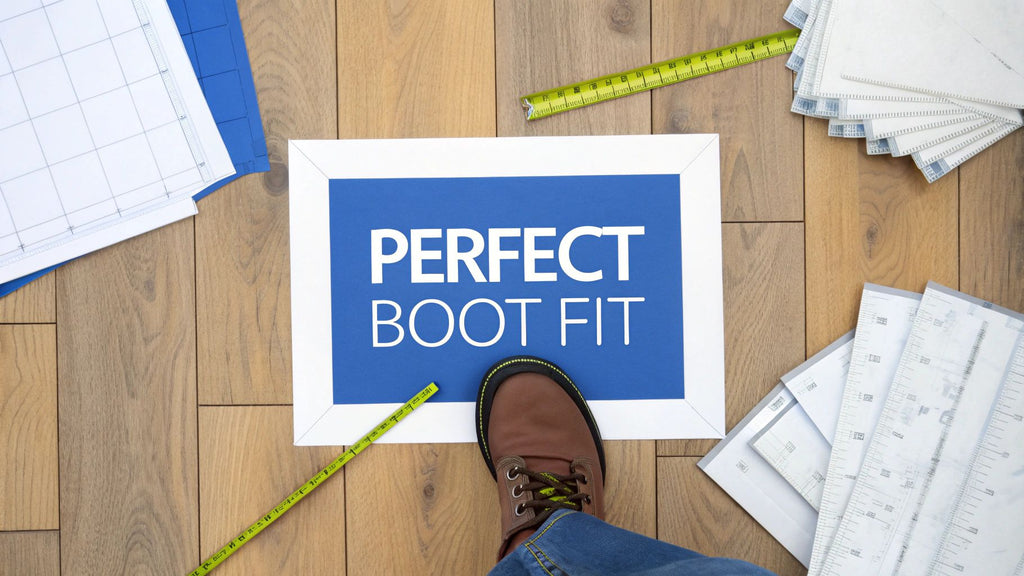
This visual guide breaks down the essential measurements for a perfect fit, focusing on length, width, and volume.
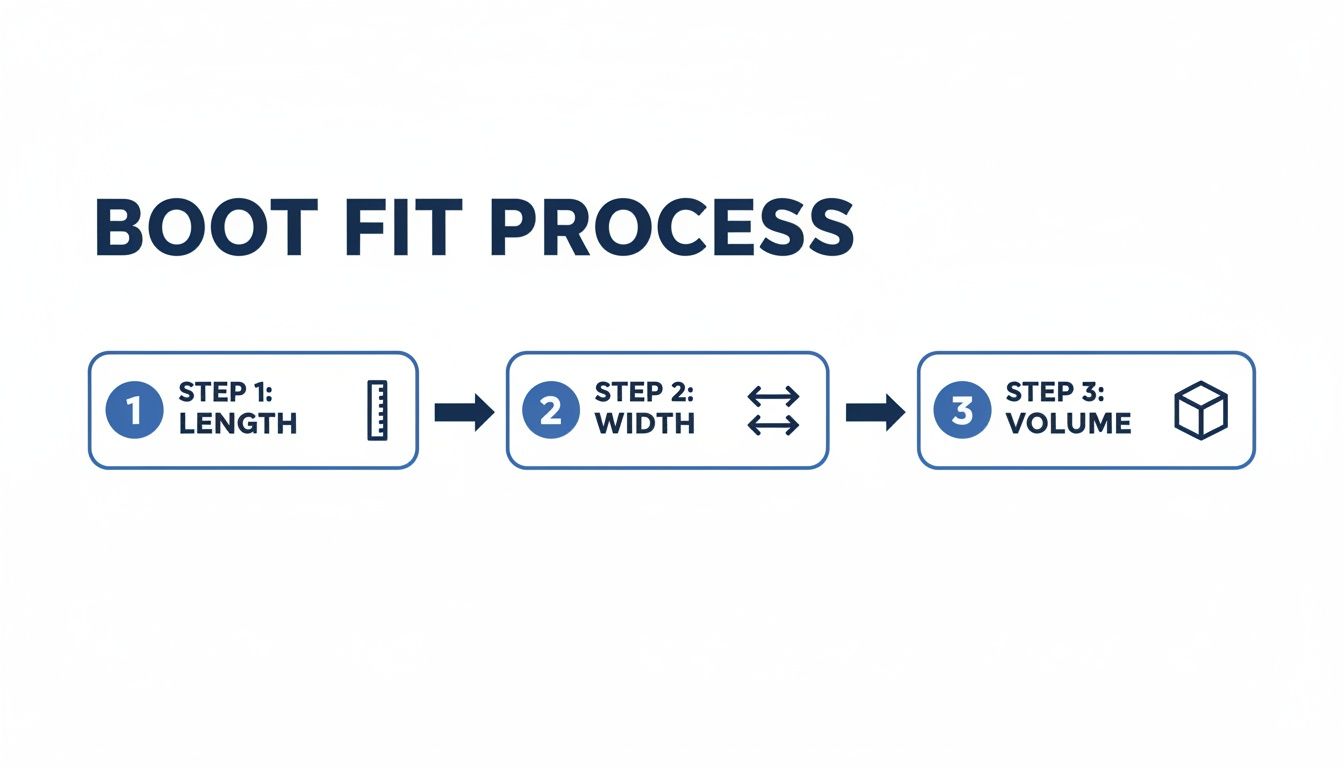
By capturing these three dimensions, you move beyond a simple size number to a true understanding of your foot's unique shape.
Translating Measurements into Your True Size
Here's a little-known fact: most people have one foot that's slightly larger than the other. Because of this, you must repeat the tracing and measuring process for both feet. When you consult a sizing chart, always use the measurements from your larger foot. This simple step prevents that frustrating issue where one boot fits like a glove and the other feels painfully tight.
Once you have your length in inches or centimeters, you can convert it to your standard boot size. For a complete walkthrough, our detailed guide on how to measure shoe size at home offers additional tips and charts to help you find your number with confidence.
Taking just five minutes to measure correctly can save you the hassle of returns and exchanges. It’s the single most important action you can take to ensure your online investment in quality footwear is a successful one.
This isn’t just about finding a number on a chart. It’s about translating your unique anatomy into a size you can trust, ensuring the handcrafted boots you invest in feel like they were made just for you from the very first wear.
Navigating International Boot Sizing Differences
Ever found the perfect pair of boots from an international artisan, only to get stuck on the size conversion? You’re not alone. A US size 10 isn’t a UK 10, and neither lines up neatly with an EU 43. This is a common hurdle that stems from different historical measurement systems, and it can make buying globally feel like a gamble.
Because we partner with incredible craftspeople from around the world, we live and breathe these sizing nuances. Our goal is to clear up the confusion so you can invest in high-quality, internationally made footwear with absolute confidence. Getting comfortable with a global boot sizing chart for men is the first step.
Why Sizing Systems Differ So Much
This isn't random—it's history. The sizing systems we use today developed over centuries, with the most common being US/Canada, UK, EU, and Japan. For instance, a single US 10 boot could be a UK 9.5, an EU 43, or a Japanese 28. It all started in the 19th century when the UK based its system on the length of a barleycorn (about 1/3 of an inch). The US later adopted a similar framework but with its own slight adjustments.
This long history is why an estimated 25-35% of international boot shipments run into sizing disputes every year. It’s also why simply picking your "usual" size doesn't work when you're buying from a global brand. You can get a full breakdown of these systems by exploring these global shoe sizing conventions, but the bottom line is that a direct conversion is always your best bet.
A Practical Guide to US, UK, and EU Sizes
Let's break down the most common conversions you'll encounter. While a chart is your best friend, knowing a few rules of thumb can make you a much savvier shopper.
- United States (US) Sizing: This is the standard you likely know best, built on a modified version of that old English barleycorn system.
- United Kingdom (UK) Sizing: Here's a simple one to remember. The UK size is almost always 0.5 to 1 size smaller than the US size. If you're a solid US 11, you'll be looking for a UK 10 or 10.5.
- European (EU) Sizing: The EU system uses its own scale and doesn't bother with half sizes, making the conversion less direct. As a general guide, a US 10 is typically an EU 43.
For a closer look at all the specifics, our complete guide on US shoe size conversion has more detailed charts to help you nail down your perfect fit.
Here's the most important takeaway: Always start with your foot measurement in inches or centimeters. That number is a universal language. It can be translated across any sizing chart in the world, taking all the guesswork out of the process.
When you're armed with this knowledge, you can navigate the global marketplace like a pro. You'll no longer have to wonder if that handcrafted boot from Spain or Italy is going to fit—you'll know. And that’s how you ensure the boot you order is the boot that fits you perfectly from day one.
Beyond the Chart: Understanding Width and Volume
Focusing only on length is like telling half the story. The difference between a decent fit and one that feels custom-made comes down to two often-overlooked details: width and volume. This is where true craftsmanship shines, creating a three-dimensional space that properly cradles your foot instead of just covering it.
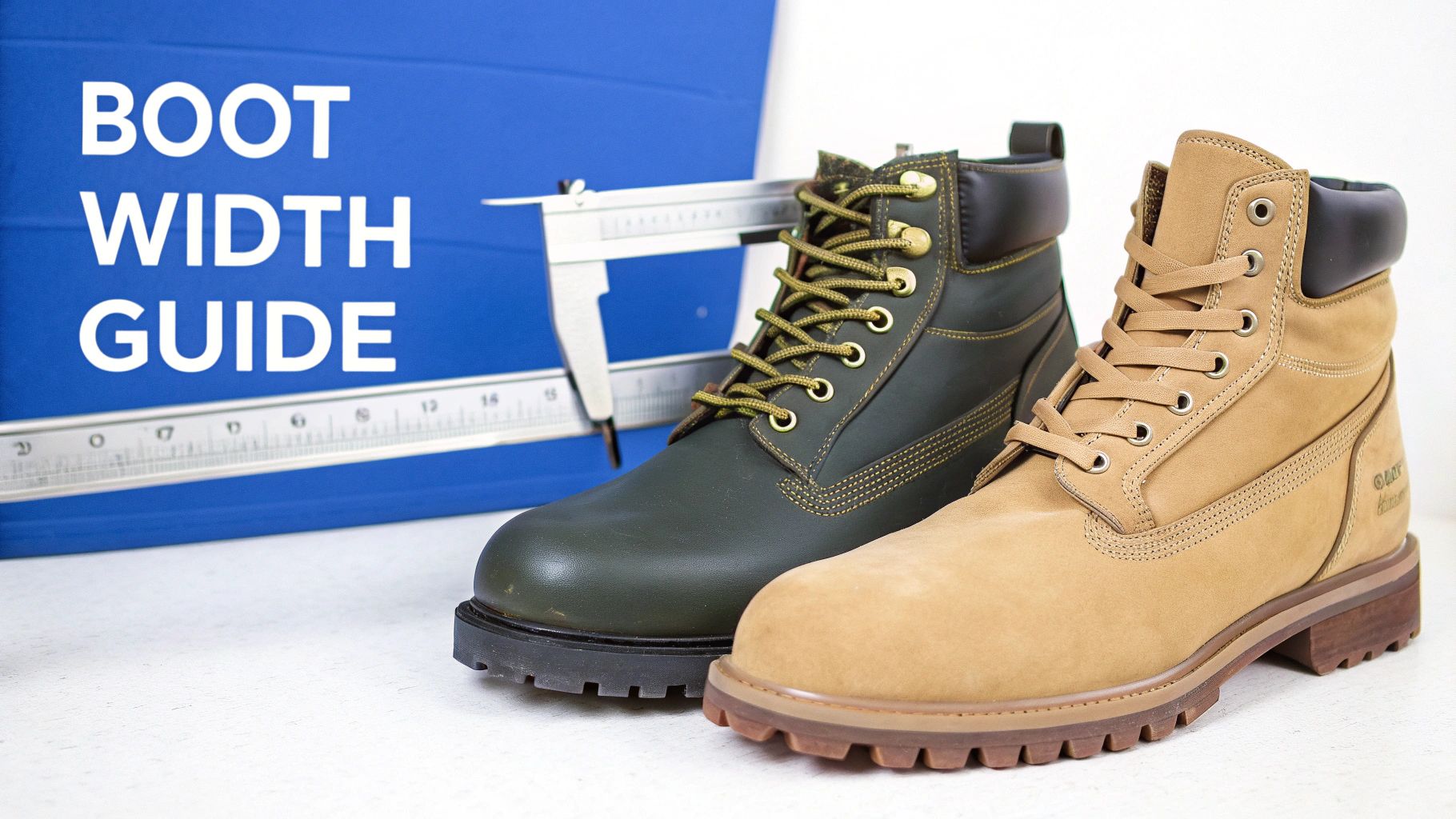
While length gets all the glory, width is the unsung hero of all-day comfort. Countless painful pressure points and blisters are caused by a boot that was the right "size" but the wrong width. Getting this measurement right is a non-negotiable step when you're looking at any boot sizing chart for men.
Decoding the Language of Boot Width
Ever notice those letters on the boot box? That (D, E, EE) system is a simple code that tells you the width. It can vary slightly between brands, but the general rule in the US is pretty straightforward.
- B Width: This indicates a narrow foot.
- D Width: This is the most common and is considered the standard or medium width for men.
- E or EE Width: These letters signify a wide fit. An EE is a step wider than an E.
- EEE+ Widths: These are for extra-wide feet that require maximum room.
Knowing where you fall on this spectrum is a total game-changer. For instance, if your foot measures a size 10 long but is also wide, a size 10 D will feel cramped and painful. But a 10 EE could be the perfect match you've been searching for. For a deeper dive, our complete guide explains shoe widths like EEE and beyond.
More Than Width—It’s About Volume
Width is just one part of the equation. The boot's entire interior volume is what truly defines the fit, and that’s all determined by its construction. This is where the shoemaker's art comes into play, specifically with the last—the foot-shaped form a boot is built around. The last dictates everything about the boot's shape, from the heel cup right down to the toe box.
A sleek Chelsea boot built on a narrow, almond-toed last will have far less internal room than a rugged work boot built on a high-volume last, even if both are labeled a size 10 D. This is exactly why a size that fits you perfectly in one style can feel completely wrong in another.
Your foot doesn't just need space from left to right; it needs vertical and diagonal space to flex and move naturally. The last is what dictates this total volume, defining how that boot will feel the second you slip it on.
It’s no surprise that modern men's boot sizing charts have evolved to include width options. An estimated 30% of men actually need a non-standard width. This is a major reason why online brands offering customization and interactive sizing guides can cut down their e-commerce returns by 15-25%.
By understanding both the simple letter for width and the more subtle influence of the last, you're armed with the knowledge to pick a boot that doesn’t just fit your foot, but feels like it was made for it.
Putting Your Boots to the Test
You've done the measuring and checked the charts, but the real moment of truth comes when you slide your foot into the boot. This is where the science of sizing gives way to the art of the fit. Drawing from years of experience with high-quality, artisan-crafted boots, here are the insider checks to ensure you've found the one.
First up is the classic toe room test. Once your heel is nestled firmly into the back of the boot, you should feel for the space in front. A good rule of thumb is about a thumb's width—or roughly half an inch—between your longest toe and the tip of the boot. This wiggle room is crucial; it prevents your toes from getting jammed when you walk, especially downhill.
Don't Fear the Heel Slip
This is a big one. A little bit of heel slippage in a brand-new leather boot is not only normal but is often a sign of a good fit. When you take a step, your heel should lift slightly, maybe about a quarter of an inch. If it's much more than that, the boot is likely too big.
Why is this a good thing? A new, well-made leather sole is stiff right out of the box. As you break in the boots, that leather sole will soften and start to flex with your foot's natural movement, and the slippage will vanish. If a boot has zero slip from the get-go, it’s a red flag that it might be too short, which can lead to painful rubbing down the road.
Not All Boots Are Created Equal
The way a boot should feel is directly tied to its materials and construction. You can't judge a Goodyear-welted leather boot—a durable construction we love for its ability to mold to the foot—the same way you'd judge a synthetic one.
- Goodyear-Welted Leather: These should feel snug, almost firm, at first. They are built with a cork footbed designed to compress and shape itself to your foot's unique contours over time. That break-in period is precisely what creates the incredible, custom-fit feeling that makes them so prized.
- Synthetic or Cemented Boots: These materials don't have much give. The fit you feel when you first try them on is the fit you'll have for good. They need to feel comfortable right away, with no noticeable tight spots or pressure points.
Always give new boots a trial run indoors, preferably on a carpet. This keeps the soles pristine, which is essential if you discover the fit isn't right and need to make a return or exchange.
One last piece of advice: always try on boots with the exact type of socks you plan to wear. A thick pair of wool socks can easily take up half a shoe size and completely change how a boot feels. Making sure your test is based on a real-world scenario is what turns a good boot into your go-to pair for years to come.
Got Questions About Boot Sizing? We Have Answers.
After years of crafting and fitting boots with our global artisan partners, we've heard just about every question in the book. It’s completely normal to have a few doubts, even with a perfect measurement. Let’s clear up some of the most common sizing puzzles we see.
Think of this as a personal consultation with your trusted bootmaker. We'll tackle the tricky parts head-on so you can feel completely confident when you choose your size.
Is My Boot Size the Same as My Sneaker Size?
This is a common question, and the short answer is almost always no.
It’s incredibly common to wear a half or even a full size smaller in boots compared to running shoes. Sneakers are built differently—they're packed with padding and constructed on a last shaped for athletic movement, which completely changes the interior volume.
Trust your foot measurement and the specific brand's sizing guide. Using your sneaker size as a direct comparison is the number one mistake that leads to a poor fit.
Should My Boots Feel Tight at First?
Yes, but there's a crucial difference between snug and painful. A new pair of high-quality leather boots should feel like a firm, reassuring handshake for your foot. You shouldn't feel any sharp pinching, hot spots, or cramping, but that initial close fit is exactly what you want.
This is where the magic of personalization happens. That snugness is the starting point for the break-in process. It allows the premium leather to stretch, soften, and mold to the unique contours of your foot, creating a fit that feels truly custom over time. A little bit of heel slip at the very beginning is also completely normal.
What If I Am Between Two Sizes?
Landing between sizes can feel like a toss-up, but it's an easy decision if you consider two things: your socks and the boot's material.
If you typically wear thick, cushioned wool socks, sizing up is almost always the right call. You'll need that extra room to stay comfortable.
On the other hand, if you're buying a quality leather boot that will naturally stretch, some prefer to size down. This gives them that ideal snug fit from day one, knowing the leather will break in perfectly. When in doubt, go with the slightly larger size. You can always add a quality insole to dial in the fit, but you can't add more space.
How Do I Know if My Boot Is Too Wide?
You'll feel it. If your foot is sliding from side to side when you walk, the boot is too wide.
Another tell-tale sign is seeing excessive creasing across the vamp—the top part of your foot—where extra material is bunching up. Take a look at your laces, too. If the eyelets are pulled so close they're almost touching, you have too much room. A proper width holds your foot securely, preventing that sloppy side-to-side movement without squeezing it.
Ready to create a pair of boots that fits perfectly in every dimension? The Alexander Noel Design Lab empowers you to build footwear tailored to your exact measurements and personal style. Explore our artisan-crafted boots and start your custom design today.
Related post
19
Sep
19
Sep
19
Sep
19
Sep
19
Sep
