

RECENT POSTS

29.August.2026
Custom Women's Boots for Fall: Choosing Between Two Black Chelsea Silhouettes
0 Comments






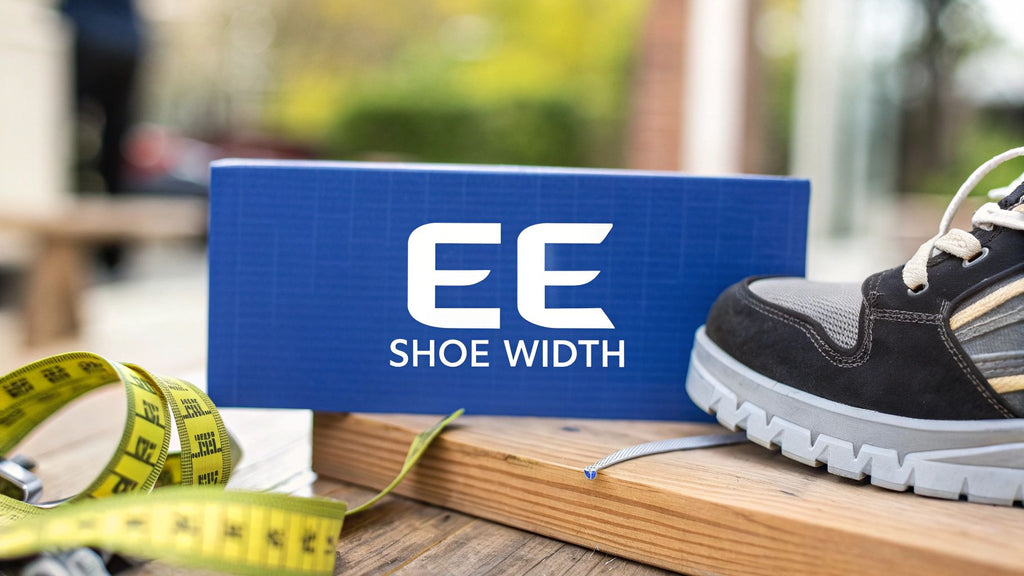
Finding Your Perfect Fit: The Ultimate Guide to EE Shoe Width
Finding a shoe that’s the right length but still squeezes your foot is a familiar frustration. It’s like a beautifully tailored jacket that fits your torso perfectly but is painfully tight in the shoulders—the whole experience is compromised. This is where understanding shoe width, specifically EE shoe width, becomes a game-changer, unlocking a new level of personalized comfort and style.
Decoding EE Shoe Width: A Primer on Finding True Comfort
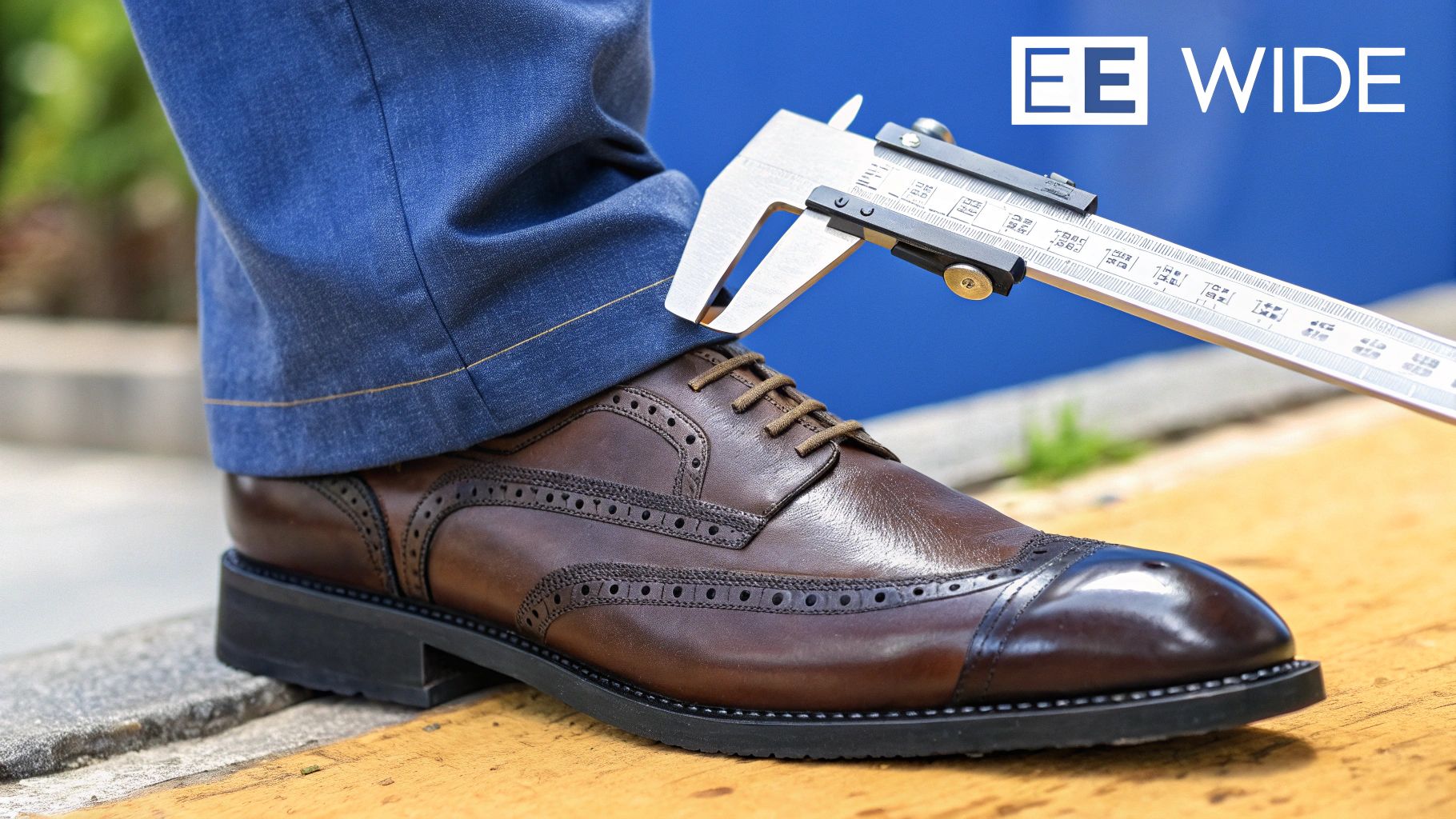
Simply put, EE shoe width designates an extra wide fit. It's a specific measurement for shoes crafted to give broader feet the space they need, especially across the ball of the foot where pinching and pressure are most common.
Ignoring width is one of the most significant oversights in footwear. It leads directly to discomfort and blisters and can even contribute to more serious issues like bunions over time. An EE width isn't just about a little extra room; it's about honoring the natural, unique shape of your foot.
Where EE Fits in the Width Hierarchy
Mastering the shoe width system is the first step toward genuine comfort. It’s a progressive scale, and each letter represents a tangible increase in volume. Many people with wide feet mistakenly size up in length, thinking it will provide more width. This is a classic fitting error that compromises arch support and leads to a sloppy, unsupportive feel.
In the US system, the progression for men typically looks like this:
- D Width: Considered the standard or "medium" width.
- E Width: The first step into the "wide" category.
- EE Width: Officially "extra wide," providing significant additional space.
For many, discovering they need an EE width is a revelation—the moment they realize shoes don't have to be instruments of torture.
That "aha!" moment is what a perfect fit is all about. It's the difference between just getting through the day and feeling completely supported and comfortable, from your first step to your last.
Here’s a quick-glance table to help visualize the system for both men and women. Notice how the letters shift, a common point of confusion when shopping.
US Shoe Widths at a Glance
| Width Letter | Men's Width Designation | Women's Width Designation |
|---|---|---|
| B | Narrow | Medium (Standard) |
| D | Medium (Standard) | Wide |
| EE | Wide / Extra Wide | Extra Wide |
| EEE | Extra Wide | Extra-Extra Wide |
As you can see, a "D" is standard for men but wide for women. The EE designation, however, consistently signals a generous, extra-wide fit for both.
This knowledge empowers you to shop smarter. Instead of forcing your feet into shoes never designed for their shape, you can seek out brands that respect the importance of width. It’s the core principle behind the Alexander Noel experience, where a perfect fit isn't a luxury—it's the standard.
For a deeper dive into even wider fits, you can explore more about shoe widths like EEE and beyond in our detailed guide.
Why Standard Sizes Don't Cut It: The Global Width Problem
You know the feeling: you grab two pairs of shoes from different brands, both in your size, but one fits like a glove while the other feels like a vise. This isn’t in your head. It’s a common frustration that points to a fundamental flaw in the industry: the myth of the “average” foot.
Most mass-produced shoes are built on a standardized last—a foot-shaped mold—that represents a mathematical average. But this "one-size-fits-all" model completely ignores the vast diversity in human foot shapes, especially when it comes to width. This is exactly why a standard "D" width from one company can feel completely different from another's.
The Geographic Fit Factor
The issue is compounded when you consider where shoes are made. A shoe designed for the European market is likely built on a last that reflects the common foot shape in that region. When that same design is sold in North America, it often doesn't fit properly, even if the length is technically correct.
This inconsistency creates a frustrating shopping experience, especially if you need a wider fit like an EE shoe width. You’re left playing a guessing game, trying to determine which brands run wide and which are notoriously narrow.
Mass production is engineered for volume, not for individuals. A shoe designed for everyone often ends up fitting no one perfectly, forcing people to choose between style, comfort, and their own foot health.
The Data Doesn't Lie
This isn't just anecdotal; the numbers tell the story. A landmark study analyzing 1.2 million foot scans from North America, Europe, and Asia revealed that foot shapes vary significantly by region. For instance, at common foot lengths, women in Asia had substantially wider feet than their European and North American counterparts. Those millimeters of difference are what turn a stylish shoe into an instrument of torture. You can dive into the full research on global foot variations to see the data for yourself.
This is precisely where a custom approach changes everything. Instead of squeezing your unique feet into a generic mold, a bespoke shoe is built around your actual measurements.
At Alexander Noel, our direct-to-consumer model and partnerships with world-class artisans were created to solve this exact problem. By connecting you with craftsmen in Spain, Italy, and Portugal, we sidestep inconsistent regional standards and craft footwear to your personal specifications. For us, a measurement like EE shoe width isn't a limitation—it’s the starting point for creating your perfect fit.
How To Measure Your Shoe Width Accurately At Home
Taking control of your own comfort starts with one simple action: measuring your feet at home. It’s an empowering step that demystifies your fit issues and provides the exact data you need to find—or create—the perfect shoe, leaving the guesswork of off-the-shelf sizing behind for good.
The best part? You don’t need any specialized equipment.
Your Simple Toolkit
- A piece of paper larger than your foot
- A pen or pencil
- A ruler or flexible measuring tape
With your tools ready, you can follow this straightforward process. We recommend measuring in the afternoon or evening, as feet tend to swell slightly throughout the day. This ensures you get the most accurate measurement for all-day comfort.
Step-by-Step Measurement Guide
- Trace Your Foot: Place the paper on a hard, flat floor. Stand on it with one foot, ensuring your weight is distributed evenly. Carefully trace the outline of your foot, holding the pen perpendicular to the paper for an accurate line.
- Mark the Widest Points: Examine your tracing and find the widest part, typically across the ball of your foot just behind your toes. Use your ruler to draw a straight line connecting these two points.
- Measure the Width: Measure the length of that line in inches. This number is your raw foot width—the key to determining if you need a standard, wide, or extra-wide shoe like an EE shoe width.
- Repeat for Both Feet: It’s completely normal for one foot to be slightly larger than the other. Always measure both and use the measurements from the wider foot when making sizing decisions.
This process highlights why so many people struggle with standard sizing. The mass-production model is built on averages, not individuals.
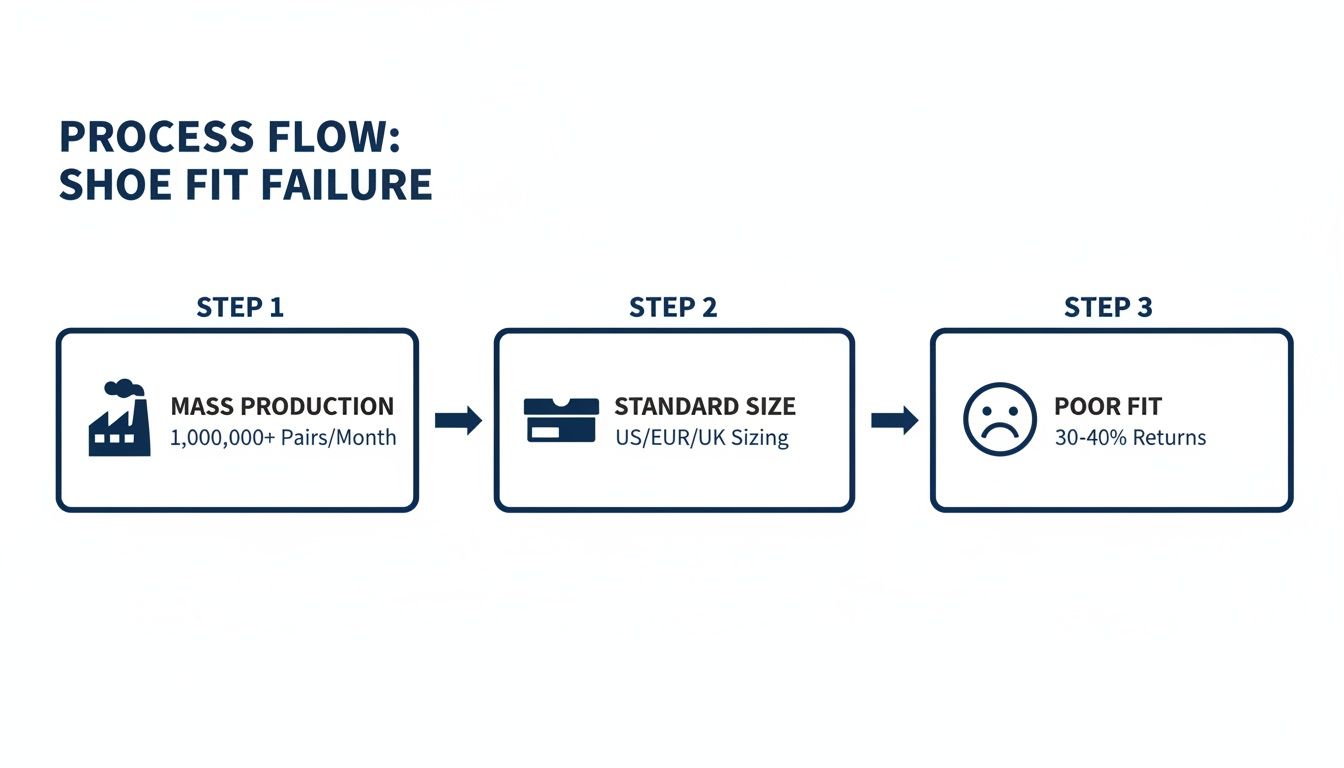
By measuring at home, you bypass this flawed system and gather the personal data needed for a truly perfect fit.
Knowing your exact width is the first step toward footwear autonomy. It transforms you from a passive consumer into an informed collaborator in your own comfort—the very foundation of the Alexander Noel bespoke experience.
Men's & Women's Shoe Width Chart (Inches)
Once you have your width measurement, you can use the chart below as a guide to find your corresponding width letter. Find your shoe size in the first column and read across to see which width category your measurement falls into.
| Shoe Size (US) | D (Medium) | E (Wide) | EE (Extra Wide) |
|---|---|---|---|
| 6 | 3.5" | 3.7" | 3.9" |
| 7 | 3.6" | 3.8" | 4.0" |
| 8 | 3.8" | 3.9" | 4.1" |
| 9 | 3.9" | 4.1" | 4.3" |
| 10 | 4.0" | 4.2" | 4.4" |
| 11 | 4.1" | 4.3" | 4.5" |
| 12 | 4.3" | 4.4" | 4.6" |
| 13 | 4.4" | 4.6" | 4.8" |
| 14 | 4.5" | 4.7" | 4.9" |
Remember, this chart is a great starting point, but every foot is unique.
With your personal measurements in hand, you’re perfectly equipped to start designing with us. This data ensures your custom-made shoes are crafted not for an "average" foot, but specifically for yours. For a complete guide, check out our detailed instructions on how to measure shoe size at home.
Navigating International Sizing Systems for Wide Feet
Stepping into the world of international footwear can feel like trying to read a map without a key. While converting shoe length between US, UK, and EU sizes is relatively straightforward, the system breaks down completely when it comes to width. This global inconsistency is a major challenge for anyone with wider feet.
You may know you're a US size 10, but that information is often unhelpful when considering a European brand. The lettered width system—where we see familiar designations like D, E, and EE shoe width—is primarily a US and UK convention. Many European manufacturers produce shoes in a single, standard width, leaving those with broader feet with limited options.
This forces international shoppers into a risky guessing game where comfort is often the first casualty.
The Breakdown of Global Width Standards
The core problem is that a "wide" shoe isn't a universally defined measurement. One brand’s wide might be another’s standard. Since the early 2000s, athletic shoes have often listed multiple country sizes, yet width indicators remain confusing and inconsistent.
Consider this: a study of UK women found that optimizing shoe fit for width could accommodate nearly twice the population compared to just optimizing for length (47% vs. 24.5%). Yet, many brands still fail to prioritize it. This oversight creates chaos for consumers, a reality you can explore further by discovering insights about global shoe sizing complexities on Wikipedia.
This is where a bespoke approach truly shines. Instead of being constrained by regional sizing quirks, custom footwear is built to your exact measurements from the ground up.
A bespoke shoe transcends confusing international charts. It’s crafted to your personal measurements, making geography and inconsistent standards irrelevant.
At Alexander Noel, our entire model was designed to solve this very issue. By working directly with master artisans in Spain, Italy, and Portugal, we sidestep the off-the-rack problem entirely. We blend world-class craftsmanship with modern innovation to deliver a genuinely personal fit, ensuring your shoes are made for you—not for a generic regional average.
By starting with your unique measurements, we deliver a perfect fit that mass-produced international brands simply cannot match. If you're currently wrestling with these conversions, our guide on understanding US shoe size conversions can offer some additional clarity.
The Alexander Noel Solution: Customization Beyond EE
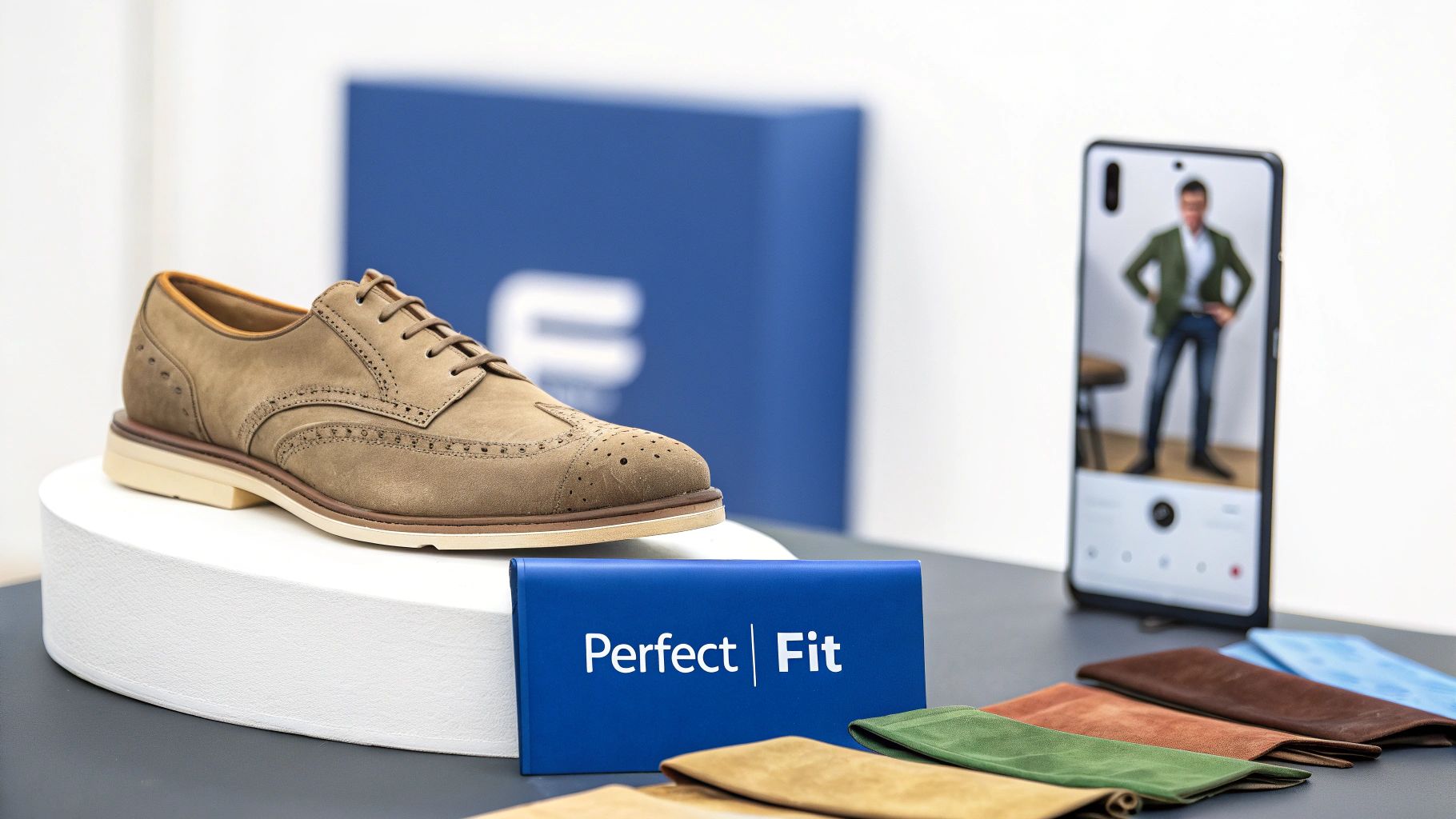
Let’s be honest: navigating standardized sizing charts is frustrating. While discovering you need an EE shoe width is a great first step, it still boxes you into a predefined category.
But what if your foot is slightly wider than a standard EE? Or what if, like many people, one of your feet is wider than the other? This is where off-the-shelf footwear hits a wall. Mass production simply cannot account for this level of personal detail.
This is where the Alexander Noel experience begins. We built our process around a core belief: a perfect fit isn't about finding the closest available size. It’s about creating a shoe that is an exact match for your unique feet. Our innovative approach eliminates guesswork entirely.
Stepping into the Design Lab
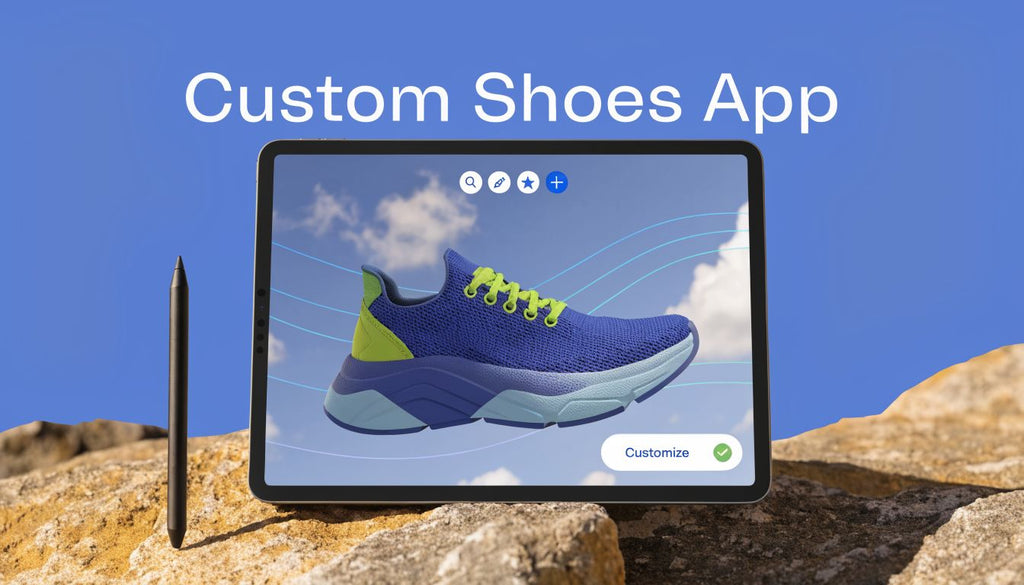
The heart of our solution is the interactive Design Lab. This is where true personalization begins, placing you in the role of creator. Forget being limited to a handful of "wide" styles. Here, you have total freedom to design a shoe that not only fits perfectly but also authentically reflects your personal style.
You are no longer just a customer searching for a product; you become a collaborator in crafting your own luxury footwear.
The process is intuitive and enjoyable:
- Select Your Silhouette: Start with a foundation, whether it's a timeless dress shoe, a modern boot, or our signature WIRA Luxury Sneakers.
- Choose Premium Materials: Handpick from a curated library of world-class materials, including buttery-soft premium leathers and exceptionally comfortable certified baby alpaca fiber.
- Define Every Detail: This is where you make it yours. Customize colors, sole types, and finishing touches—down to the last stitch.
We believe luxury is more than high-quality materials. It's the freedom to create something that is a perfect extension of your style and comfort needs. True luxury is a perfect fit, in every sense of the word.
Craftsmanship Tailored to You
Once you've designed your ideal shoe, your measurements bring it to life. This is where we leave generic labels like EE shoe width behind. You provide the specific dimensions you took at home, and our master artisans in Spain, Italy, and Portugal use that exact data to handcraft your pair.
Imagine designing classic brogues for the boardroom, specifying the precise width needed to eliminate pinching during a long day. Or creating a stunning pair of custom stilettos, ensuring the toe box has ample room without compromising an elegant silhouette.
Our direct-to-consumer model makes this level of bespoke quality accessible. By connecting you straight to our artisan partners, we eliminate the traditional retail markups that inflate the price of luxury goods.
We invite you to experience the Alexander Noel Design Lab and see for yourself how a truly custom-made shoe can transform your relationship with footwear.
Common Mistakes to Avoid When Buying Shoes for Wide Feet
Shopping for shoes with wide feet can be a challenge, but knowing what not to do is half the battle. Many people fall into the same traps, leading to shoes that cause discomfort and wear out prematurely.
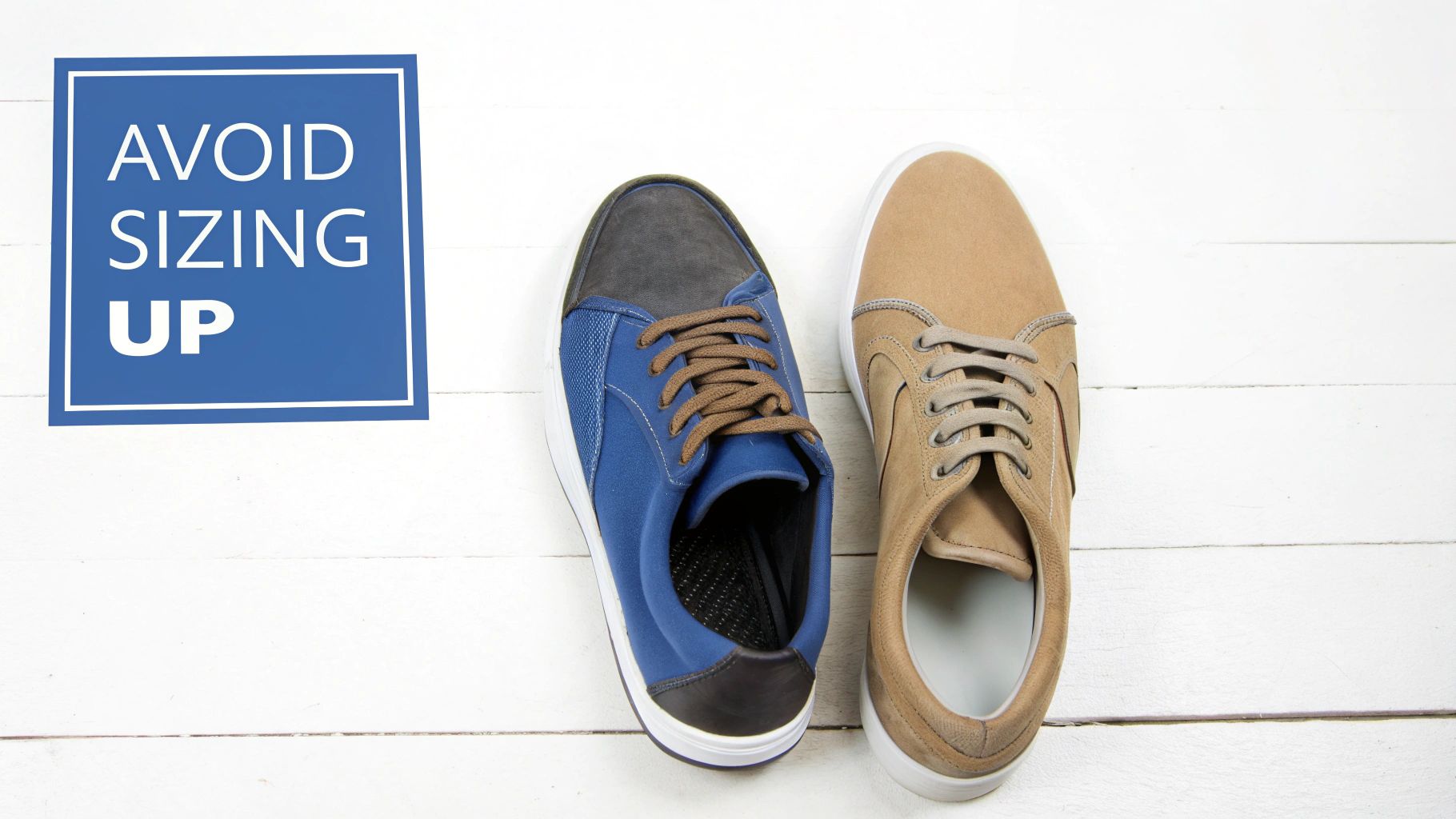
The most common mistake? Sizing up in length to get more width. It seems like an easy fix when a shoe feels tight across the ball of your foot, but this shortcut backfires. A shoe that’s too long means your arch is improperly supported, your heel slips, and you might even trip.
The correct solution is to address the width directly. Measure your feet and seek out an EE shoe width or whichever size you truly need.
Timing and Brand Assumptions
Another classic mistake is trying on shoes first thing in the morning. Your feet naturally swell as the day goes on. A pair that felt perfect at 10 AM can become restrictive by 5 PM.
Always try on new shoes in the late afternoon or evening to ensure you’re buying a size that will remain comfortable when your feet are at their largest.
Assuming a "wide" size from one brand will fit the same as another is setting yourself up for disappointment. Sizing is notoriously inconsistent. One company's EE can easily feel like another's E. Your best bet is to ignore the label and trust your own measurements or the brand’s specific size chart.
Why It All Matters
The numbers don't lie. Research shows that for feet of the exact same length, the width can differ by as much as 15.8 mm. That’s a massive difference, and it’s precisely why a "one-width-fits-most" approach is ineffective.
A SATRA survey drove this home: when they offered a range of widths from 'C' to 'E' instead of just the standard UK women's 'D', their coverage of the population shot up from 24.5% to 47%. It’s clear proof that getting the width right is everything. You can find more fascinating stats on how shoe sizes and widths vary across populations on Viakix.com.
Clearing Up Your EE Shoe Width Questions
Even after doing your homework, a few questions often arise when trying to find the perfect shoe size. Let's tackle some of the most common ones.
Is EE The Same As 2E or W?
For men's shoes in the US, yes, they generally mean the same thing. 'EE' is the same as '2E', and many brands simplify this by labeling the shoe 'W' for Wide.
However, for women, a standard wide is a 'D' width, making an 'EE' an 'Extra Wide.' This is a perfect example of why grabbing a "wide" shoe off the shelf can be a gamble. Always check the brand's specific sizing chart. Of course, with a bespoke process like Alexander Noel’s, this confusion disappears—we build the shoe to your foot, not to a generic label.
Can I Just Squeeze Into Standard Shoes If I Have EE Feet?
You might be able to, but you shouldn't. Forcing a wide foot into a standard-width shoe (a 'D' for men) is a recipe for discomfort. Initially, you'll experience blisters and pain. Long-term, you risk more serious problems like bunions and hammertoes.
While quality leather has some give, it won't fundamentally change the shoe's structure. You'll end up stretching the leather unnaturally, stressing the seams, and damaging both your shoes and your feet.
"Forcing a wide foot into a standard-width shoe is like trying to fit a square peg into a round hole. You might get it in, but you'll damage both in the process. True comfort starts with honoring your foot's natural shape."
How Much Does Shoe Material Matter for a Wide Foot?
The material is a massive part of the equation, and this is where natural materials truly shine.
Materials like the premium leathers and baby alpaca fiber we use at Alexander Noel are designed to breathe and gently mold to the unique contours of your foot over time. They work with your foot's shape. Synthetic materials, on the other hand, are often rigid and unforgiving, which exacerbates pressure points on a wider foot. If you have EE feet, choosing high-quality, natural materials isn't a luxury—it's essential for all-day comfort.
Don't compromise on comfort or style. At Alexander Noel, you are the designer. Create footwear that is uniquely yours and built to your precise measurements.
Related post
04
Oct
04
Oct
26
Sep
26
Sep
26
Sep
