

RECENT POSTS








How to Fit Shoes Properly: Your Ultimate Guide to Comfort and Style
Knowing your shoe size is one thing, but knowing how to get a truly perfect fit is something else entirely. It’s about more than just a number stamped inside a shoe. A great fit means having just the right amount of space—about a thumb’s width—at the toe, a heel that’s locked in place without any slipping, and a width that feels snug but never pinches.
This isn't just about comfort. It’s about building a foundation for your entire day, ensuring your shoes support your health, not just your style. At Alexander Noel, we blend traditional craftsmanship with modern innovation, offering an educational approach to footwear that empowers you to find a fit that is uniquely yours.
Why A Perfect Shoe Fit Is a Game Changer
Let's be honest—we've all been there. We’ve squeezed our feet into a pair of sharp-looking but unforgiving dress shoes for a big meeting or suffered through an event in boots that cramped our toes. Sacrificing comfort for style feels like a necessary evil sometimes.
But the real cost of a bad shoe fit goes way beyond a few blisters or a day of aching feet. It’s an investment in your daily health and long-term well-being that you might not even realize you’re making. Our focus on fit, quality, and personalization stems from the belief that you should never have to compromise.
That nagging discomfort from a poorly sized shoe can easily snowball into chronic problems that seriously impact your quality of life. What starts as a minor annoyance can escalate into painful conditions like bunions, hammertoes, or persistent joint pain. This isn't just about getting through the day; it's about protecting yourself from years of future problems.
The Hidden Costs of a Bad Fit
Relying on mass-market sizing is an old-school approach that just doesn't work for most people. Standard sizes simply can't account for the unique geometry of our feet—things like width, arch height, or the fact that for most of us, one foot is slightly larger than the other.
This one-size-fits-all guesswork has real consequences. Studies show that a staggering 80% of adults will face foot problems by the time they're 50, and a lot of that stems from decades of wearing ill-fitting shoes. For professionals who are on their feet all day, a poor fit is linked to 23% of lower limb injuries. You can dig deeper into the data on sizing and its effects over at OneFit.ai.
A perfect fit is not a luxury. It's the fundamental foundation of good posture, lasting comfort, and confident movement throughout your day.
Moving Beyond Standard Sizing
The answer is to stop being reactive—buying shoes and just hoping they fit—and start being proactive. This is where the precision of a bespoke, handcrafted approach makes all the difference.
Instead of trying to force your feet into a shoe built on a generic mold, custom footwear is crafted around your specific, individual measurements. Here at Alexander Noel, we believe the perfect fit should be the starting point, not a lucky accident. By working with master artisans who use your exact dimensions, we create shoes that honor the natural shape of your feet.
The result? Style and comfort can finally coexist, just as they should.
Your Guide to Accurate At-Home Foot Measurement
Getting a perfect fit all starts with one thing: knowing your true measurements. You don’t need any fancy gadgets or guesswork; you can get remarkably precise results right at home with a few simple tools. This is the foundational first step, the key that unlocks how to fit shoes properly and moves you from off-the-shelf uncertainty to bespoke confidence.
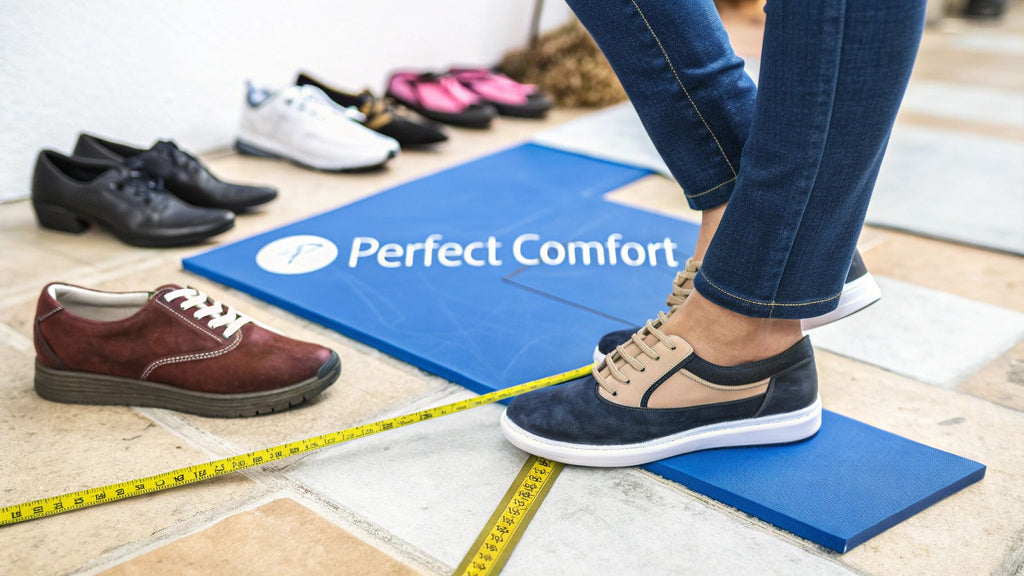
The process itself is straightforward, but the details matter. Grab a piece of paper, a pen, and a ruler or tape measure. It's absolutely crucial to take these measurements while standing up. Your feet naturally spread and lengthen under your body weight, and if you measure while sitting, you'll get a smaller, inaccurate reading.
Tracing and Measuring Your Feet
Start by placing a sheet of paper on a hard, flat surface like a wood floor. Stand with one foot planted firmly on the paper. Now, trace the outline, making sure to keep your pen or pencil as straight up and down (perpendicular) as possible. If you angle it, you'll distort the tracing.
Once you have the outline, you can take two key measurements:
- Length: Measure the distance from the very back of your heel to the tip of your longest toe.
- Width: Find the widest part of your foot—usually the ball of your foot, right behind the toes—and measure straight across.
Do this whole process again for your other foot. It’s a common myth that our feet are identical. In reality, most people have one foot that is slightly larger than the other. You should always use the measurements from the larger foot to determine your shoe size.
The infographic below shows exactly why getting this right is so important—it illustrates the painful journey that begins with a poorly chosen shoe.
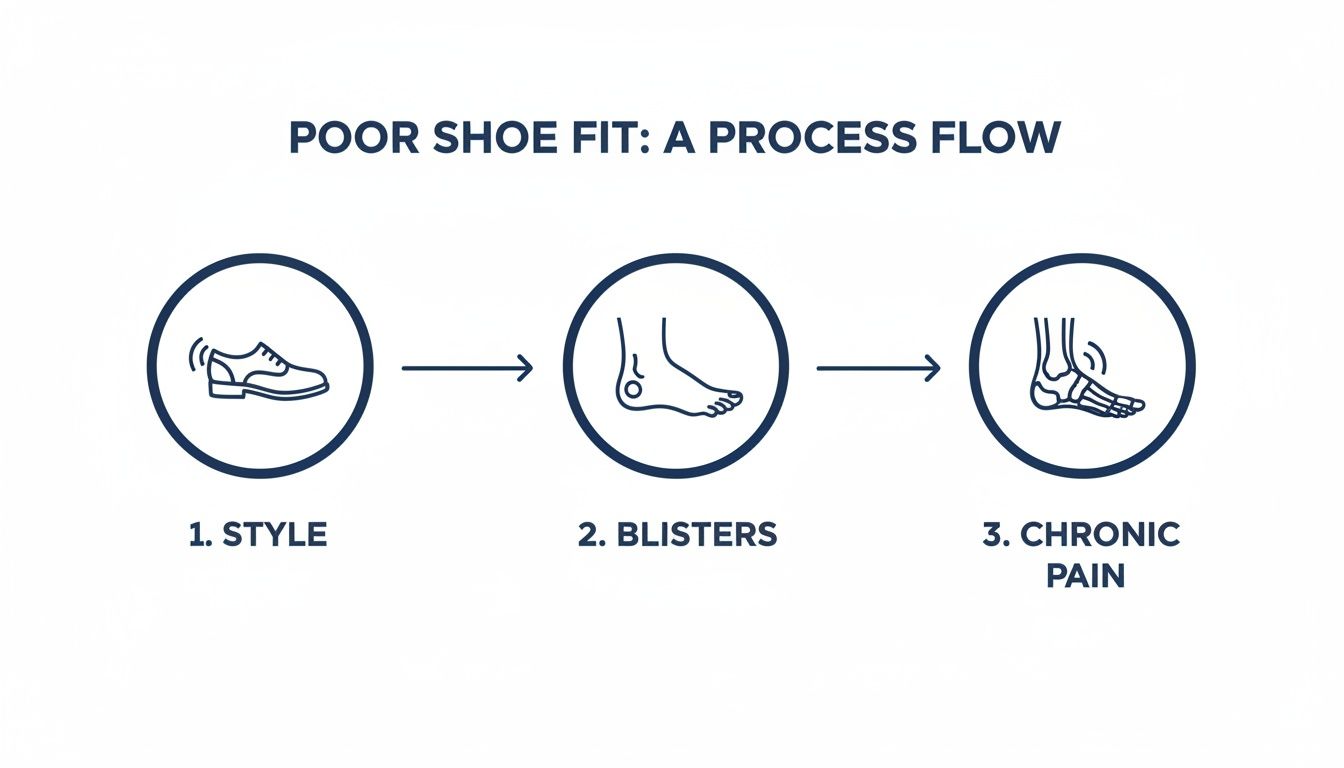
As you can see, a stylish but pinching shoe is the first step toward blisters and, eventually, chronic pain. It's a clear visual reminder of the long-term consequences of a bad fit.
Timing and Common Pitfalls
When you measure is just as important as how you measure. Feet naturally swell as the day goes on, so for the most accurate numbers, measure them in the late afternoon or evening. This ensures your new shoes will still feel great after you've been on your feet all day.
A common mistake is measuring while seated. This can lead to underestimating your true size, as your foot is not fully expanded. Always stand to get the most reliable dimensions for a perfect fit.
These fundamental measurements are the starting point for Alexander Noel's advanced at-home fitting system. Our tech-driven solution uses your precise dimensions to ensure your custom WIRA sneakers or bespoke stilettos are crafted to your exact specifications, bridging the gap between traditional craftsmanship and modern precision.
You can also check out our guide on how to measure shoe size at home for even more detailed tips.
Decoding the Anatomy of a Perfect Fit
A perfect fit is so much more than the number on the shoe size tag. It's a three-dimensional experience, where every curve and contour of your foot feels supported. When you really learn how to fit shoes properly, you start looking beyond just length and considering the whole shoe in relation to your foot's unique shape.
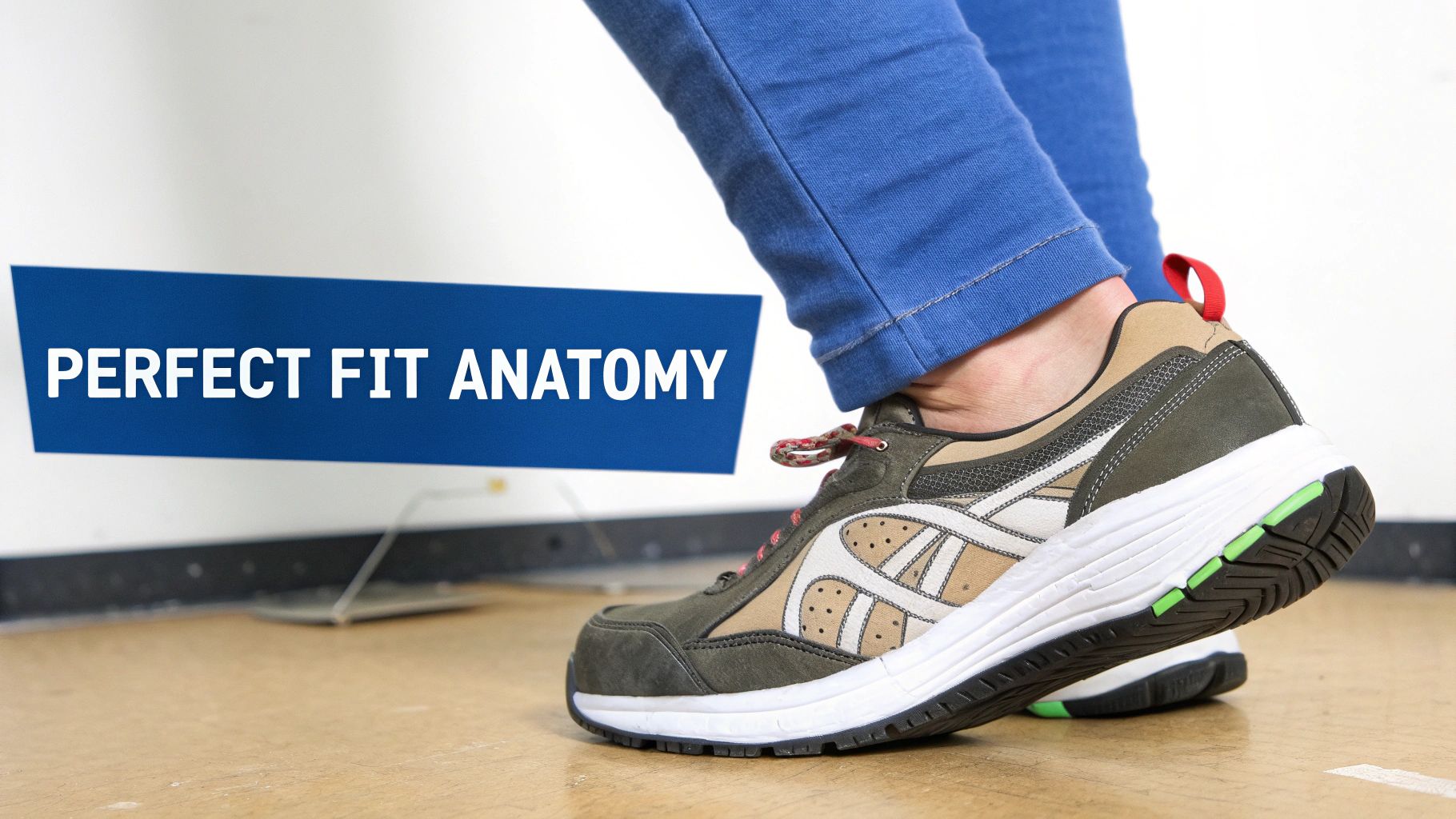
This is the kind of detail that separates a generic, mass-produced shoe from a truly handcrafted one. Our master artisans in Italy and Spain don’t just build a size; they meticulously shape each dimension to create footwear that feels like it was made just for you—because, well, it was.
The All-Important Toe Box
Your toes need room to spread out. It’s that simple. A cramped, narrow toe box is one of the biggest culprits behind painful issues like bunions and hammertoes. Anytime you squeeze your toes, you're just asking for trouble down the line.
A great way to check is the classic 'rule of thumb.' You want about a thumb's width (roughly half an inch) of space between the tip of your longest toe and the very front of the shoe. Crucially, you should be able to wiggle all your toes freely without them feeling squished from the sides or the top.
Securing the Heel
You know that annoying feeling when your heel constantly lifts out of your shoe with every single step? That slipping isn't just an inconvenience; it's a dead giveaway of a poor fit.
That constant friction is a fast track to painful blisters or even bruised heels. A properly fitted shoe should grip your heel gently but firmly, locking it into place without digging into your Achilles tendon. When you walk, your foot and the shoe should move together as one.
A proper fit means your heel feels secure and stable, not like it's trying to escape. This single element can make or break the comfort of a shoe.
Finding the Right Width
Shoe width is so often overlooked, but it's absolutely essential for all-day comfort. A shoe that’s too narrow will pinch the sides of your foot, especially around the ball, causing immediate pain and potentially long-term nerve issues. On the flip side, a shoe that’s too wide lets your foot slide around, leading to instability and friction.
The sweet spot is a width that feels snug and supportive, hugging your foot without squeezing it. If standard sizes always seem to miss the mark for you, it might be time to explore your options. You can dive deeper in our complete shoe width sizing guide.
The Foundation of Arch Support
Think of your arches as the unsung heroes of your feet. They support your entire body weight and absorb shock with every step you take. The problem is, most mass-produced shoes come with generic, flat arch support that just doesn't work for most people's individual needs.
Poor arch support is a huge contributor to plantar fasciitis, that awful condition known for causing sharp, stabbing heel pain. A perfectly fitted shoe will have an insole that actually contours to the natural curve of your arch, giving you consistent support. This alignment is not just about foot health; it's key for your overall posture and balance, too.
Beyond your own foot measurements, it also helps to understand how different companies approach sizing. For a closer look at how specific brands fit, you can check out a definitive sizing guide for various brands.
To help you get it right every time, here's a quick checklist to run through when you're trying on a new pair.
Shoe Fit Checklist: Key Areas to Check
Use this checklist to evaluate the fit of any shoe, ensuring comfort and support across all critical points of your foot.
| Fit Area | What to Check For | Why It Matters |
|---|---|---|
| Length (Toe Box) | About a thumb's width (1/2 inch) of space for your longest toe. | Prevents toes from hitting the front, reducing risk of bruised toenails and hammertoes. |
| Width (Ball of Foot) | Snug but not tight across the widest part of your foot. | Avoids pinching, which can lead to bunions, neuromas, and general discomfort. |
| Heel | Minimal to no slipping when you walk. Heel feels secure. | Prevents blisters, calluses, and provides stability for a confident stride. |
| Arch | The shoe's arch contour matches your natural arch. | Provides proper support, reducing strain and preventing conditions like plantar fasciitis. |
| Instep (Top of Foot) | No excessive pressure or gaping across the top. | Ensures good circulation and prevents the "falling asleep" feeling in your feet. |
Taking a moment to check these five areas will dramatically increase your chances of walking away with a pair of shoes you'll love for years, not just for a few minutes in the store.
How Fit Changes Across Different Shoe Styles
Ever tried on a size 10 sneaker that fit like a glove, only to find a size 10 dress boot feels completely different? You're not imagining things. A shoe's materials, the way it's built, and what you'll be doing in it can dramatically change how it feels on your foot.
This is something we live and breathe in the world of bespoke shoemaking. Understanding these subtle (and not-so-subtle) differences is the key to getting a perfect fit, whether you're in casual kicks or your sharpest formal wear.
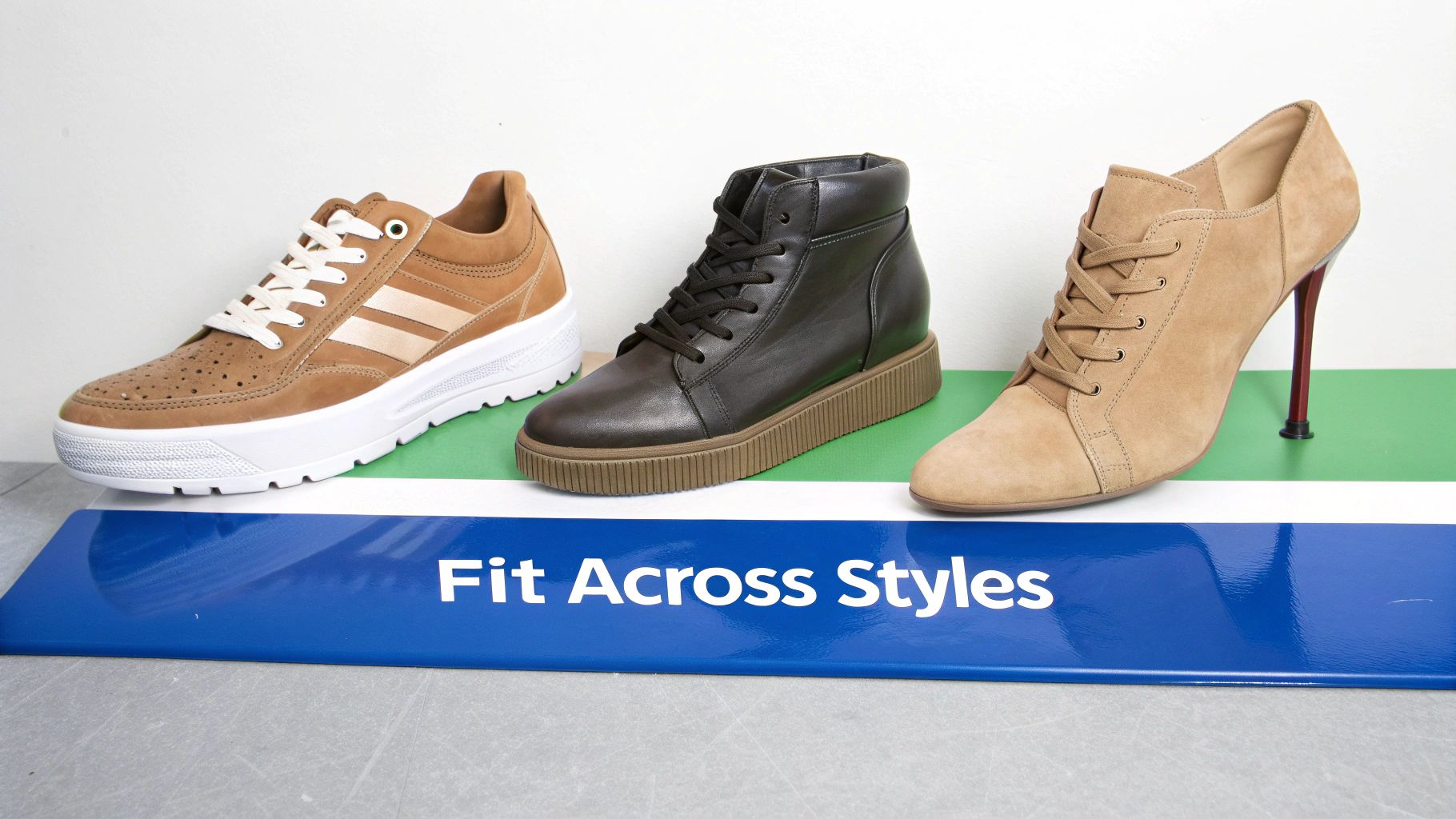
Each design has its own unique demands, which is exactly where a custom process makes all the difference. We tailor the fit to the function of the shoe, guaranteeing both comfort and performance—from a rugged custom boot to one of our head-turning 'Cascabel Red' stilettos.
Fitting Leather Dress Shoes and Boots
High-quality leather dress shoes and artisan boots have a personality of their own. When you first slip them on, they should feel snug. I'm not talking painful or cramped, but securely held. That’s because the premium leather our master craftspeople use is meant to gradually stretch and mold to the exact shape of your foot as you wear it.
You shouldn't feel any major slipping in the heel, and your toes need enough room to lie flat. Unlike a sneaker that’s comfortable right out of the box, a well-made leather shoe starts off feeling firm and supportive. Over time, it becomes a perfect second skin.
With boots, the fit goes beyond your foot and up to your ankle. A great boot fit means:
- Secure Ankle Support: The shaft of the boot should wrap your ankle comfortably, giving you stability without rubbing or chafing.
- Room for the Right Socks: You have to think about the socks you'll be wearing. Trying on hiking boots with thin dress socks is a recipe for disaster. You need to account for a thicker, more durable sock like a Darn Tough Hiker Micro Crew Midweight Hiking Sock to get a true feel for the fit.
The Specific Needs of Sneakers and Heels
Sneakers are a different story entirely—they're built for instant comfort. Thanks to flexible materials and cushioned soles, they should feel great from the moment you put them on. The fit should be secure but not suffocating, with that all-important thumb's width of space at the toe to accommodate natural foot swelling when you're on the move.
Heels, on the other hand, are a true feat of engineering. The design shifts your entire body weight forward, putting a massive amount of pressure on the balls of your feet and toes.
The anatomy of a stiletto demands a precise fit. If it's too loose, your foot slides forward and cramps your toes. If it's too tight, you create painful pressure points all over. The key is in the arch support and heel cup—they have to be perfectly contoured to cradle your foot and keep it locked in place.
This is where custom really shines. With stilettos like our 'Cascabel Red,' we craft every single angle and dimension to your specific measurements. This bespoke approach ensures the shoe supports your foot's natural structure, distributing your weight more evenly. It’s what makes a three-inch heel feel remarkably stable and comfortable—the difference between just enduring a pair of shoes and truly enjoying them.
Mastering Suit and Shoe Pairings for Any Occasion
Getting the fit right is a crucial first step, but once you've nailed that, the real fun begins: pairing your shoes with confidence. The right pair of shoes doesn’t just finish an outfit; it elevates it from good to great. This is where you get to play with color, style, and even fabric to pull together a polished look for any room you walk into.
This isn’t about memorizing a bunch of stuffy, outdated rules. It’s about understanding what makes a pairing work, whether you're dressing for the boardroom or a casual weekend brunch. A well-chosen shoe shows you pay attention to the details and are in complete command of your personal style.
Matching Shoe and Suit Colors
The most straightforward principle is color harmony. Black shoes will always be your go-to for formal occasions, and they are non-negotiable with a black or charcoal suit. But the modern man’s wardrobe has a lot more room to play.
Take a navy suit, for example. You’ve got options. Black shoes give you that classic, authoritative look perfect for a big meeting. But swap them for a pair in a rich brown or a deep oxblood, and suddenly you’ve added warmth and personality—perfect for less formal settings. That versatility is how you get the most out of what you own.
A grey suit is practically a blank canvas:
- Black Shoes: Creates a sharp, professional contrast.
- Brown Shoes: Gives off a softer, more approachable vibe.
- Burgundy Shoes: Adds a sophisticated pop of color that stands out for all the right reasons.
The idea is to create a cohesive look where your shoes complement your suit, not compete with it. A simple color switch can shift the entire tone of your outfit from strictly business to relaxed and elegant.
Ready to see how different shades work together? You can explore our complete shoe color matching guide for a deeper dive.
For a quick reference, here’s a simple guide to get you started on matching your suits and shoes.
Suit and Shoe Color Pairing Guide
This table is your cheat sheet for matching shoe color with your suit for any occasion, from formal business meetings to casual events.
| Suit Color | Recommended Shoe Color(s) | Occasion |
|---|---|---|
| Navy Blue | Black, Dark Brown, Oxblood/Burgundy | Business, Weddings, Smart Casual |
| Charcoal Grey | Black, Dark Burgundy | Formal Business, Evening Events |
| Light/Medium Grey | Black, Brown (all shades), Oxblood | Business Casual, Daytime Events |
| Black | Black | Formal, Black-Tie, Funerals |
| Brown/Tan | Brown (contrasting shades), Tan | Casual, Daytime Events, Smart Casual |
| Olive Green | Brown, Tan, Burgundy | Creative, Smart Casual |
This guide covers the essentials, but don't be afraid to experiment. The key is to build a look that feels authentic to you.
Fabric and Formality
It’s not just about color—the material of your suit also plays a big part in choosing the right shoe. Heavier, textured fabrics like tweed or flannel have a certain ruggedness to them, so they pair beautifully with more robust footwear. Think brogues or a sturdy pair of derby shoes. The detailed perforations on a brogue, for example, echo the fabric's texture for a really balanced look.
On the flip side, a sleek, lightweight worsted wool suit needs a more refined shoe. A classic cap-toe oxford is the perfect partner here. Its clean lines and smooth leather mirror the suit's own formality. And for those summer suits in linen or cotton? A relaxed loafer or even a high-end custom sneaker can create a modern, stylish look that feels completely effortless.
The Great Debate: Brown vs. Black Shoes
So, what's more popular these days? While black shoes remain the undisputed king for highly formal events and conservative business environments, brown shoes have become the workhorse of the modern man's closet.
Their versatility is just unmatched. A great pair of brown shoes can easily take you from a business-casual office setting to a weekend dinner without missing a beat. As dress codes have relaxed, brown shoes have often become the more practical and stylish choice for daily wear. A well-made pair of brown oxfords or loafers offers an essential level of adaptability for today’s professional.
The Alexander Noel Difference: A Perfect Fit, Guaranteed
After diving into measurements, foot anatomy, and all the style details, it's pretty clear that getting the perfect shoe fit is part science, part art. If you've ever been let down by off-the-shelf sizes, you know exactly what I'm talking about. The usual shoe shopping experience just doesn't cut it for a lot of people.
This is where a bespoke shoe isn't just a nice-to-have; it's the only real solution.
At Alexander Noel, our entire process is built on a single, core promise: a perfect fit, every time. We blend modern tech with the classic, time-tested traditions of our artisan partners across the globe to create footwear made only for you. It all starts in our online Design Lab, where you're the one in the driver's seat.
From Digital Design to Artisan Craft
Our Design Lab lets you build your dream shoe from the sole up. You pick the exact materials, choose the colors, and tweak every little style detail with our advanced visualization tools. But that's just the beginning.
To make sure the final shoe fits like a glove, we use a precision at-home fitting system. This completely takes the guesswork out of buying shoes online. Think about it: improper shoe fit is a huge, hidden cost for retailers, leading to return rates as high as 30-40% of online sales.
Even though the Brannock Device was invented way back in 1925, inconsistent sizing is still a massive headache worldwide. Our system fixes that problem, which means far fewer returns and a shoe you'll love from the very first step. You can dig into the numbers on online shoe sales statistics here.
Plus, our direct-to-consumer model means you get incredible value by cutting out the middleman and the retail markup.
The Confidence of a Bespoke Fit
Every pair of shoes we make is a showcase of the incredible skill of our master shoemakers in Italy, Spain, and beyond. They take your unique design and precise measurements and handcraft a shoe that truly respects the natural shape of your foot.
A custom-made shoe doesn't just fit your measurements; it fits your life. It’s an investment in your daily comfort, your long-term health, and your personal style.
This is the kind of confidence and comfort you can only get from footwear made just for you. It's time to step away from mass-produced shoes that are always a compromise and feel the luxury of a truly personal fit. We combine your vision with our craftsmanship to create more than just shoes—we create your perfect pair.
For more on this unique process, discover your perfect pair with Alexander Noel’s bespoke shoes.
Ready to experience the difference a perfect fit can make? Explore the Alexander Noel Design Lab and create your own custom, handcrafted footwear today at https://www.shopalexandernoel.com.
Related post
24
May
17
May
16
May
16
May
16
May
