

RECENT POSTS


29.August.2026
Custom Women's Boots for Fall: Choosing Between Two Black Chelsea Silhouettes
0 Comments





Made to Order Shoes for Women: Fit and Timing
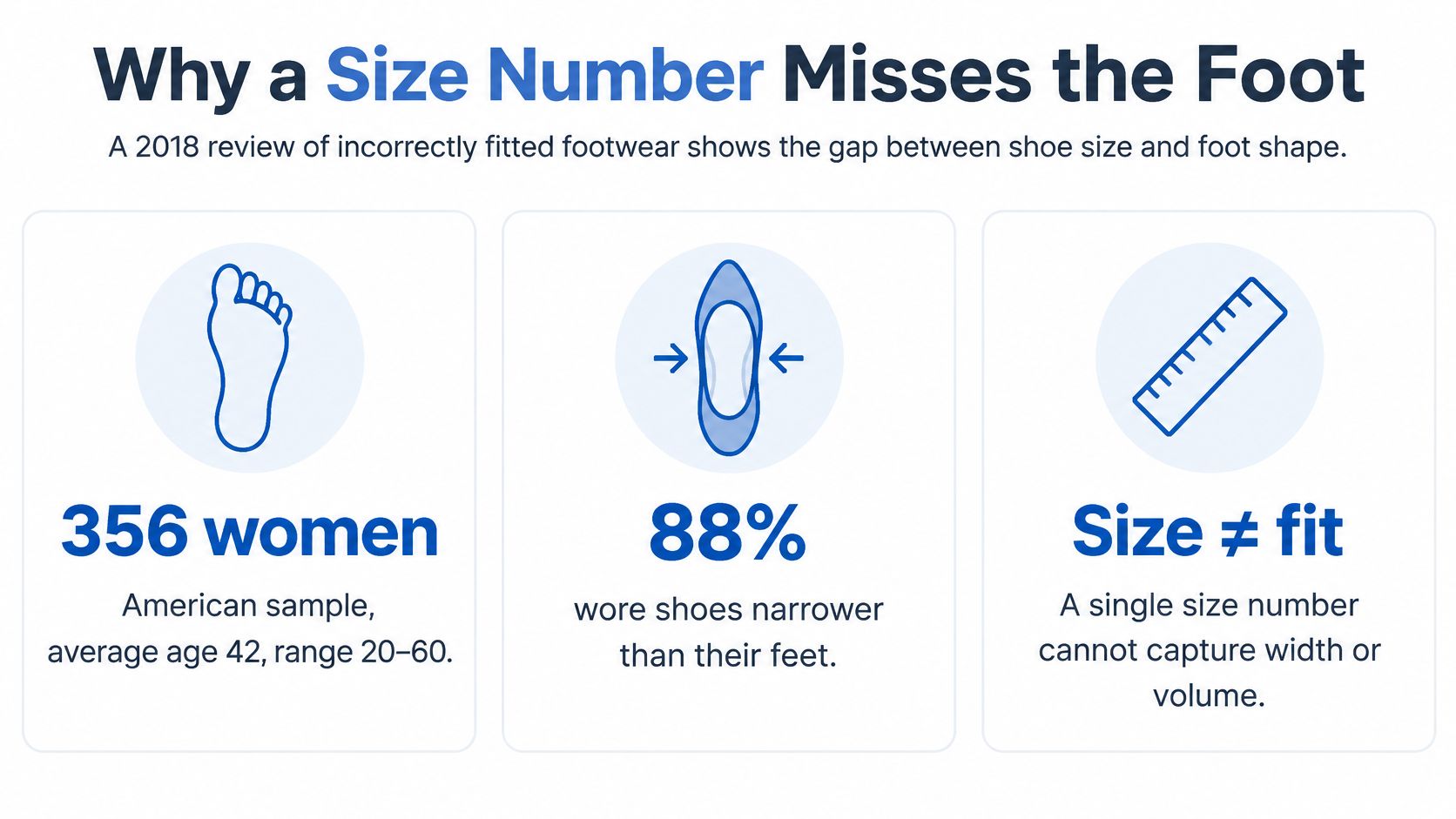
In one sample of 356 American women, average age 42 and ranging from 20 to 60, 88% wore footwear narrower than their feet, by 1.2 centimeters on average, according to a 2018 systematic review of incorrectly fitted footwear. The same review reported a second sample of 255 American women, average age 41, in which 86% wore shoes too narrow by 0.88 centimeters on average, and it cited the 1993 American Orthopaedic Foot and Ankle Society Women's Shoe Survey, in which 88% of healthy women wore shoes smaller than their feet by 1.2 centimeters in length, 80% reported foot pain while wearing shoes, and 76% had some form of foot deformity.
That gap is why made to order shoes for women are worth understanding before you treat them as a luxury extra. A pair cut after checkout is not automatically a precise fit, and it is not automatically a low-impact purchase. Width, shape, the difference between left and right, and heel geometry have to be specified. Building the pair only after the order removes unsold stock. It does not, by itself, redraw the last or shrink the footprint of leather, dye, packaging, and shipping.
The useful order of decisions is practical. First, name which of four paths you are buying. Then decide which measurements change the fit. Then watch how that brief becomes a shoe, how heels and flats load the foot differently, and which quality questions are worth asking. Many custom pairs cannot come back, so the confirmation screen is part of the fit, not a formality after it.
Four Ways Women's Shoes Get Made
Women accounted for approximately 37.9% of the global custom-shoes market in 2025, according to DataIntelo. That share is large enough that the phrase "custom" shows up on very different offers. Before any craft story, place the pair you are about to order on one of four paths. What you can change, how long you wait, and whether the pair can come back are not the same thing.
| Path | Best for | What you can change | Typical timing | After you order |
|---|---|---|---|---|
| Off-the-rack | A foot that already matches a size run | Length and in-stock width only | Immediate or a few shipping days | Often returnable, not rebuildable |
| Made to order | A chosen design in your size, width, and materials | Size, width, material, color, and selected details on a proven pattern | Often 10 to 20 business days | Usually final once confirmed |
| Made to measure | A known last that needs instep, heel, or width tweaks | Adjustments on an existing last | Often a few weeks | Usually final once the last is adjusted |
| Full bespoke | Asymmetry, bunions, or a foot no standard last fits | New last, pattern, and construction | Commonly several weeks to a few months | Costly to change after the last is made |
Off-the-rack and made to order
Off-the-rack is a finished pair in a standard length and, usually, a medium width. You can try it, and many shops will take it back. You cannot change girth, toe shape, or the curve of the heel cup. If your foot already matches that size run, speed is the advantage. If it does not, a return only restarts the search.
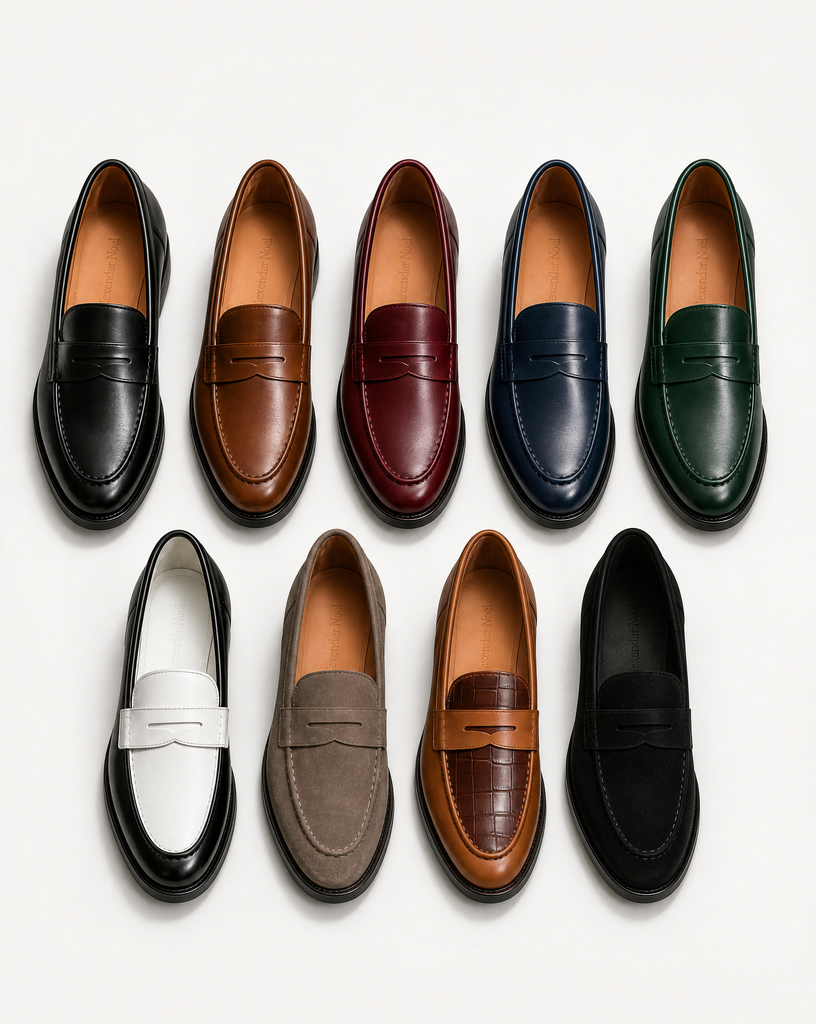
Made to order starts from a proven pattern and cuts that design after checkout. Size, width, material, color, and selected details are set for your pair. The pattern itself stays one the maker already knows how to build. That is the path most women mean when they want made to order shoes for women without commissioning a new form. Timing is often 10 to 20 business days, read as a range. Destination and design complexity move the date. Once you confirm, the pair is usually final.
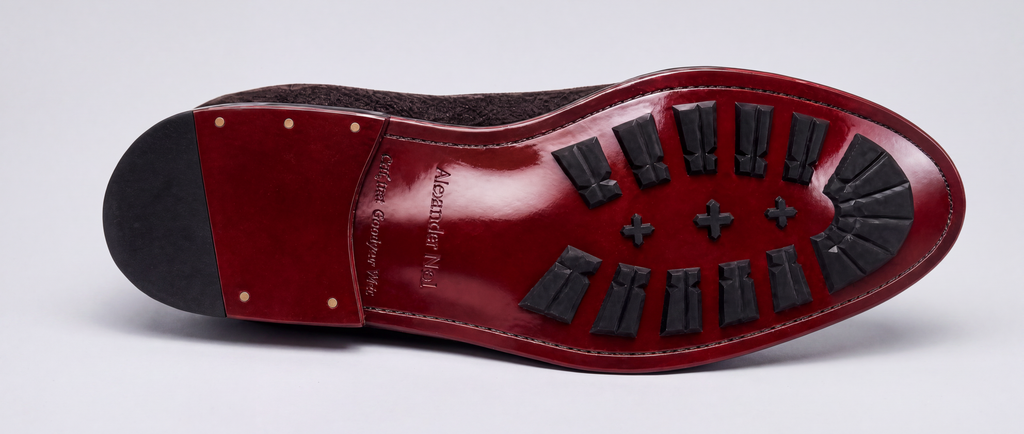
How the sole joins the upper is part of that proven pattern, not a separate menu item you should assume you can rewrite. Cementing, Blake stitching, and Goodyear welting hold a shoe together in different ways, and a clear account of those shoe construction methods shows why a chosen design already has a construction, a flex point, and a repair path.
Made to measure and full bespoke
Made to measure keeps an existing last and tweaks it, commonly at the instep, the heel, or the ball of the foot. You are not drafting a new form. You are asking a known shape to open, tighten, or lengthen where your foot disagrees with it. Expect a few weeks, and expect the adjusted last to lock the order.
Full bespoke makes a new last from a full measurement set or a cast. It is the right path when one foot is sharply different from the other, when a bunion needs its own room, or when no standard last comes close. It is also the slowest, commonly several weeks to a few months, because the form has to exist before anyone cuts leather. Changing your mind after that last is made is costly.
Practical rule: Read the timing column as a range, not a delivery promise. A simple flat on a known pattern and a boot that needs a new last are not in the same queue.
The rows below this table follow the same order. A length size fails for reasons a color menu cannot fix. The measurements you send have to arrive before the pair is cut. The build uses that brief. Heels, flats, and boots load different bones. Quality is a set of tests, not an eco slogan. And because many custom pairs cannot come back, the last step is a pause on the confirmation screen.
Why a Size Number Misses the Foot
A length size is one number doing the work of several dimensions. It never independently sets forefoot width, instep volume, heel-cup shape, toe-box clearance, or the difference between your left foot and your right. Two women can share a size 8 and still need different girths, different toe boxes, and different heel curves. Assigning both of them the same last repeats the miss that standard sizing has made for decades.
Think of a jacket measured only across the shoulders, with the hope that the waist and the sleeves will follow. Sometimes they do. Often the shoulders fit and the waist bags, or the sleeves stop short of the wrist. A shoe size works the same way. Length is the shoulder seam. Width at the ball, volume over the instep, and the cup under the heel are the waist and the sleeves. Hoping they follow is how a "correct" size still pinches, slips, or crowds the toes.
What the label leaves out
Say you wear a 7.5 for work and the toe feels tight by lunch, while the heel of the other foot lifts when you walk. A longer size may give the toes air and make the heel slip worse. A wider size, if the shop even stocks one, may fix the ball and leave a high instep rubbing the vamp. Those are separate errors. A maker who only offers more length sizes has not fixed them.
For women from their twenties through their sixties who wear dress shoes at a desk, in meetings, and between the train and the office, this is a practical reason to order, not a decorative one. The shoe has to survive hours, not a mirror check. Pain that shows up only after the commute is still a fit problem. A deformity that makes one forefoot wider than the other will not average out inside a symmetric pair.
The same logic shows up outside shoes. A runner who checks only the tag on a training shirt can still get a bind across the chest or a hem that twists, which is why a fit note has to name more than one dimension. The Power Print runner shirt guide is a useful reminder that a garment label and a body are not the same map.
The test to apply to any maker
Before you care about leather color, apply one test. Can width and shape change separately from length, or is customization only a color menu on the same last?
- Separate width: You can order a wider or narrower forefoot without jumping a full length size.
- Separate volume: A high instep can be eased without ballooning the heel cup.
- Separate toe box: Bunions, hammer toes, or a long second toe get clearance instead of a generic round toe.
- Separate feet: The maker will hear that the left foot is longer, or the right heel is narrower, and will say how they will build to that.
If the answer is a palette of colors on one unchanging form, you are buying a made-to-order colorway, not a made-to-order fit. That can still be a good purchase when the last already matches you. It is a poor purchase when the last is the thing that has been hurting you.
A pretty upper on the wrong last is still the wrong shoe. Fit is a set of dimensions, and length is only the first of them.
Measurements That Actually Change the Fit
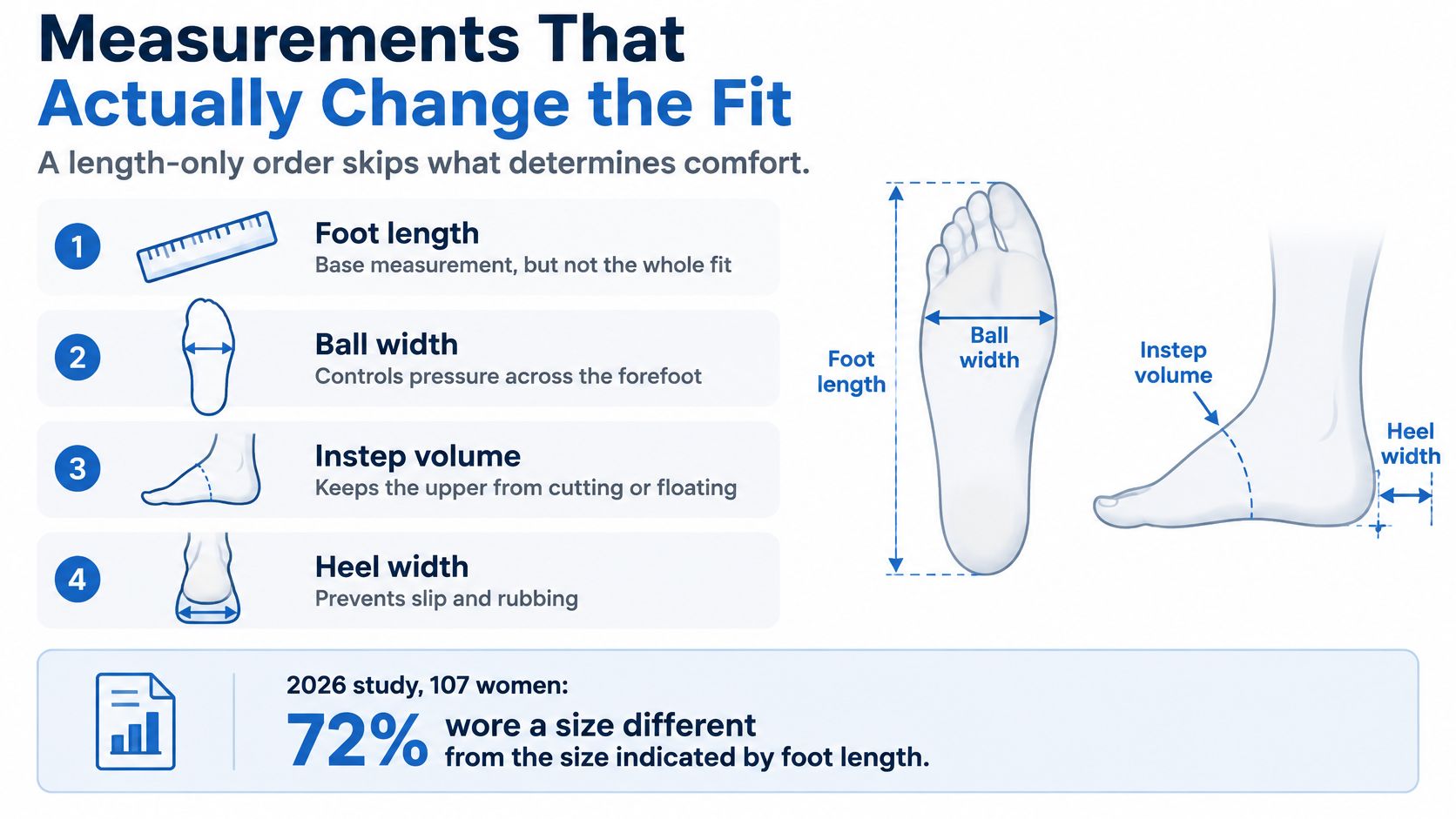
A 2026 study of 107 women found that 72% wore a shoe size different from the size indicated by foot length under U.S. sizing, while 65% differed under EU sizing, and 68% reported at least one recurring fit problem, as covered by Medical Xpress. Sending your usual size, or even a careful length, does not make a pair precise. Made to order is not the same thing as orthopedically exact. Without a measurement protocol, a fit check, and a clear policy if the pair is wrong, a custom order can repeat the same miss as a shop size.
The same point shows up in formalwear. A gown can hang at the right overall length and still pull at the shoulders or pool at the shoes, which is the lesson in how a commencement gown should fit. One tidy number on a form is not a fit.
What to record while you stand
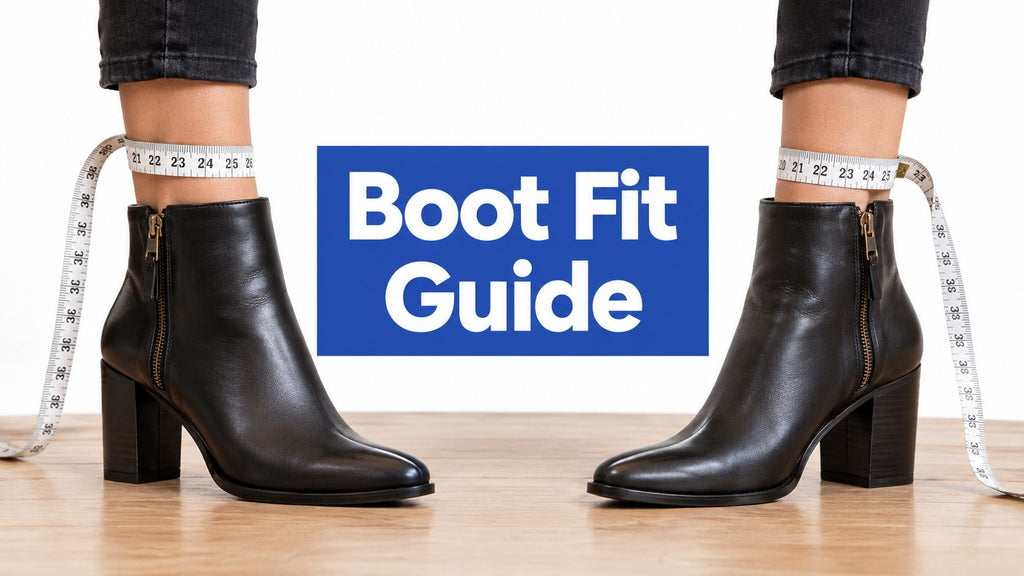
Measure in the afternoon, on a hard floor, standing with your weight on the foot. Feet spread under load. A tracing taken while you sit will understate the ball and the instep.
Do both feet, then use the larger foot as the baseline. Note how the smaller foot differs so the maker can build to the larger side or split the difference on purpose. Write the trouble in one sentence: toes that crowd, a narrow heel that slips, a high instep, or one foot that is longer.
- Overall length: Heel to the longest toe, which is not always the big toe. This is the base, not the whole fit.
- Forefoot width at the ball: Across the widest point, usually the joint behind the big toe to the joint behind the little toe. This is what controls pressure across the front of the foot.
- Instep girth: A tape around the foot at the top of the arch, where a vamp or an instep strap will sit. Too little tape and the upper cuts. Too much and the foot floats and the heel slips.
- Heel width: Across the back of the heel where the counter will grip. A narrow heel in a wide shoe is a blister pattern, not a style choice.
- Arch height: Low, medium, or high is enough if you are not sending a scan. Say whether the arch collapses when you stand.
- The spot that needs room: A bunion, a hammer toe, a tailor's bunion, or a toe that always hits the end. Point to it on the foot, left or right.
If you want a house method for the tape and the paper tracing, follow a step-by-step home routine such as this guide to how to measure shoe size at home, then add the girth and the trouble-spot sentence that a length chart leaves off.
Those standing numbers are what become the last. A computer-vision fitting system evaluated on 19 medical-grade foot models measured length, width, arch height, and instep girth at 95.23%, 96.54%, 89.14%, and 99.52% accuracy, respectively, in work indexed by PubMed Central. Combined with heel shape and weight-bearing posture, that set is the three-dimensional envelope the shoe is built around. A nominal length picked from a size run is a shortcut past that envelope.
How the note changes by shoe
Don't send the same one-line note for every pattern. The foot data stays. The failure you are trying to prevent changes.
A stiletto needs toe clearance and a stable heel counter. Say how many hours you will stand, and whether the pain usually sits under the big-toe joint. A higher heel slides the foot forward. If you only send length, the toes pay for it.
A flat needs forefoot room and a vamp that does not pinch. Flats don't have heel height to hide a short toe box. If the ball is wide, say so in centimeters, not as "I like a roomy fit."
A boot needs the same foot data plus shaft and calf notes. Measure the calf at the widest point and say where a zipper or an elastic gusset has failed before. A boot that fits the foot and chokes the calf is still a failed order.
A checklist you can send
- Both feet: Left and right, not a single "I'm a 7."
- Standing posture: Weight on the foot, hard floor, later in the day.
- Larger-foot baseline: Build from the bigger foot, and say how the other one differs.
- Girth as well as length: Ball width, instep girth, and heel width, with units.
- One sentence on the trouble spot: What hurt, on which foot, in which kind of shoe.
Keep a copy. The confirmation screen later should match this note, not your memory of it.
How a Made-to-Order Pair Is Built
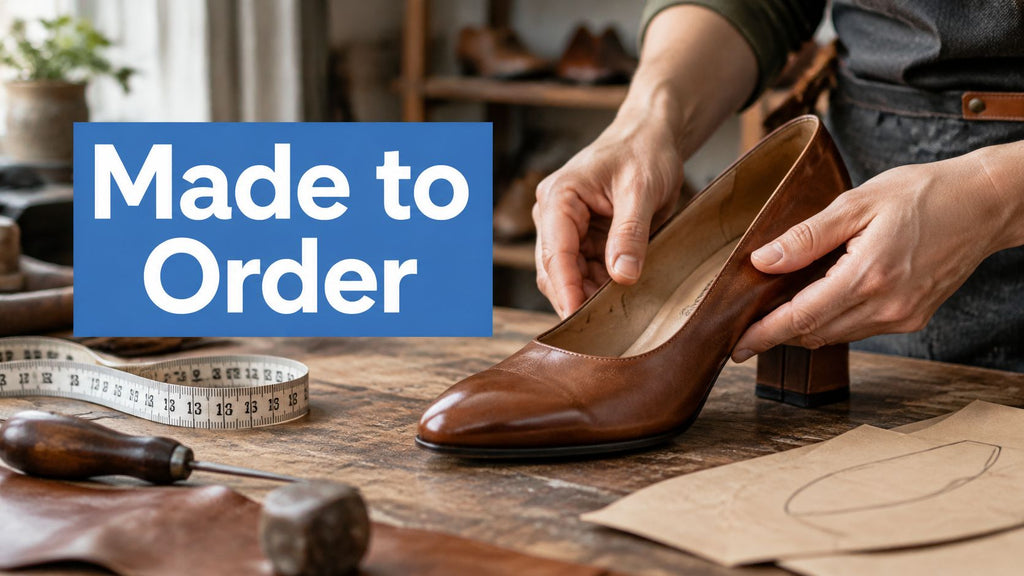
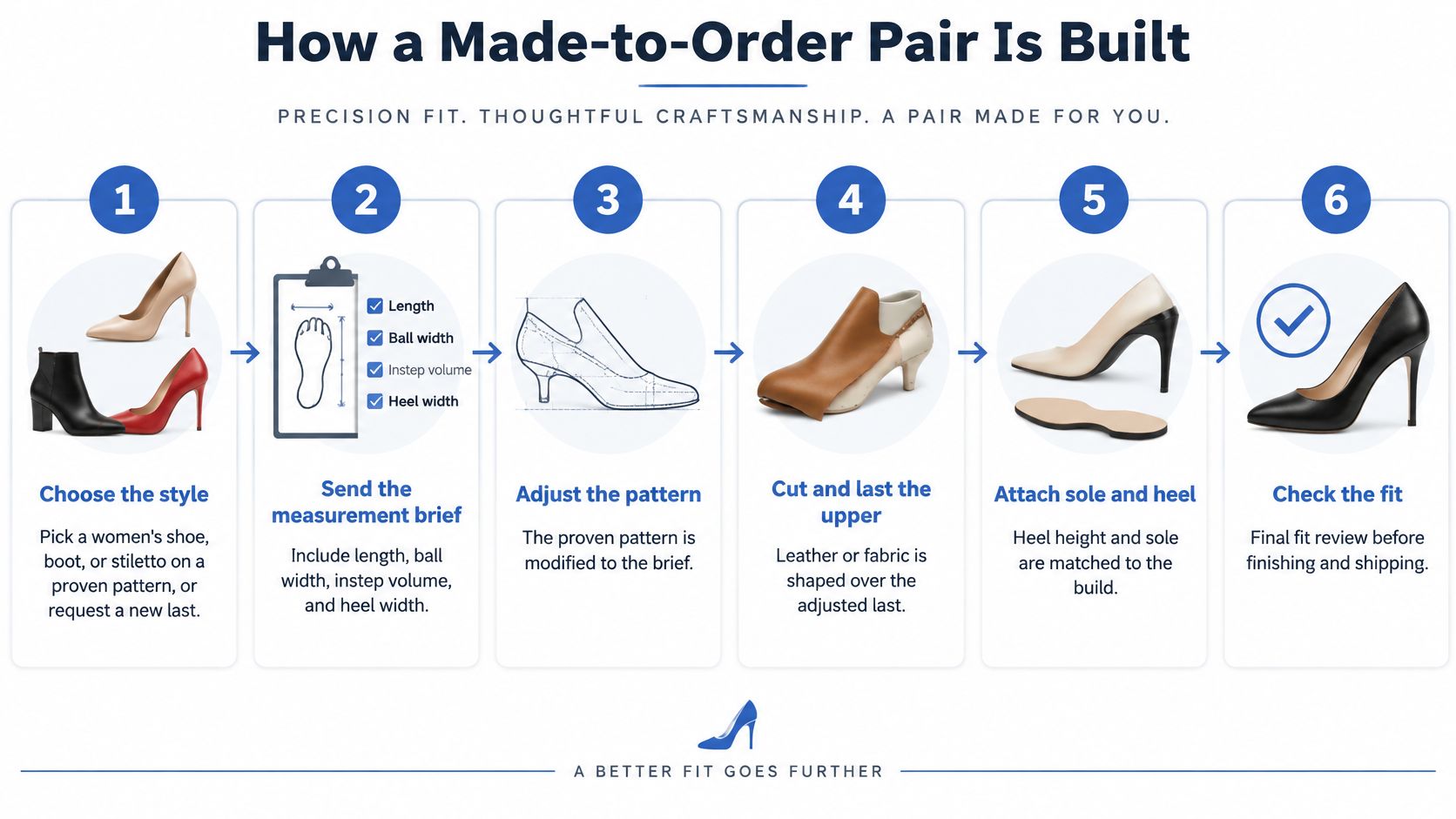
Once the path and the brief are chosen, the bench work is a sequence, not a mood. Our artisan experts create each pair at the time the order is placed. Nothing is pulled off a finished size run and relabeled with your name.
Six stages from brief to pair
- Choose the style. Pick a women's shoe, boot, or stiletto on a proven pattern. Request a new last only when asymmetry, a bunion, or no standard last fits. That choice is the path from the table, not a new clock.
- Set the materials. Choose leather or another upper, the color, and the details that pattern allows. A buckle, a toe shape, or a sole that the pattern already supports is a detail. A detail the pattern cannot hold is a different shoe.
- Attach both feet. Send length, forefoot width, instep girth, heel width, arch height, the larger-foot baseline, and the trouble spot. This is the brief the cutter uses. A missing girth means the maker guesses, and a guess is how a custom pair inherits a standard-size error.
- Cut when the order is placed. The pair is cut for that order. It is not a stock shoe waiting in your length. If a listed size is missing, the honest move is to design the pair in your size rather than forcing a neighbor size.
- Read the updates against your confirmation. After you place the order or the custom design, we send periodic updates on where the shoe is in production. Match those notes to the size, width, color, and window you saved. An update that names a different width is the moment to write back, not the moment the box arrives.
- Use the path table for the date. For our made-to-order shoes, delivery is within 10 to 20 business days. Destination and the complexity of the design move the date. Don't keep a second, prettier timeline in your head.
What moves the date inside that range
A configured flat waits mainly on size and material. The pattern exists, the last exists, and the work is cutting and closing your pair inside the queue. A stiletto or a boot on an existing pattern stays in that same band unless heel geometry or shaft work adds finishing.
A new last, or full bespoke, commonly runs several weeks to a few months. The form has to be made before cutting starts. That is not a pair sitting untouched for the whole wait. Much of any footwear lead time is queue. Materials, a production slot, lasting, sole work, and finishing each wait their turn. Asking a workshop to jump your pair forward only pushes someone else's confirmed order back.
Treat 10 to 20 business days as the band for a proven pattern, and treat anything that needs a new form as the longer row in the path table. If the design is complex or the delivery address adds transit, the later end of the range is the one to plan around. A ceremony date that sits inside the early end of the range is a gamble, not a plan.
Heels Flats and Boots Load the Foot Differently
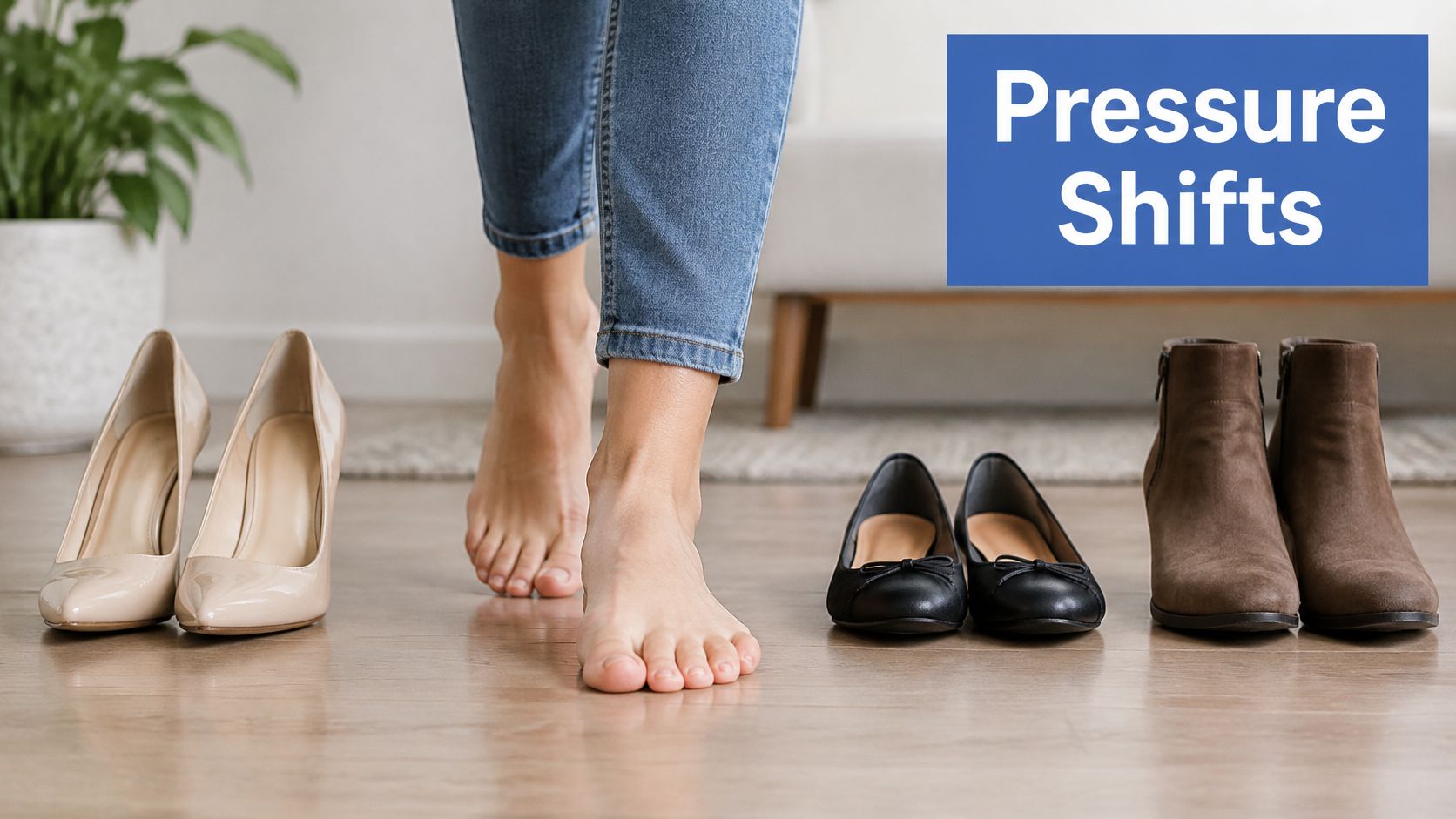
Heel height is engineering. In a study of 27 healthy young women, high-heeled shoes produced the highest pressures beneath the first and second metatarsal heads, while flat shoes produced the highest pressures in the third-to-fifth metatarsal-head and hindfoot regions, and running shoes showed lower overall regional pressure except at the midfoot, according to the study indexed on PubMed. A custom stiletto cannot be optimized by the way it looks from the side. Raising the heel shifts load toward the inside of the forefoot. A flat can still concentrate stress on the outer forefoot and the heel if the toe box, the sole, or the cushioning is wrong.
An occasional-event stiletto
A slim heel around three inches, including a slip-on dress shoe you will wear for a dinner or a short ceremony, can be specified for shorter wear. Ask for enough toe clearance that the foot can slide forward a little without the toes hitting the end. Ask for a stable heel counter so the back of the foot doesn't twist. Ask for controlled flex at the ball, not a sole so stiff that you rock off the front. Cushioning or a softer pad under the medial forefoot is there to meet the pressure that height creates under the first and second metatarsal heads.
That is a different specification from a shoe you will walk in from morning to evening. If you only tell the maker "elegant," you will get a silhouette. You may not get a forefoot that can tolerate the load.
A pump for a workday
A pump worn through meetings needs the same bones protected for more hours. The foot still slides forward. A short toe box becomes the pain point by midafternoon, even when the shoe felt fine on the carpet at home. Say that the pair is for daily professional wear, not for a photograph. A slightly lower pitch, a roomier toe, and a counter that holds the heel will do more for a workday than a thinner heel stem.
Where pressure mapping is available, use it to look for peaks under those two medial joints, not for a general "this feels soft." A two-minute indoor try-on is too short a test. Sit, stand, and walk long enough for the foot to migrate. More on what makes a heel wearable for real hours is in this note on comfortable heels for women.
Flats and boots are not automatically kinder
A flat skips the forward slide of a heel and can still pile stress on the outer metatarsal heads and the heel. A stiff sole, a thin footbed, or a toe box that was styled narrow will do that even when the length is "your size." Say if your usual flat leaves a hot spot under the outside of the forefoot or a bruise at the heel. That is a construction note, not a complaint to save for later.
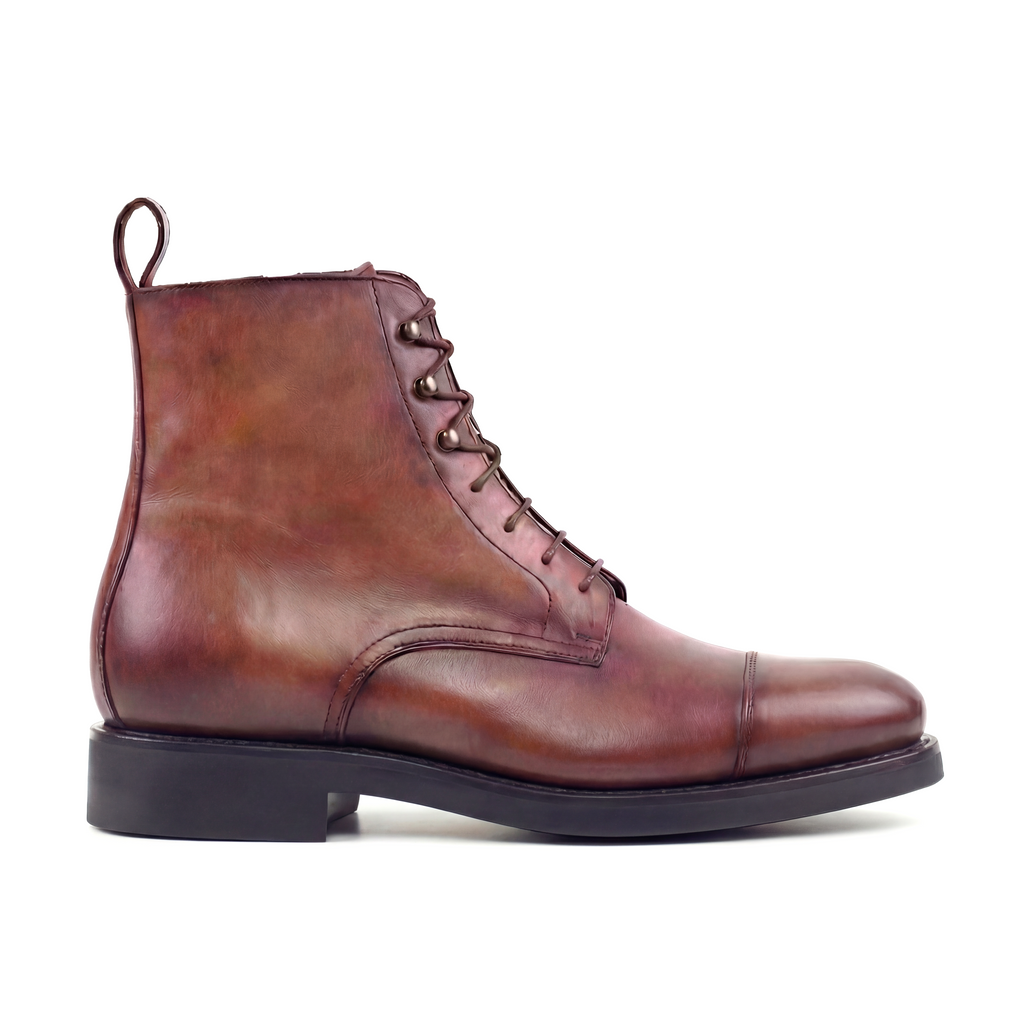
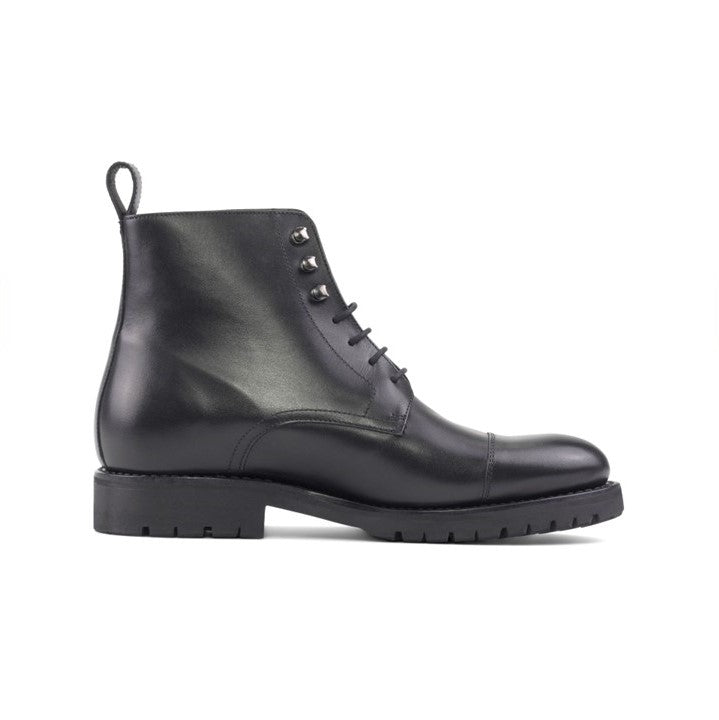
Boots add a shaft. Bespoke boots are made with detailed measurements to fit the customer's unique foot shape. The shaft has to follow that shape, not a single length size. A calf that is larger than the sample, or a low instep inside a high shaft, needs to be accounted for. Otherwise the foot is right and the boot still fails.
Close the specification in one line you can paste into the order: intended height, hours on your feet, and the spot that usually hurts. An event heel, a work pump, and a walking boot are three answers to that line, not three moods of the same shoe.
Craft Quality and the Real Footprint
Handwork is not proof. A beautiful upper that separates from the sole, or a lining that transfers dye onto a stocking, is not a quality pair. The European Commission footwear criteria turn craftsmanship into checks you can ask about without pretending any one brand has passed them. The EU Ecolabel footwear document names upper flex resistance, upper-to-sole adhesion, upper tear strength, outsole flex resistance, outsole abrasion resistance, outsole tear strength, and color fastness of the interior. It also invites repair and recycling where possible.
Questions that stand in for a slogan
You don't need a lab report in the product photo. You do need to know whether anyone is willing to talk about those failures.
- Flex: Will the upper and the outsole survive repeated bending at the ball, or will they crack where the foot flexes?
- Adhesion and tear: Can the upper stay attached to the sole, and can the materials resist a tear at a seam or a strap?
- Abrasion: Will the outsole wear through at the ball or the heel in ordinary walking?
- Color fastness: Will the interior transfer color when your foot warms up?
An artisan workshop, including the makers we work with in Italy, Portugal, Spain, and India, is a description of who cuts and lasts the shoe. It is not a footprint number, and it is not a test result. Ask the questions. A workshop that cannot say how a sole is attached, or whether a heel can be rebuilt, is asking you to trust a story.
What building on demand does not erase
On-demand production is often sold as sustainable because the pair wasn't made for a shelf. The waste it can avoid is real. Unsold inventory is a genuine problem. It is not the whole problem.
More than 85% of shoes are ultimately landfilled or incinerated, an analysis of sneakers found only 3.4% qualified as eco-friendly, and sustainable alternatives carried an average premium of $48.79 while producing only a 9.12% average emissions reduction, according to 2026 footwear industry figures from Erasers. Making your pair after the order can cut unsold stock. It does not erase leather, dyeing, packaging, or shipping. A small emissions cut with a price premium is a trade-off, not a halo.
Ask three narrow questions, and skip the broad eco claim.
Is a lower-impact material available for this design? Some patterns can take a non-leather upper. Some cannot without changing the flex and the edge finish. A useful place to start that comparison is the case for vegan shoes and sneakers, read as a materials choice, not as a guarantee.
Can the heel or the sole be repaired or replaced? A pair you can resole or reheel stays in use. A pair that is glued into a single disposable unit does not, however carefully it was ordered.
What happens to a defective pair? If the workshop will repair a fault, say so in the order notes you keep. If a defect has no path except the trash, the on-demand story has a hole at the end of the shoe's life.
Building after checkout removes the pairs nobody bought. It does not, by itself, make the pair you did buy light on materials, dye, or freight.
The only useful test is specific. Which stage gets better, unsold stock or the materials and the miles, and what repair option shows the shoes are meant to stay in use for years? If neither answer is concrete, you are buying a well-fitted shoe, which may still be worth it, and you are not buying a low-impact one.
Confirm the Pair Before You Check Out
All women's shoes and boots are custom-made and cannot be changed, returned, or refunded. Re-read size, width, color, heel height, and every design detail on the screen before you pay. The women's shoes listed on the women's collection page are priced from $230.00 to $350.00, and shoes created exclusively online qualify for free delivery. The money decision and the fit decision happen in the same step. There is no fitting-room do-over after checkout.
Match the path to the use
Use the path you already chose. Don't add a new theory of fit on the payment page.
A Design Lab pair suits a proven pattern when you need your own size, width, material, and color. You are configuring a shoe the workshop already knows how to cut. Check that the width on the screen is the width in your saved note, not the width you wear in a different brand.
A fuller measurement note suits one foot that differs sharply from the other, a bunion, a narrow heel, or a high instep. If that note isn't attached, the order is a standard pattern in a chosen size. That can be right. It is not a bespoke last.
Boots still need the shaft and calf notes you already took. A stiletto still needs the hours-on-your-feet line and the spot that usually hurts. If those sentences are sitting in a draft email and not in the order, they will not affect the pair.
One check, then the order
Open the women's Design Lab, or the women's shoes, boots, and stilettos. Put your measurement note beside the screen. Read size, width, color, heel, and details out loud once. Place the order only when that confirmation matches the brief you saved.
If something on the screen is the neighboring size, the medium width you did not mean, or a heel height you did not specify, stop. Fix it before payment. After payment, the pair is in production as confirmed, and our updates will track that confirmed pair, not the one you meant to click.
Alexander Noel makes women's shoes, boots, and stilettos to order, and you can set size, width, materials, and design details yourself before a pair is cut. That is the practical side of made to order shoes for women: a brief you control, a window measured in business days for a proven pattern, and a confirmation that should match the foot you measured. When you are ready to compare a pattern or start a design, visit Alexander Noel.
Related post
22
Nov
22
Nov
22
Nov
14
Nov
14
Nov
